Over rates, and the penalties that finally changed them
Sides bowled slowly for forty years because fines were cheaper than the advantage. It stopped when the penalty became points and fielders rather than money.
Cricket has a required minimum number of overs per hour and sides have been falling short of it for as long as the requirement has existed. What changed recently is not the rule but what happens when you break it.
- Fifteen overs an hour in a Test, and a finish time in white-ball cricket
- Fines were treated as a cost of doing business for four decades
- Championship points and an in-match fielding penalty changed the behaviour
- A stop clock between overs was added because it is countable
What the requirement is
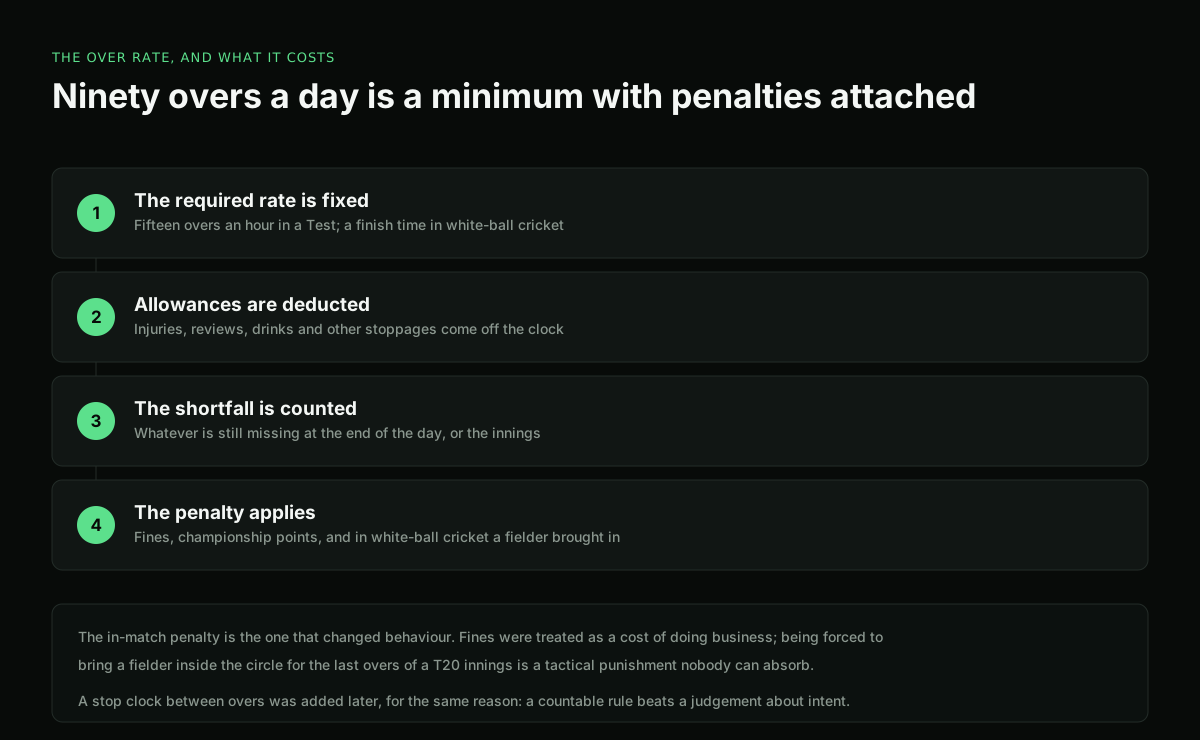
A Test day is ninety overs, which works out at fifteen an hour across six hours of play. In limited-overs cricket the requirement is expressed as a finish time instead: the innings must be completed by a specified clock time.
Allowances come off. Time lost to injuries, to reviews, to drinks breaks and to other genuine stoppages is deducted before any shortfall is calculated, which is fair and is also where a great deal of the argument happens.
Whatever is still missing at the end of the day, or the innings, is the shortfall, and the penalty applies to that.
Why sides bowled slowly
Because it worked, and because it was cheap.
A slow over rate buys a fielding side several things. Bowlers get more recovery between deliveries, which means they bowl faster for longer. Fields are adjusted more carefully. Momentum is broken when a batter is set. And on a hot afternoon it is simply easier.
The West Indian sides of the 1980s bowled around thirteen overs an hour with four fast bowlers, and there was no mechanism to stop them. Everybody else followed, because the advantage was real and the punishment was a fine.
For a professional cricketer, a percentage of a match fee is an irritation. For a board, it is a rounding error. Fines were levied for decades and over rates declined throughout.
What actually changed it
Two penalties, and both of them attach to something the team cares about.
Championship points. The World Test Championship deducts points for over-rate shortfalls, and those deductions come off a percentage that decides who plays a final. That has kept sides out of finals, and it is the first time a slow over rate has cost anybody anything they valued.
An in-match fielding penalty. In white-ball cricket, a side behind the rate at a specified point must bring an extra fielder inside the circle for the remaining overs. This is the one that changed behaviour fastest, because it is immediate, tactical and impossible to absorb: a fielding captain at the death with one fewer boundary rider is being punished in the currency of the match itself.
| Penalty | Era | Did it work |
|---|---|---|
| Fines, percentage of match fee | decades | no |
| Suspension of the captain | occasionally | partly, and it was unpopular |
| Championship points | recent | yes, at Test level |
| A fielder inside the circle | recent | yes, immediately |
The stop clock
The most recent addition is the simplest: a countdown between overs, displayed on the ground, with a penalty for exceeding it.
Sixty seconds from the end of one over to the first ball of the next, two warnings, and then five penalty runs to the batting side for each subsequent breach.
It works for the same reason the leg-side fielding restriction worked after Bodyline: it is a countable rule with no judgement in it. An umpire does not have to decide whether a side is deliberately wasting time. The clock either ran out or it did not.
What sides do to comply
Three things, and one of them is a genuine cricketing cost.
Bowl spin. A spinner's over takes appreciably less time than a fast bowler's, so a side behind the rate brings on the slow bowler regardless of whether it is the right bowling decision. That is the real cost of the rule, and it produces overs that exist for the clock rather than for the match.
Set the field once. Captains who are behind the rate stop fiddling between deliveries, which arguably improves the cricket.
Move faster between overs. Fielders jogging to their positions rather than walking, the bowler having his field set before the previous over ends. Most of the compliance is here, and most of it is free.
The batting side is not innocent
The rule targets the fielding side because the fielding side controls the pace, and that is only mostly true.
A batter who pulls away as the bowler runs in, calls for a change of gloves, asks for the sightscreen to move, or takes a long walk between deliveries is costing time that will be charged to somebody else. Time-wasting by the batting side is covered by the Laws and is penalised with a warning and then five penalty runs, but it is enforced far less often than the fielding equivalent.
The stop clock helps here too, because it starts regardless of which side is responsible for the delay, and a batting side that dawdles is now costing its own team the clock rather than the opposition's.
Where the time actually goes
Watch a slow session closely and the lost minutes are not where people assume.
Between overs is the largest single component and the one the stop clock targets. Six fielders changing position, a bowler walking back to his mark, and a captain having a conversation adds up to well over a minute, repeated fifteen times an hour.
Long run-ups. A fast bowler with a thirty-metre approach takes around twenty seconds between deliveries; a spinner takes eight. Four fast bowlers is structurally slower than three and a spinner, before anybody dawdles.
Reviews and drinks are deducted as allowances, so they are visible and accounted for. The perception that they are the problem is wrong: they are the part that already comes off.
Wickets. A dismissal costs the time for the batter to leave, the new one to arrive, and the field to be reset — which is why a side taking wickets is frequently the side behind the rate, and why the penalties feel unfair to bowling attacks that have done well.
Why the requirement exists at all
Not for the purity of the game. For the audience and the contest.
A ninety-over day is what the ticket was sold for and what the broadcast schedule assumes. A side bowling seventy-five overs has delivered five-sixths of the cricket, which is a consumer question as much as a sporting one.
The sporting argument is about the balance between bat and ball. A fielding side that can slow the game down to rest its fast bowlers has an advantage the Laws never intended to give them, and the batting side has no equivalent lever.
A side is behind the required over rate in a T20 innings. What is the penalty that changed behaviour fastest?
Fines were absorbed for decades. Bringing a fielder inside the circle is an immediate tactical punishment in the match being played, and it cannot be treated as a cost of doing business.
- Rest between deliveries for fast bowlers
- More time to set a field
- Broken momentum for a set batter
- Nothing, historically
- Championship points, at Test level
- A fielder inside the circle, in white-ball cricket
- Five penalty runs, under the stop clock
- The captain's reputation, which never worked
- Fifteen overs an hour in a Test; a finish time in limited-overs cricket
- Fines failed for forty years because they were cheaper than the advantage
- Points and in-match fielding penalties worked immediately
- The compliance cost is spin bowled for the clock rather than the match
The short version
Over rates did not improve when cricket asked nicely or when it started fining people. They improved when the penalty was paid in the same currency as the advantage: fielders, points and runs.
For the competition where those deductions decide finals, see the World Test Championship points system, and for how the day is structured around the requirement, a day of Test cricket.