What a wicket is actually worth in each format
Ten wickets and a fixed number of balls produce completely different economies. In a Test a wicket is the only currency; in a T20 the tenth one is nearly worthless.
The three formats share almost every rule. What separates them is a single ratio: how many balls a side gets for its ten wickets. Almost every difference in how they are played can be derived from it.
- A Test innings has ten wickets and no ball limit, so a wicket is the only end
- An ODI innings has 300 balls and ten wickets — thirty balls a wicket
- A T20 innings has 120 balls and ten wickets — twelve balls a wicket
- Which is why a Test batter leaves the ball and a T20 batter cannot afford to
The arithmetic
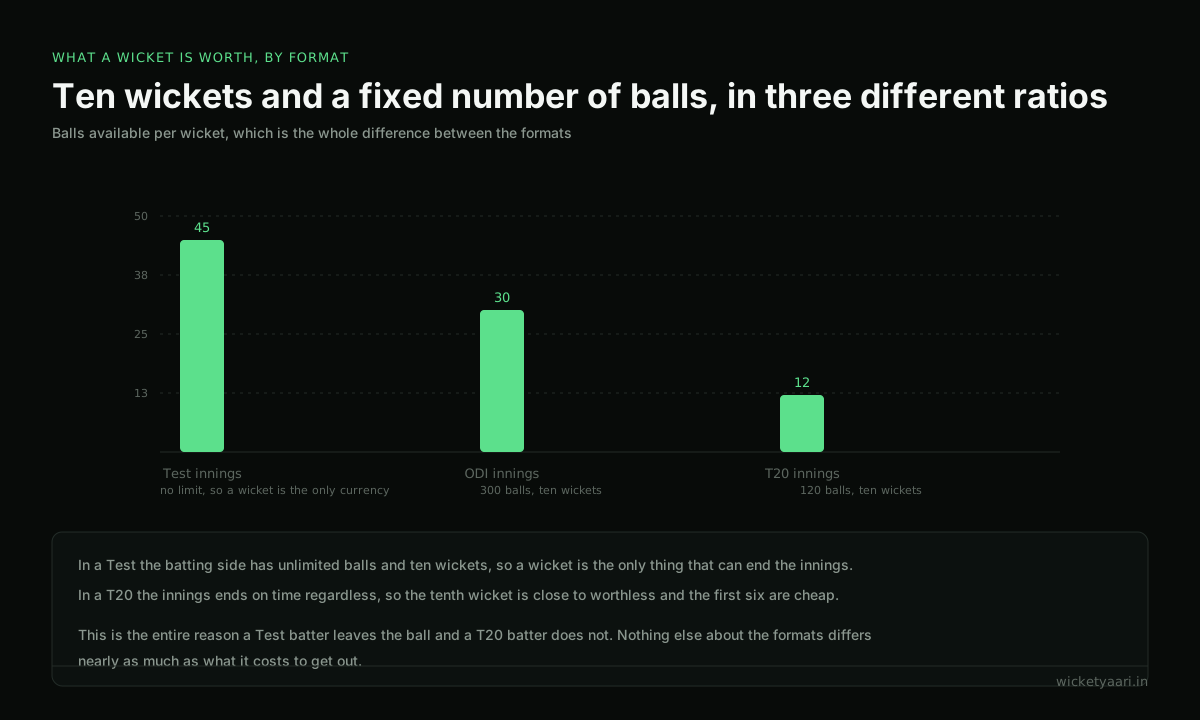
An innings ends when the balls run out or the wickets do. Which of those two happens first decides what kind of cricket gets played.
In a Test, only wickets can end an innings. There is no ball limit, so a wicket is the entire currency — the batting side's job is to not lose them and the bowling side's job is to take them. Time exists, but it is a constraint on the match, not on the innings.
In an ODI, a side has 300 balls and ten wickets: thirty balls per wicket. That is enough for a side to lose four or five and still bat out the overs, so wickets matter but they are not scarce.
In a T20, a side has 120 balls and ten wickets: twelve balls per wicket. Almost no side is ever bowled out. The innings ends on the clock, which means the last two or three wickets have no value at all.
What that does to batting
The whole difference in technique follows from the ratio.
A Test batter can leave a ball outside off stump all day. Costing themselves a delivery costs nothing, because there is no delivery limit. Their risk of dismissal is the only thing being managed.
A T20 batter cannot leave anything. Every delivery not scored from is a twelfth of a wicket's worth of resource discarded, and there is no way to get it back. The batter is managing two scarcities at once, and the balls are the scarcer of the two.
The ODI batter sits in the middle and has the hardest job of the three, because which scarcity is binding changes over the innings. In the first ten overs, wickets matter more. In the last ten, balls do. Getting the switch wrong in either direction is how one-day innings fail.
| Format | Balls per wicket | The scarce resource | The batter's instinct |
|---|---|---|---|
| Test | unlimited | wickets | survive, and runs will come |
| ODI | 30 | both, in turn | assess which one is binding |
| T20 | 12 | balls | score, and accept the risk |
What it does to bowling
The mirror image, and it explains why the same bowler is valued so differently.
A Test bowler is paid in wickets. Economy is a means to an end — you build pressure so that a batter plays a shot they would not otherwise play — but nobody wins a Test by conceding two an over for ninety overs without taking wickets.
A T20 bowler is paid in dot balls. Wickets are useful, mostly because a new batter scores more slowly for a few deliveries, but a bowler who takes two wickets for 45 has lost his side the match and one who takes none for 22 has probably won it.
This is why bowling averages and bowling economy swap places in importance between the formats, and why a bowler can be a Test great and a T20 liability without anything about their bowling changing.
The wicket that is worth almost nothing
The tenth wicket in a T20 is close to valueless to the bowling side and close to valueless to the batting side.
For the bowlers, taking it ends an innings that was going to end anyway in a few deliveries. For the batters, protecting it costs them the aggression that is the whole point of the format.
Which produces the strange spectacle of a number eleven walking out with two overs left and swinging at everything, correctly. There is nothing to protect. The downside of getting out is an innings ending eight balls early, and the upside is twenty runs.
The same wicket in a Test is enormous. The last pair can bat for an hour, save a match, or add eighty for the last wicket that turns a first-innings deficit into a lead.
What it means for how sides are picked
The ratio decides squad construction as directly as it decides batting.
A Test side picks the eleven best cricketers for taking twenty wickets and batting long, in that order, and will carry a number eleven who cannot bat at all if he takes wickets. A T20 side cannot: with twelve balls a wicket, a batter who cannot score is a resource the innings has no room for, and the eleventh player has to contribute with bat or ball in a way a Test tail-ender never needs to.
That is why "batting depth" is a franchise-cricket phrase and barely a Test one.
Why the fourth innings is different again
The ratio explains the formats. It also explains the strangest phase of Test cricket, which is a fourth innings with a target and a clock.
A side chasing 280 on the final day has both constraints at once for the first time in the match: it can be bowled out, and it can run out of overs. That is structurally an ODI innings played with a Test field and a fifth-day pitch, which is why fourth-innings chases produce more tactical arguments than any other part of the game.
It is also why the draw exists. A side that decides it cannot get the runs stops managing balls entirely and manages only wickets, and the two objectives — win and do not lose — require opposite behaviour from the same batters.
Where the ratio bends
Two things distort the simple arithmetic.
Batting depth. A side with a genuine batter at number eight has effectively more wickets than one with a tail starting at seven. This is why franchise sides pay so much for bowlers who can bat: it changes the ratio without changing the rules.
The impact substitute, where a competition uses it, does the same thing more bluntly. A side that can add a batter after the toss is a side batting with eleven recognised players and bowling with a specialist attack, which changes the value of every wicket in the innings.
A T20 side is 140 for 8 with three overs left. Their number ten is on strike. What is the correct approach?
With two wickets left and eighteen balls, being bowled out costs almost nothing — the innings ends within a few deliveries either way. The downside of attacking is negligible and the upside is substantial.
- The end of an innings
- A slower few overs
- A new batter to bowl at
- Access to the tail
- Test: everything
- ODI: significant
- T20: a few dot balls, at best
- Test and ODI: often decisive
- Balls per wicket is the ratio the formats differ on
- The Test batter's only scarce resource is wickets, so leaving is free
- The T20 batter's scarce resource is balls, so leaving is a loss
- The tenth wicket is enormous in a Test and nearly worthless in a T20
The short version
Everything that looks like a difference of temperament between the formats is actually a difference of arithmetic. Give a side unlimited balls and ten wickets and they will defend; give them 120 balls and the same ten and they cannot afford to.
For the format-by-format detail, see Test, ODI and T20: what actually differs, and for how that ratio changes across a single innings, the shape of a T20 innings.