The T20 World Cup format, and why it keeps changing
Super 8, Super 10, Super 12 and back again. The structure has changed almost every edition, and small groups are why it is the most winnable global trophy.
The T20 World Cup has changed its structure more often than any other global cricket tournament. What has not changed is the consequence of that structure: it is the trophy an outsider can actually win.
- The second-round format has been a Super 8, a Super 10 and a Super 12 across editions
- Groups are small, so one defeat can end a tournament
- Net run rate decides more qualifications than results do
- An Associate side beating a full member has happened in almost every edition
The shape that survives the rewrites
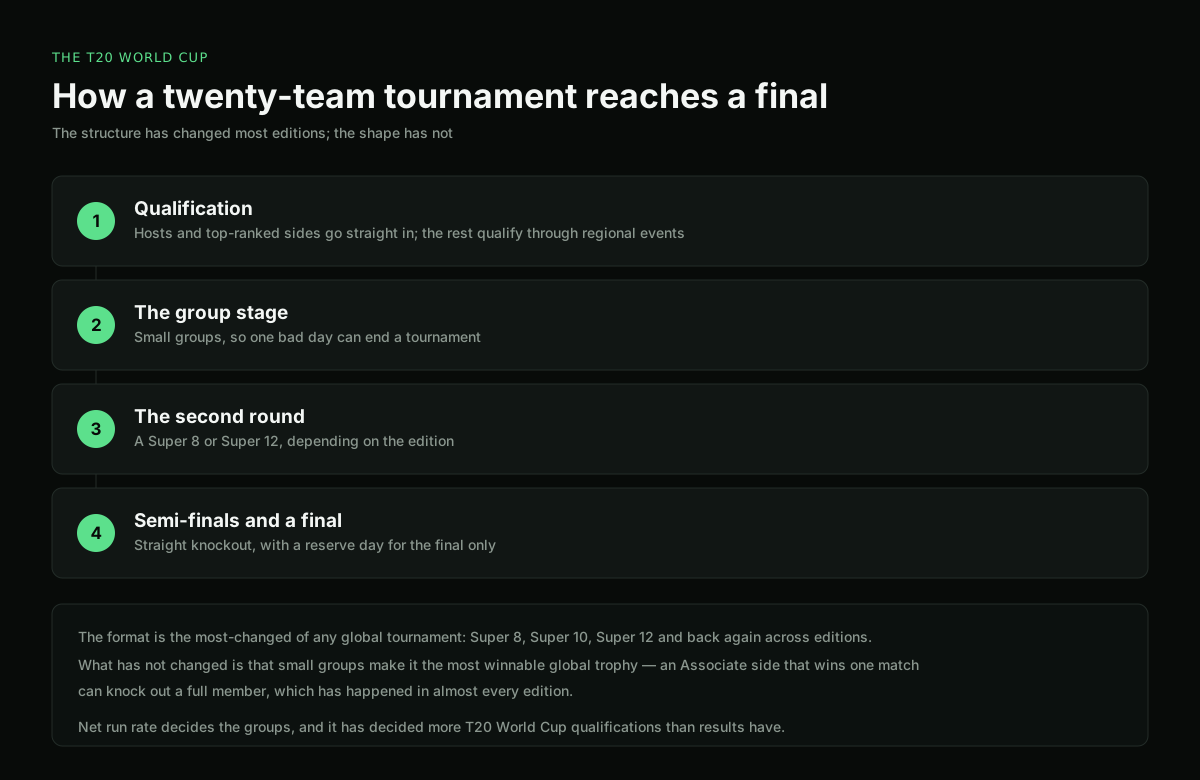
Qualification, a group stage, a second round, then semi-finals and a final.
The hosts and the highest-ranked sides go straight into the main draw. Everybody else comes through regional qualifying events, which is where most Associate nations spend their cycle.
The group stage puts sides into small groups. The second round is the part that keeps being renamed — Super 8, Super 10, Super 12 — and it is essentially a question of how many teams survive the first cut and how they are rearranged. Then two semi-finals and a final, straight knockout.
Why small groups change everything
A group of four or five teams playing each other once is not a sample. It is three or four matches, in a format where a single good hour decides a result.
That is why the T20 World Cup produces outcomes the other tournaments do not. A side that would lose a seven-match series 6-1 can win one match out of four and put the favourite out.
The 50-over World Cup has run a long league stage precisely to stop this: ten teams, nine matches each, and the best four go through. It produces a fairer result and far fewer memorable upsets, and both of those are the same fact.
| Tournament | Group stage | What it rewards |
|---|---|---|
| T20 World Cup | small groups, three or four matches | surviving one bad day |
| 50-over World Cup | long league, nine matches | being the better side |
| Champions Trophy | very small groups | almost nothing but form |
Net run rate is the real qualifier
Because the groups are short, teams finish level on points constantly, and net run rate separates them.
That has a specific consequence you can see in almost every edition: a side that has already won will keep batting hard when the result is settled, or will chase a small target with unnecessary urgency, because the decimal is what decides whether they go through.
It also means the tournament is frequently decided by a match those teams are not playing in. A side can finish its group and then wait to find out whether it has qualified, based on how quickly somebody else chases.
The upsets are structural, not flukes
Ireland beating Pakistan in 2009. The Netherlands beating England in 2009 and South Africa in 2022. Afghanistan beating England in 2024. Namibia, Scotland, the USA — every edition has one.
These are not accidents in the sense of being undeserved. Twenty overs is short enough that the gap between a full member and a good Associate closes on any given day, and the format gives the Associate a genuine shot rather than a courtesy appearance.
That is the argument for the tournament as it is designed. It is also the reason the format keeps getting rewritten: every edition, somebody concludes the results were too random and adds teams or rounds to make them less so.
There is a fourth pressure that is rarely stated: the tournament is now held roughly every two years rather than every four, which means any format has two editions to prove itself before somebody proposes the next one.
Why it keeps changing
Three pressures pull in different directions and no structure satisfies all three.
Broadcasters want the big sides to play each other and to survive to the knockouts, which argues for more teams in the second round and fewer ways to be eliminated early.
Associate nations want more matches against full members, which argues for a larger first round.
The calendar wants the whole thing over in about four weeks, which caps the total number of matches and forces the other two against each other.
Every format the ICC has tried is a different compromise between those three, and that is why none of them lasts more than an edition or two.
Why does net run rate decide so many T20 World Cup qualifications?
A group of four teams playing three matches each produces ties on points far more often than a nine-match league does. The shorter the group, the more often the tiebreaker is what actually decides who goes through.
- The name of the second round
- How many teams qualify
- Whether there is a Super 8 or a Super 12
- The number of Associates admitted
- Small groups in the first
- Net run rate as the separator
- One bad day ending a campaign
- An Associate beating a full member
The reserve day question
Semi-finals and finals have a reserve day. Group matches do not, and that is where the format's sharpest edge sits.
A washed-out group match splits the points. In a three-match group that can eliminate a side that has not lost, and it has. A team can play well, win its matches, and go out because rain fell on a fixture it was not involved in and somebody else's net run rate survived better than its own.
There is no clean fix. Reserve days for every group match would add a week to a tournament already squeezed into four, and the alternative — bowling in worse conditions to force a result — trades one unfairness for another.
What a good T20 side looks like here
The format rewards a specific shape rather than the best eleven cricketers.
Two death bowlers, because the last four overs decide short matches and there is no room to hide a fifth bowler.
A spinner who can bowl in the powerplay, because the small grounds and short boundaries at several host venues make pace expensive early.
Batting depth to eight, because a side that collapses in a four-match group has no time to recover its net run rate.
Sides built for fifty-over cricket routinely underperform here, which is another reason the tournament produces results that look wrong to people reading the rankings.
The women's tournament
It runs on the same principles with fewer teams, and the structural consequence is the same: short groups, net run rate, and a knockout that has produced finalists nobody predicted.
The 2020 final at the Melbourne Cricket Ground drew 86,174 people, which is the largest crowd ever to watch a women's cricket match anywhere. That number is the strongest argument the format has ever made for itself.
- The second round has been a Super 8, a Super 10 and a Super 12
- Small groups are why upsets happen, and removing them removes the format
- Net run rate decides qualification more often than results do
- Broadcasters, Associates and the calendar want three incompatible things
The short version
A tournament that keeps redesigning its middle because the results feel too random, in a format that is random by construction. The small groups are not a flaw to be fixed — they are why an Associate side can beat a full member, which is the only thing this tournament has that the others do not.
For the tiebreaker that runs it, see net run rate explained, and for the format itself, Twenty20 cricket explained.