The Sheffield Shield, and why it still picks the Test side
Six states, four-day cricket on pitches that behave like Test pitches, and the only reliable evidence Australian selectors have ever trusted.
Australia has picked its Test team from the same competition since 1892. The Sheffield Shield is not the best-attended cricket in the country or the best-paid, and it is still the only thing selectors take seriously.
- Six state teams, four-day matches, first-class conditions
- It has been the Test selection pathway for more than a century
- The Big Bash and the One-Day Cup sit around it in the calendar
- Losing your best players to the Test side is the sign it is working
The three competitions
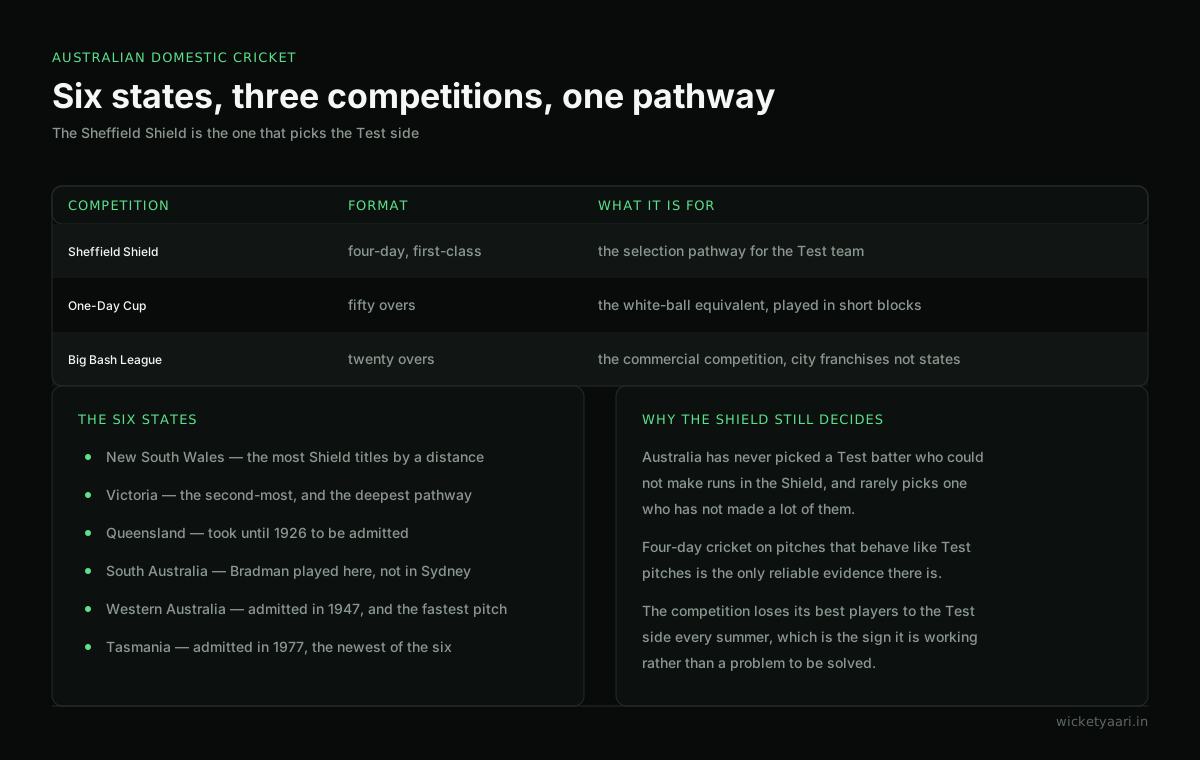
The Shield is four-day, first-class cricket between six state sides. The One-Day Cup is the fifty-over equivalent, usually played in short blocks. The Big Bash is twenty overs and is not state-based at all — it uses eight city franchises, which is a different structure for a different purpose.
Only the first of those has ever been a selection pathway, and that is not an accident.
There is a second reason, which is about conditions rather than length. Shield matches are played at the same grounds, on the same square, with the same ball as Australian Test matches. A player who succeeds at the Gabba or the WACA in February has done it in the conditions they will face in December.
Why four-day cricket is the evidence
A Test selector is trying to answer one question: can this player make runs, or take wickets, against a good attack over a long innings on a pitch that deteriorates?
Four-day cricket answers it. Twenty-over cricket does not, and neither does fifty-over cricket, because neither asks the question. A batter can average 45 in the Big Bash without ever having faced a second new ball or batted on a fourth-day surface.
That is why Australia has essentially never picked a Test batter who could not make runs in the Shield, and rarely picks one who has not made a great many.
The six states
| State | Admitted | Note |
|---|---|---|
| New South Wales | 1892 | the most titles by a distance |
| Victoria | 1892 | the second-most, and the deepest pathway |
| South Australia | 1892 | Bradman played here, not in Sydney |
| Queensland | 1926 | waited thirty-four years to be admitted, and sixty-eight to win |
| Western Australia | 1947 | and the fastest pitch in the country at Perth |
| Tasmania | 1977 | the newest, and a first title in 2007 |
Six teams is small, and that is the point: a player who is in a state side is one of about ninety first-class cricketers in the country. The concentration is what makes the standard high and what makes the step up to a Test debut smaller than it is almost anywhere else.
The trophy itself
The Shield is a silver trophy, made in England in 1892, and it is enormous — close to a metre across and heavy enough that lifting it is a two-person job.
It has been won by New South Wales more times than the other five states combined, which is the sort of imbalance that would kill a franchise league and has never been treated as a problem here. The competition is a selection pathway first; who holds the trophy is secondary to whether the players in it are good enough for Australia.
What a Shield season looks like
Each state plays ten matches, home and away against every other side, and the top two meet in a final hosted by whichever finished first.
The final has a rule that exists nowhere else in cricket: the higher-placed side wins the trophy if the match is drawn. A team that has been the best across the season does not lose it to four days of rain, and the side chasing has to actually win.
Matches are played at the main grounds, in front of almost nobody, and streamed rather than broadcast. The attendance is not a measure of the competition's health; the number of Test cricketers it produces is.
Losing players to Australia
The complaint you hear every season is that the Shield is weakened because the Test players are away.
It is true and it is the system working. A domestic competition whose best players are never selected is a competition that is not producing anybody. A Shield season in which New South Wales lose four players to the Test side is a season in which New South Wales produced four Test cricketers.
The genuine problem is different: the Shield is now scheduled around the Big Bash rather than the other way round, so four-day cricket is played in blocks before and after the T20 window, sometimes in conditions nobody would choose.
The pink ball and the day-night round
The Shield has been used as the testing ground for day-night first-class cricket, which is how the pink ball reached Test matches at all.
Australia played rounds of Shield cricket under lights with a pink ball for several seasons before the first day-night Test, and the feedback from those matches decided the specification: the seam colour, the amount of lacquer, and how long the ball stays visible.
That is an unglamorous use for a domestic competition and it is one of the more valuable things the Shield has done in the last twenty years.
Where the name comes from
Lord Sheffield took an English team to Australia in 1891-92 and left £150 behind for the promotion of cricket. The Australian Cricket Council spent it on a trophy for a competition between the three colonies that had teams.
That is the whole origin. A competition that has picked every Australian Test cricketer for over a century exists because a touring patron left some money on the table on his way home.
Australian selectors have used the Sheffield Shield as the Test pathway for over a century. What does four-day cricket show them that the Big Bash cannot?
A Test selection is a bet on somebody batting or bowling for hours in conditions that change across a match. Only four-day cricket puts a player in that situation, which is why the T20 averages have never been the evidence.
- Small crowds
- Losing its best players
- Only six teams
- Scheduled around the Big Bash
- It was never a spectator competition
- Those players are now Test cricketers
- Ninety first-class players is why the standard holds
- This one is a real problem
- Six states, four-day cricket, and the Test pathway since 1892
- It answers the question a Test selector is actually asking
- Losing players to Australia is the output, not the failure
- Being scheduled around the Big Bash is the genuine complaint
The argument about the pitches
The recurring complaint about the modern Shield is that its pitches have become too helpful to seam bowling, and that Australia has therefore stopped producing batters who can play long innings.
The evidence offered is batting averages, which have fallen across the competition. The counter-evidence is that the same pitches have produced a generation of fast bowlers who travel better than any before them.
Both can be true. A competition is a training environment, and what it trains is whatever it rewards — which is the strongest argument for taking domestic pitch preparation as seriously as the international kind.
The short version
Six teams, four days, and a hundred and thirty years of picking the Australian Test side from it. It survives without crowds because it is the only competition that produces the evidence selectors need.
For the competition that now shapes its calendar, see the Big Bash League explained, and for what four-day cricket asks of a player, Test cricket explained for a new watcher.