The sweep, the reverse sweep and the switch hit explained
Four shots that start from the same position and end up in four different places, all invented to send the ball where the fielders are not.
There is a family of shots played on one knee with a horizontal bat, and they range from the most orthodox way to play spin to a shot that turns a right-handed batter into a left-handed one mid-delivery. All of them exist for the same reason.
- The sweep removes turn from the equation by playing square of the wicket
- The reverse sweep sends the ball where the field is not, on the off side
- The slog sweep is the aerial version and the highest risk
- The switch hit is not a sweep at all, and it is legal
Why any of them exist
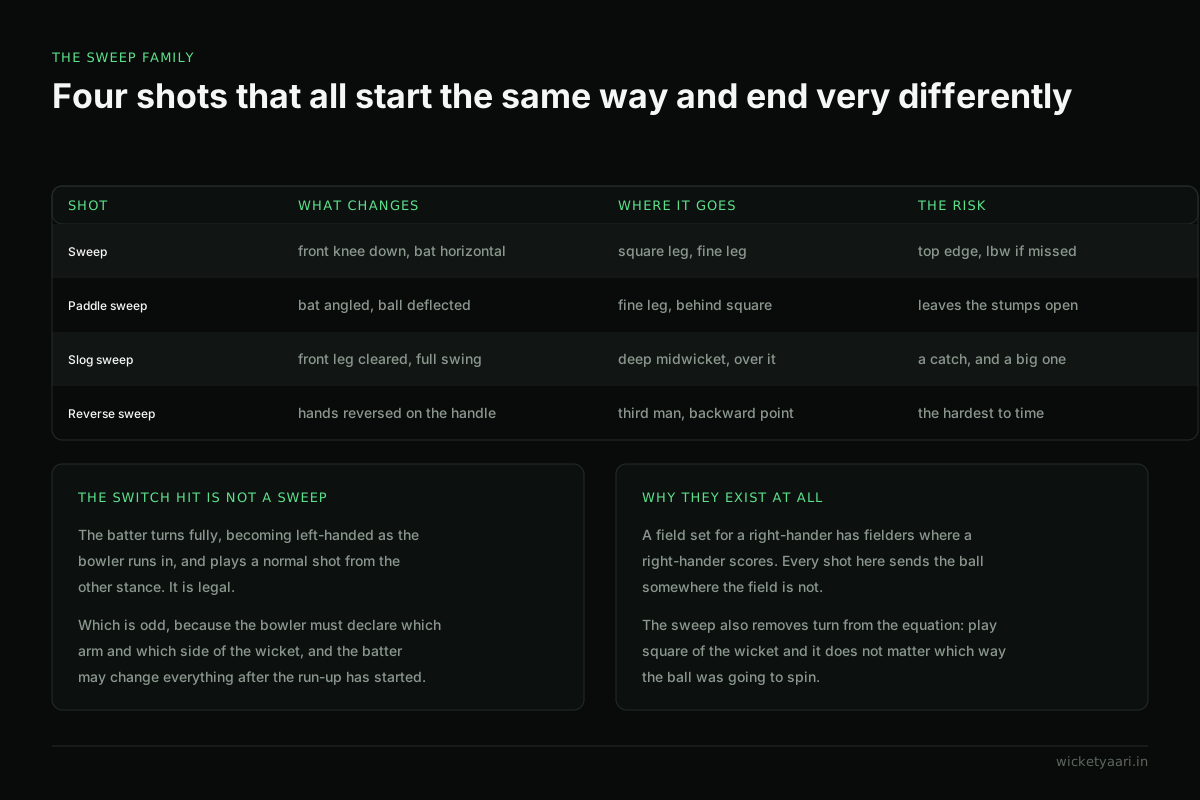
A captain sets a field for the shots a batter normally plays. Against spin, that means fielders in front of the wicket on both sides, catchers close in, and the boundary riders behind square doing very little.
Every shot in this family sends the ball behind square, which is where the fielders are not. That is the first reason.
The second is more technical and more important. A ball turning sharply is difficult to play straight, because the bat is going one way and the ball is going another. Play it square, with a horizontal bat, and the direction of turn stops mattering: the bat covers the line the ball is travelling along rather than intersecting it at a point.
That is why the sweep is taught as the answer to a turning pitch, not as an adventure.
The orthodox sweep
Front knee down, head over the ball, bat swung horizontally across the line, usually to a ball pitched on or outside leg stump. It goes square or fine on the leg side.
The risks are specific. A top edge carries to a fielder behind square, which is why the fielding side posts one there the moment a batter starts sweeping. And a missed sweep to a ball pitching in line is lbw — the batter is across the stumps with no bat involved, and the only defence is that the ball pitched outside leg.
The good sweepers manage that second risk by only sweeping deliveries pitched outside leg stump, where lbw is impossible whatever happens.
The paddle
A softer version. The bat is angled rather than swung, and the ball is deflected fine behind square rather than hit square.
It requires much less power and much better timing, and it is the shot batters use to rotate strike against a spinner bowling to a defensive field. It also leaves the stumps completely exposed, so a batter who misjudges the length is bowled rather than caught.
The slog sweep
The aerial version: front leg cleared, full swing, hit over deep midwicket.
It is the highest-risk shot in the family and the highest-reward, and it is the one that has changed most in the last twenty years. On a turning pitch with a short square boundary, a batter who can slog sweep reliably makes a spinner's defensive field irrelevant, and sides now select for the ability.
The failure mode is a catch at deep midwicket, and it is a catch that gets taken because the ball goes very high rather than very far.
The reverse sweep
The hands change position on the handle, or the bat is turned over, and the ball is swept in the opposite direction — towards backward point and third man.
It is harder than it looks for a reason that is not about courage: the batter is generating power with the weaker of their two hands in the dominant position, and the contact point is behind the body rather than in front of it. Timing is the whole shot.
What it buys is enormous. A field set for a right-hander playing orthodox shots has almost nobody on the off side behind square, and the reverse sweep goes exactly there. Against a spinner bowling into the rough outside leg stump, with five fielders on the leg side, it is frequently the only scoring option available.
| Shot | Where it goes | Main risk | Typical use |
|---|---|---|---|
| Sweep | square or fine leg | top edge, lbw | any turning pitch |
| Paddle | fine leg | bowled | rotating strike |
| Slog sweep | over deep midwicket | caught, very high | attacking a spinner |
| Reverse sweep | third man, backward point | mistiming | a packed leg-side field |
The switch hit, which is a different thing entirely
The switch hit is not in this family and is frequently listed with it.
The batter reverses their stance completely as the bowler runs in, becoming a left-hander, and plays an ordinary shot from the other side. It is not a sweep, not a deflection, and not a shot played from one knee. It is a normal cover drive played by somebody who has just changed hands.
It is legal, and the legality is genuinely strange. A bowler must tell the umpire which arm they bowl with and which side of the wicket they will bowl from, and changing either without notice is a no-ball. A batter may change everything about their stance after the bowler has started running in and nothing happens at all.
The MCC has considered the asymmetry more than once and has left it alone, on the reasoning that the shot is difficult enough to be its own punishment and that restricting it would be harder to police than permitting it.
What the fielding side does about it
Three responses, in increasing order of desperation.
Post the catcher. A fielder at short fine leg or backward square exists solely to catch a top edge, and putting one there is the first move against any sweeper.
Change the length. Sweeping a full ball is difficult and sweeping a short one is dangerous, so a spinner facing a good sweeper pushes the length up and dares them to drive instead.
Go round the wicket and attack the stumps. Sweeping a ball pitching in line carries an lbw risk, so bowling straighter removes the free version of the shot.
The one thing that does not work is bowling wider outside off, which is what instinct suggests and which simply hands the batter a reverse sweep with no risk attached.
A batter sweeps at a ball pitching in line with the stumps, misses it entirely, and is struck on the pad in front of middle. What is the likely decision?
Playing a shot only protects a batter from lbw when the impact is outside off stump. A ball pitching in line, struck in line, that would hit the stumps is out whether a shot was offered or not.
- Horizontal bat, head across
- Playing behind square
- Not watching the ball onto the bat
- Inventing a shot
- It removes the direction of turn from the problem
- That is where the fielders are not
- The head is lower and closer than in a drive
- The sweep is older than the reverse swing it now answers
- Sweeping square makes the direction of turn irrelevant
- Sweeping only balls pitched outside leg removes the lbw risk entirely
- The reverse sweep attacks the empty side of a packed leg-side field
- The switch hit is a normal shot from a reversed stance, and it is legal
The short version
Every shot in this family answers the same question: the field is set for the shots I usually play, so where can I hit it that nobody is standing? The sweep answers it square, the reverse sweep answers it on the other side, and the switch hit answers it by becoming a different batter.
For what the bowler is trying to do in return, see the googly explained without jargon, and for the field it is being played against, cricket fielding positions named and explained.