What an opening batter is actually for, format by format
The only position in cricket defined by what it faces rather than where it bats, and the job reverses completely between a Test match and a T20.
Every other position in a batting order is defined by when you arrive. Opening is defined by what you face: the hardest ball, the most fielders in catching positions, and a pitch nobody has read yet.
- The Test opener's job is survival and information, and it is badly measured
- The T20 opener's job is speed, and leaving the ball is close to worthless
- A good Test opener averages less than a good number four, for structural reasons
- The main product of the job is somebody else's hundred
The two jobs
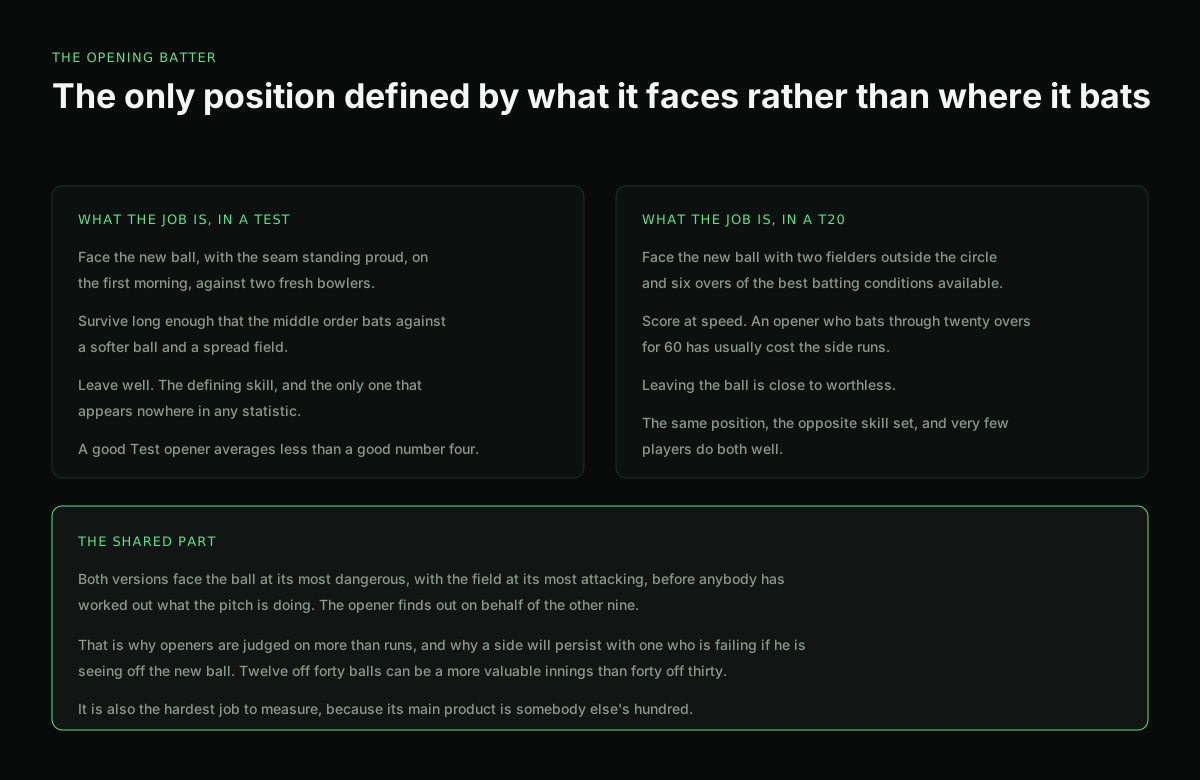
In a Test, the opener faces a new ball with the seam standing proud, in the morning when there is moisture in the pitch, against two fresh bowlers with three slips and a gully. Their job is to still be there an hour later.
In a T20, the opener faces the same new ball with two fielders outside the circle and six overs of the most favourable conditions the innings will offer. Their job is to score at speed, and an opener who bats through twenty overs for 60 has usually cost their side.
Both face the ball at its most dangerous. What they are supposed to do about it is opposite.
Why Test openers average less
This is a structural fact rather than a comment on the players.
An opener faces the hardest bowling in the hardest conditions in every innings they play. A number four frequently arrives at 120 for 2 with the ball forty overs old, the shine gone and the bowlers into their second spell.
The consequence is that a career average of 42 as an opener is worth roughly what 48 is worth in the middle order, and selectors who compare the columns directly are comparing two different jobs.
It also means that the great openers are separated from the good ones by consistency more than by peak scores. Failing twice in a series is normal. Failing in a way that exposes the number three to the new ball repeatedly is what gets somebody dropped.
Leaving, which is the whole skill
The defining Test opening skill is knowing which balls not to play, and it appears in no statistic anywhere.
A good opener leaves everything outside a defined line, forces the bowler to come straighter, and then scores off the straighter ball. That process takes twenty or thirty deliveries and it is what "seeing off the new ball" actually consists of.
A batter who plays at everything gets an edge eventually. A batter who leaves correctly makes the bowler bowl at the stumps, which is where the scoring shots are.
The trap is leaving too much. A bowler who is never driven can bowl a fifth-stump line all morning with no risk, and an opener who has left forty balls without scoring has not created pressure, they have absorbed it — and the batter at the other end is now facing a bowler in rhythm.
| The skill | In a Test | In a T20 |
|---|---|---|
| Leaving the ball | the defining skill | close to worthless |
| Playing straight early | essential | useful for two overs |
| Scoring square of the wicket | comes later | immediately |
| Judging length | to defend | to attack |
| Surviving thirty balls | a good start | a failure |
What the T20 opener is doing instead
Six overs with two fielders out is the largest structural advantage available in the format, and it lasts thirty-six deliveries.
The opener's job is to convert as much of it as possible. That means attacking from the first over, accepting a high risk of dismissal, and treating a personal dismissal in the fifth over for 30 off 16 as a good outcome rather than a bad one.
The measure is not average. It is strike rate in the powerplay and the number of boundaries in the first six, and sides select on those figures rather than on runs per dismissal.
That is also why T20 openers are frequently dropped while averaging well. A player averaging 34 at a strike rate of 118 is using more of the powerplay than their runs justify.
The information job
There is a part of Test opening that never appears anywhere and that every dressing room understands.
The openers find out what the pitch is doing. How much it is seaming, whether the bounce is even, which end is quicker, whether the ball is holding in the surface. By the time the number three walks out, that information has been gathered by somebody else at some cost.
This is why sides persist with an opener who is failing but seeing off overs, and why "he got us through to the fifteenth over" is treated as an achievement even in a low score. Twelve off forty balls can be more valuable than forty off thirty, and no scorecard can express that.
A Test opener scores 14 from 62 balls and is dismissed in the twentieth over, with the score 38 for 1. Is that a failure?
The opener has seen off most of the new ball and passed the information about the pitch to the middle order. A number four arriving in the twenty-first over against a softer ball is facing a materially easier job than they would have in the fourth.
The partnership, which is half the job
Opening is the only position in cricket where the two players are permanently linked, and the pairing matters as much as either individual.
A good opening pair divides the work. One of them is usually the more attacking and takes on the bowler who is off his length; the other absorbs the one who is not. They talk between overs about what the ball is doing, which is a conversation no other pair in the order gets to have at the same point in the innings.
The best pairs also manage the strike deliberately. If one of them is struggling against a particular bowler, the other farms the strike against them — refusing singles late in an over so their partner is protected — and the arrangement is worked out in the middle rather than beforehand.
That is why sides break up opening partnerships reluctantly, and why an opener who averages 38 with one partner and 30 with another is not a mystery.
Why so few do both formats
Almost every habit that makes a good Test opener is a liability in a T20, and vice versa.
The Test opener's trigger movement is back and across, to play late under the eyes. The T20 opener's is forward and often across the stumps, to access the leg side. The Test opener leaves; the T20 opener cannot afford to. The Test opener plays the ball on merit; the T20 opener frequently premeditates.
Players who manage both tend to be the ones who can genuinely switch modes rather than compromise between them, and they are rare enough that most sides now pick different openers for different formats without anybody treating it as unusual.
- Average, and it should be read against position
- Balls faced before dismissal
- Whether the number three faced the new ball
- Consistency across a series
- Strike rate in the powerplay
- Boundaries in the first six overs
- Whether the total at six overs was par
- Whether the risk taken was the right risk
- The Test job is survival, leaving, and gathering information
- The T20 job is converting thirty-six deliveries of fielding restriction
- Test openers average less than middle-order batters for structural reasons
- The two versions require opposite habits, so sides pick different players
The short version
An opener faces the ball when it is at its most dangerous and the field at its most attacking. In a Test their job is to make that somebody else's problem; in a T20 it is to cash in before it becomes one.
For what the fielding restrictions are doing at the other end of the decision, see powerplays explained format by format, and for why the ball is so difficult early, what a Kookaburra ball does that a Dukes does not.