Shivnarine Chanderpaul by the numbers, and the stance nobody copied
11,867 Test runs at 51.37, scored from an open, crab-like stance that every coach would have corrected, for a side that lost most of the matches he saved.
Shivnarine Chanderpaul scored 11,867 Test runs at 51.37 from a stance that faced square down the pitch, for a West Indian side that was in decline for the entire twenty-one years he played.
- 11,867 Test runs at 51.37, from 164 Tests
- An open, chest-on stance that no coaching manual has ever recommended
- 49 Test not-outs, which is more than any specialist batter has
- He was unbeaten in a quarter of his innings, batting with tails
The record
| Format | Matches | Runs | Average | Span |
|---|---|---|---|---|
| Tests | 164 | 11,867 | 51.37 | 1994-2015 |
| ODIs | 268 | 8,778 | 41.60 | 1994-2011 |
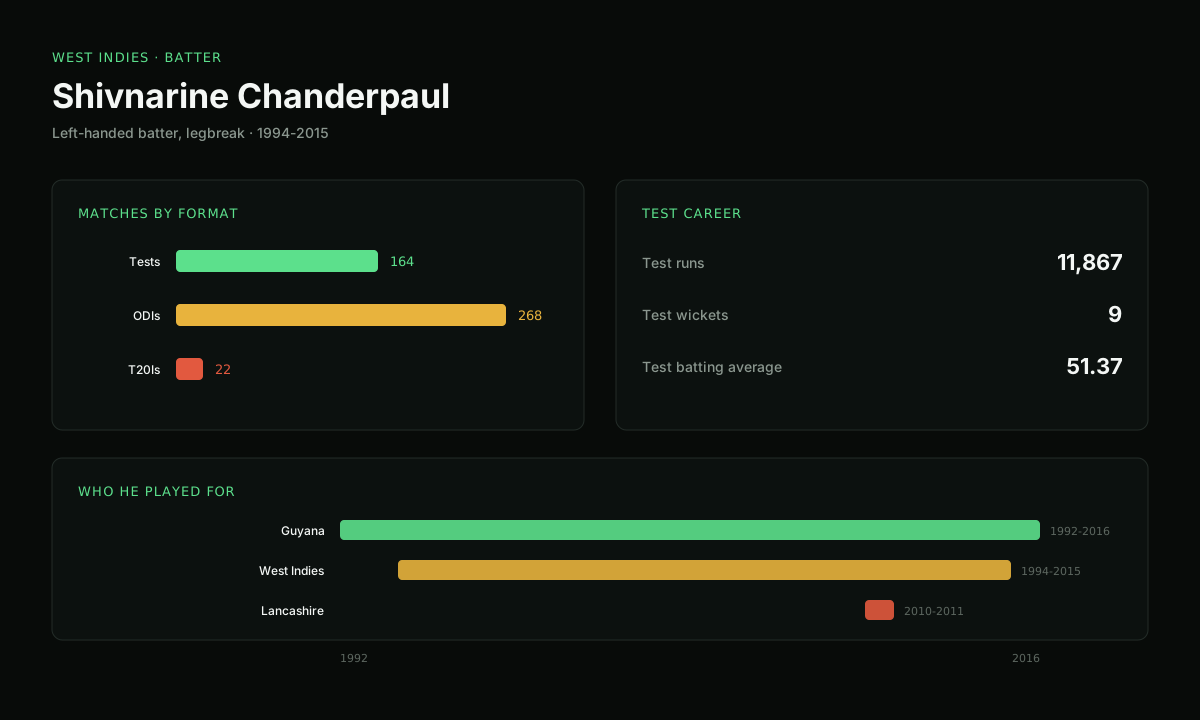
The full record is on his player page.
The stance
He stood almost square to the bowler, chest facing down the pitch, with the bat tapped in front of the leg stump and his back foot outside leg.
Every element of it is wrong by the coaching manual. A batter is supposed to be side-on, with the front shoulder pointing towards the bowler, to allow a straight bat to come down the line. His shoulders faced the wrong way and he still played the ball straight, by rotating as the ball arrived.
The reason it worked appears to be that it let him watch the ball with both eyes, squarely, and that the rotation into the shot happened so late that no bowler could set up for it. It also made him almost impossible to bowl at outside off stump, because he simply did not reach for anything.
Nobody has copied it and nobody teaches it. It is the clearest illustration available that a technique that produces runs is a correct technique.
The not-outs
49 Test not-outs is more than any specialist batter in history has recorded, and it is the number that explains the average.
He batted for a side that lost a great deal and whose lower order was frequently exposed, which meant a large proportion of his innings ended with him unbeaten and the rest of the side dismissed. Batting with a number ten or eleven while trying to score is a specific skill and he did more of it than anybody.
The critique that follows is that the average is inflated by not-outs. It is a fair mechanical point and it applies to any batter who is often stranded, and the reasonable response is that being the last one standing in a collapsing innings is not a statistical trick.
Twenty-one years of decline
He debuted in 1994, one year before Australia ended the West Indian unbeaten run, and retired in 2015.
The entire span is West Indies' decline: a side that had been unbeaten in twenty-nine series became one that lost consistently, lost its production line, and spent two decades in disputes between the board and the players.
Chanderpaul averaged 51.37 through all of it. He scored 30 Test centuries, most of them in defeats or draws, and a striking number of them in the fourth innings or with the side several down for very little.
The concentration
The other thing everybody says about him is that he did not get bored, and it is worth taking literally.
He batted for very long periods without scoring quickly, in matches with nothing at stake, in a side going nowhere, at an age when most players have stopped. He batted 1,000 Test runs in a calendar year at 39. He was still averaging over fifty in his final full year.
The mental component of Test batting is discussed constantly and almost never demonstrated as clearly as by a batter who occupied the crease for two decades in matches his side was going to lose.
Country and role narrow it. The span from 1994 to 2015 is what closes it.
Shivnarine Chanderpaul — The crab stance, 11,867 runs, and 49 innings in a row without being dismissed for a duck. Full record
The one-day record
8,778 runs at 41.60 from 268 matches, and a World Cup in 1996 in which he played and West Indies lost a semi-final they were winning.
The format did not suit him and he adapted to it better than the technique suggested he would. He was never a fast scorer and he was extremely difficult to dismiss, which in a fifty-over innings is worth more than it looks: a side that loses four early wickets needs somebody who can bat thirty overs, and he could.
The end
He was dropped in 2015, at 40, having scored 92 runs in six innings against England.
The manner of it was poor. There was no farewell Test, the selection was communicated publicly before it was communicated to him, and he was two runs short of passing Brian Lara as West Indies' leading Test run-scorer when it happened.
He said afterwards that he would have liked one more match. He did not get it.
The nail
He marked his guard by hammering a bail into the pitch with a stump, rather than scratching a mark with a spike, which is a small thing that became a signature.
The reason was practical: on softer pitches a scratched mark disappears within an over, and a batter who has taken guard three inches from where they think they have is playing a different game from the one they planned. A bail driven into the surface does not move.
It is characteristic of the whole career. An unusual solution to a real problem, adopted because it worked, retained for twenty years despite everybody finding it odd.
The comparison with Lara
The two overlapped for twelve years in the same middle order and are almost perfect opposites.
Lara scored 11,953 runs at 52.88 with a 400 not out, a 375, and a series of innings that people describe as the best they have seen. Chanderpaul scored 11,867 at 51.37 with a highest score of 203 not out and almost nothing anybody would call spectacular.
The totals and the averages are within a hundred runs and a run and a half of each other. Lara is in every conversation about the greatest batters of the era and Chanderpaul is in almost none.
Some of that is legitimate — peak matters, and Lara's peak is higher than anybody's. Some of it is that a batter who accumulates unspectacularly for a losing side is easy to overlook, which is roughly the whole thesis of his career.
The son
His son Tagenarine Chanderpaul opened the batting for West Indies from 2022, which makes them one of a small number of father-and-son pairs to have played Test cricket for the same country.
The two of them also opened together in first-class cricket for Guyana, which is rarer still.
- Stand side-on
- Front shoulder to the bowler
- Play the ball under your eyes
- A technique produces runs
- Stand square, chest facing the bowler
- Both eyes level, rotating late
- Play it under your eyes from a different angle
- 11,867 of them, at 51.37
Where he sits in our dataset
Difficulty tier 1 on the player list. West Indies, batter, 1994 to 2015 is a unique combination, and the Tests column confirms it against Lara.
- 11,867 Test runs at 51.37 across twenty-one years
- A stance no coach would teach and nobody has copied
- 49 not-outs, the most of any specialist batter
- He averaged over fifty for a side in continuous decline
The short version
He batted with the wrong shape, for a side that was losing, for two decades, and finished with an average above fifty and more not-outs than anybody. The technique is the argument for judging batters by what they produce rather than by how they look doing it.
For the era he arrived at the end of, see the rise of the West Indies, and for what not-outs do to an average, batting average is not runs per innings.