Clive Lloyd by the numbers, and the decision that built a dynasty
7,515 Test runs and a captaincy of 74 Tests, in which he decided that four fast bowlers and no spinner was the answer and was proved right for fifteen years.
Clive Lloyd scored 7,515 Test runs, which is a good career. He also made a single tactical decision in 1976 that shaped the next fifteen years of world cricket, which is why the batting record is the second thing anybody says about him.
- 7,515 Test runs at 46.67, from 110 Tests
- He captained West Indies in 74 Tests, winning 36 and losing 12
- The four-fast-bowler strategy was his decision and it was contested at the time
- Two World Cups, in 1975 and 1979, including 102 in the first final
The record
| Format | Matches | Runs | Average | Span |
|---|---|---|---|---|
| Tests | 110 | 7,515 | 46.67 | 1966-1985 |
| ODIs | 87 | 1,977 | 39.54 | 1973-1985 |
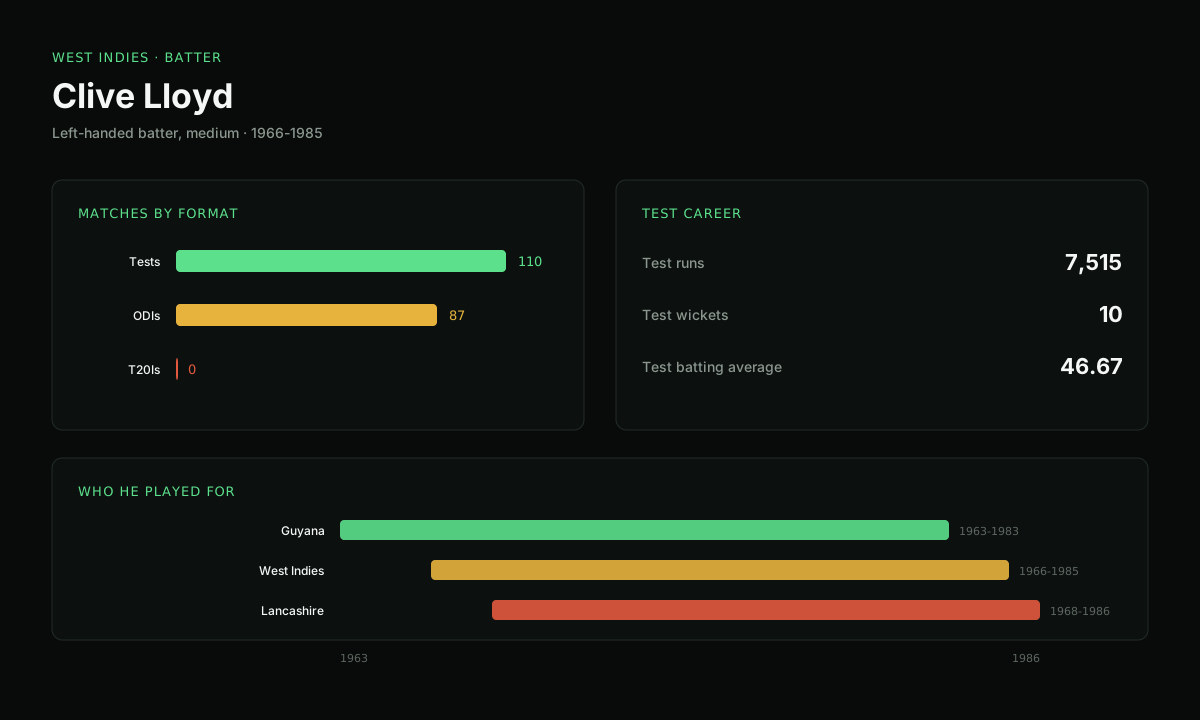
The full record is on his player page.
The decision
Australia, 1975-76. West Indies were beaten 5-1 by a side whose attack was Dennis Lillee and Jeff Thomson bowling as fast as anybody has.
West Indies had played spinners. Their batters were hit repeatedly. Lloyd, captaining, concluded that the only answer to sustained extreme pace was sustained extreme pace, and that the way to produce it was four fast bowlers and no spinner at all.
The decision was contested. Playing four seamers meant no variation, a slow over rate, and enormous physical demands on the bowlers. It also meant abandoning a tradition of West Indian spin that went back decades.
It worked for fifteen years. West Indies did not lose a Test series between 1980 and 1995, which is the longest period of dominance in the sport's history and is covered in the rise of the West Indies.
The batting
7,515 runs at 46.67, with 19 centuries, batting at five or six.
He was a left-hander who hit the ball extremely hard, with a very heavy bat and a high backlift, and who scored at a rate that was fast for the era. The most-cited innings is 102 from 85 balls in the 1975 World Cup final, which won the first World Cup and which was made against Lillee, Thomson, Gilmour and Walker.
The Test average is good rather than outstanding by the standards of the batters around him, and part of the explanation is that he captained for most of it in a side that frequently did not need him to bat long.
The captaincy record
74 Tests, 36 wins, 12 defeats, 26 draws.
The win rate is close to fifty per cent, which for the era — when draws were far more common — is exceptional. He is the captain with the most Test wins until Steve Waugh and Ricky Ponting passed him, and both of them captained sides he had a hand in creating the conditions for.
He also took the side through World Series Cricket. Almost the entire West Indian team signed for Packer, and Lloyd resigned the official captaincy in 1978 in protest at how the board handled it, then returned when the dispute was settled.
The two World Cups
West Indies won the first two World Cups, in 1975 and 1979, both at Lord's, both under his captaincy.
His 102 in the 1975 final is the innings that made the tournament: West Indies were 50 for 3 and he took the total to 291 for 8 in sixty overs. Australia were bowled out for 274 in the last over, with five run-outs, three of them by Viv Richards.
They then lost the 1983 final to India, in the match that moved the sport's centre of gravity to the subcontinent. That was his last World Cup.
What made the four-bowler plan work
Three things, and only the first is about bowling.
Depth. Roberts, Holding, Garner, Croft, Marshall, Daniel, Clarke, and later Ambrose, Walsh, Bishop and Patterson. No other country produced fast bowlers at that rate for that long, and the plan required an unbroken supply.
Batting that scored fast enough. Greenidge, Haynes, Richards and Lloyd himself gave the bowlers big totals, which meant they could attack from the first over rather than defend.
Over rates nobody policed. Thirteen overs an hour was the cost of four bowlers operating at full pace all day, and the laws did not then penalise it. Every over-rate penalty in the modern game was written afterwards, partly in response.
Country and role narrow it. The span from 1966 to 1985 is the fastest route in.
Clive Lloyd — Captained West Indies to two World Cups and built the four-man pace attack that ran the eighties. Full record
The two hundreds people forget
He scored 242 not out against India at Bombay in 1975 and 178 against Australia at Perth in 1975, both in matches West Indies won, and both are innings his own team-mates cite more often than the World Cup final hundred.
The Perth innings in particular is worth stating: it came in the series West Indies lost 5-1, on the fastest pitch in the world, against Lillee and Thomson, and it was the only Test they won.
A batter who scores 178 in those circumstances and then concludes that his side needs four fast bowlers of its own has drawn a conclusion from personal evidence rather than from theory.
The glasses
He wore thick spectacles throughout his career, which was unusual for a batter facing genuine fast bowling and which he never made anything of.
He was also, before a knee injury, an outstanding fielder — regarded as one of the best cover fielders of the 1960s and 1970s — which is not a combination anybody expects.
The one-day record
1,977 runs at 39.54 from 87 matches, which looks small and is a function of the era: one-day internationals barely existed until 1975 and were played rarely for years afterwards.
He captained in three World Cups and won two of them, and West Indies did not lose a World Cup match at all until the 1983 group stage. The 1983 final, lost to India after bowling them out for 183, is the match that ended it.
His 102 in the 1975 final is one of a very small number of hundreds in World Cup finals, and it was made in the first one, on the day the format proved it could fill Lord's.
Afterwards
He managed West Indies, chaired the ICC match referees, and has been a consistent public voice on the decline of West Indian cricket since.
The West Indies of the 2000s and afterwards is the counterfactual for his own achievement: the same region, without the fast bowling production line, without the board stability, and with the athletes going to other sports. What he built required conditions that no longer exist.
- 7,515 runs at 46.67
- 19 Test centuries
- 102 in the 1975 World Cup final
- 110 Tests
- A tactical decision made after a 5-1 defeat
- Four fast bowlers, and no spinner, for fifteen years
- Two World Cups won at Lord's
- 74 of them as captain, with 36 wins
Where he sits in our dataset
Difficulty tier 2 on the player list. West Indies, batter, 1966 to 1985 is a unique span, and the debut year is the giveaway.
- 7,515 Test runs at 46.67, and 102 in the first World Cup final
- 74 Tests as captain, 36 wins, in an era when most Tests were drawn
- The four-fast-bowler decision was his, was contested, and defined an era
- He resigned the captaincy over the board's handling of World Series Cricket
The short version
The batting record is good and the captaincy record is the reason he matters. He concluded after a 5-1 defeat that four fast bowlers was the answer, and world cricket spent the following fifteen years failing to find a response.
For the era he built, see the rise of the West Indies, and for the tournament he won twice, the first cricket World Cup 1975.