Viv Richards by the numbers, and the batter who never wore a helmet
8,540 Test runs at 50.23, scored at a rate nobody else in his era approached, by a man who faced the fastest bowling in history in a cap.
Viv Richards averaged 50.23 in Test cricket and scored at a strike rate that would be respectable today, in the 1970s and 1980s, without ever wearing a helmet. The last part is not a colour detail; it is central to how he batted and how he was bowled to.
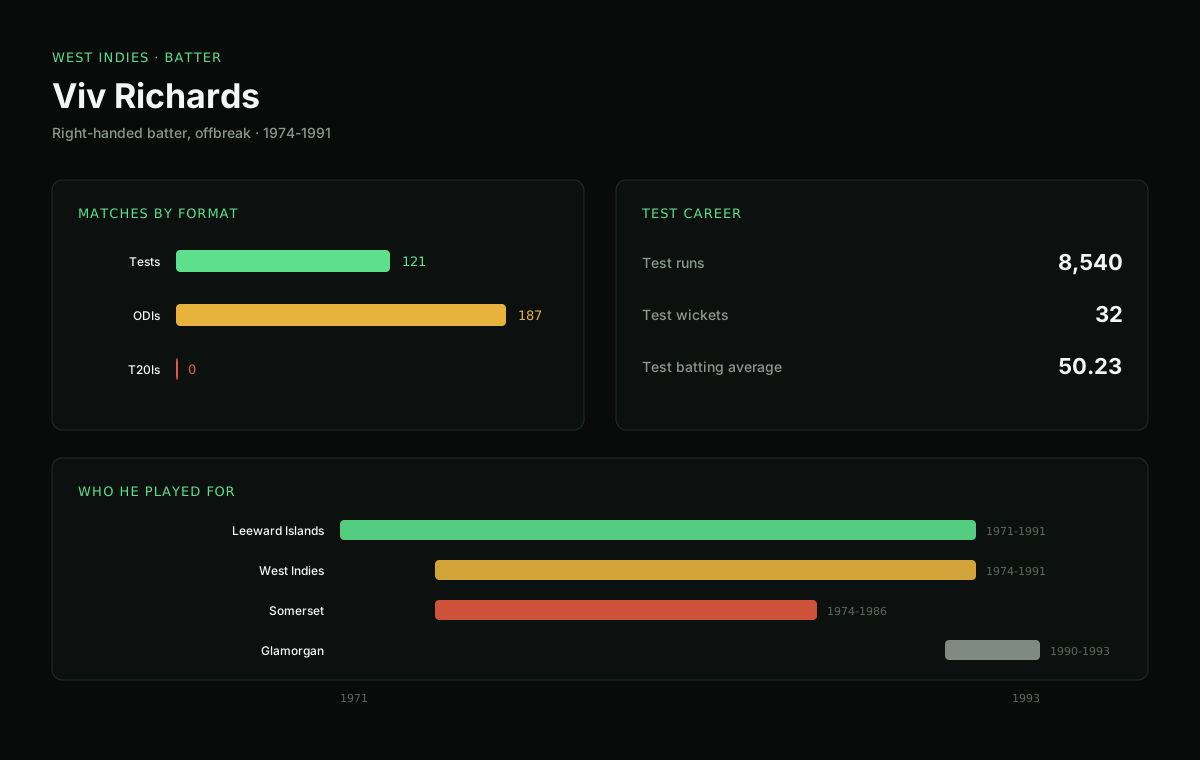
- 8,540 Test runs at 50.23, from 121 Tests
- He scored at around 69 per hundred balls in an era averaging in the forties
- Never wore a helmet, against the fastest bowling the game has produced
- Captained West Indies through the second half of their unbeaten run
The record
| Format | Matches | Runs | Average | Span |
|---|---|---|---|---|
| Tests | 121 | 8,540 | 50.23 | 1974-1991 |
| ODIs | 187 | 6,721 | 47.00 | 1975-1991 |
The full record is on his player page.
The scoring rate
Around 69 runs per hundred balls in Test cricket, at a time when the very good batters were scoring at 45 to 50.
That is a difference of roughly a run and a half per over, sustained for seventeen years, and it is the reason West Indies could bowl sides out twice: their batting gave the attack time.
The rate came without any of the modern apparatus. Small bats by current standards, long boundaries, uncovered pitches for part of it, and no fielding restrictions helping him. He simply hit the ball harder and more often than anybody else was willing to.
No helmet
He faced Lillee, Thomson, Imran, Willis, Hadlee and the entire West Indian net attack without head protection, at a point when helmets had arrived and were becoming normal.
The reason he gave was straightforward: he did not want to. It became part of how he was perceived — a batter walking out in a maroon cap, chewing gum, taking guard against genuine pace — and it was also a tactical statement. A batter who is not protecting himself is telling the bowler that the short ball is not a plan.
Bowlers bowled it anyway. He hooked, pulled and left, and was hit rarely enough that the decision never looked reckless in retrospect.
The 56-ball hundred
Antigua, 1986, against England. He reached a hundred from 56 deliveries, which was the fastest Test century by balls faced and stood as the record for over thirty years.
The innings finished at 110 not out from 58 balls. West Indies won the match and the series 5-0, which was the second consecutive whitewash of England in three years.
It is the clearest illustration of the scoring rate: a Test century in under an hour, in 1986, without any of the equipment or field restrictions that would make it easier today.
The walk
There is a part of the record that has nothing to do with runs and is mentioned by every bowler who played against him.
He walked to the crease slowly, chewing gum, without a helmet, and took an unusually long time over his guard. The effect, described consistently by opponents, was that the bowler had time to think about what was coming.
That is not an accident of temperament. It was a deliberate piece of theatre from a player who understood that a fast bowler running in at somebody who is visibly unbothered is a fast bowler in an argument he has already lost.
Whether it added runs is unmeasurable. That it existed, and that bowlers of the period bring it up unprompted forty years later, is a fact about the record.
The one-day record
6,721 runs at 47.00 in 187 matches, in a format that was in its infancy and was mostly played defensively.
His 189 not out against England at Old Trafford in 1984 is the innings usually cited: West Indies were 102 for 7 and he took them to 272, batting with the tail for the entire second half of the innings. It was the highest one-day score at the time and it was made in a sixty-over match, which means the field was up for very little of it.
He also scored 138 not out in the 1979 World Cup final, which West Indies won.
The captaincy
He took over from Clive Lloyd in 1985 and captained West Indies until 1991, without losing a Test series.
That is the part of the record that gets stated and under-appreciated. Continuing an unbeaten run is harder than starting one: the side he inherited was ageing, the replacements were arriving in fewer numbers, and every opponent had spent a decade working on the problem.
He never lost a series. Australia ended the run in 1995, four years after he retired.
Country and role narrow it, and the span from 1974 to 1991 finishes it against the batters around him.
Viv Richards — Never wore a helmet and never lost a Test series as captain. Full record
The 1976 series
England, summer of 1976, is the series that made the reputation and it is worth stating what he actually did in it.
He scored 829 runs in four Tests, at an average over 118, having missed one match through illness. In the calendar year he scored 1,710 Test runs, which was a record at the time and required only eleven matches.
The context is the one the whole era is remembered for: England's captain had said before the series that he intended to make West Indies grovel, and West Indies won 3-0 with a fast bowling attack that abandoned the idea of a balanced one. Richards was the batting half of that answer.
It is also where the tone was set for the fifteen years that followed, and he was 24.
What he was actually doing
The technique was orthodox and the intent was not.
He played straight, with a full swing, and hit through the line more than any batter of his period. The distinctive shot was the whip through midwicket off a ball pitched outside off — a stroke that requires the batter to move their whole body across and play against the line, and which almost nobody attempts because getting it wrong is lbw.
He got it right for seventeen years, and the effect on bowlers was that there was no safe line. A ball outside off went through midwicket; a ball at the stumps went straight; a ball short was pulled. There was nowhere to bowl.
- Test scoring at 45 per hundred balls
- Helmets becoming standard
- One-day cricket played defensively
- A captaincy that could only go wrong
- 69, for seventeen years
- A maroon cap, against Lillee and Thomson
- 189 not out from number three, with the tail
- Six years, no series defeat
What the average understates
50.23 is very good and is lower than several of his contemporaries and successors, and there is a specific reason.
He batted at three or four in a side that was frequently winning comfortably, which means a large number of innings ended with a declaration or with the match already decided. It also means many of his innings were played at a rate chosen to force a result rather than to accumulate.
A batter scoring at 69 per hundred balls is taking risk with almost every delivery. The average that emerges from that is not comparable with one built from batting time, and the honest comparison is with the batters who scored at a similar rate — of whom, in his era, there were essentially none.
The bowling
32 Test wickets from a part-time off-spinner, which is a footnote and appears on the scorecard often enough to be worth a line.
He bowled when the over rate needed help, when a partnership needed breaking, and against left-handers. It is the least remarkable thing about him and it is the kind of contribution that a side with four fast bowlers and no spinner genuinely required.
Where he sits in our dataset
Difficulty tier 1 on the player list, and one of the more distinctive entries because the span column does so much work: West Indies, batter, 1974 to 1991 is a combination with essentially one answer.
- 8,540 Test runs at 50.23, scored at a rate belonging to a later era
- The fastest Test century by balls faced for over thirty years
- No helmet, ever, against the fastest bowling in the sport's history
- Six years as captain without losing a series
The short version
He batted in the 1970s and 1980s the way batters started batting in the 2000s, with worse equipment and no protection, and he did it well enough to average over fifty for seventeen years. The scoring rate is the record and the cap is the reason people remember it.
For the side he played in and then led, see the rise of the West Indies, and for what a strike rate is measuring, strike rate means nothing alone.