Shane Warne by the numbers, and what he did to leg spin
708 Test wickets from a discipline everybody had written off as too expensive and too unreliable for the modern game. The wickets are only half of what changed.
When Shane Warne made his Test debut in 1992, leg spin was regarded as a luxury: a gamble a captain took when nothing else was working. He finished with 708 Test wickets and left the discipline as a first-choice option in every side that could find somebody to bowl it.
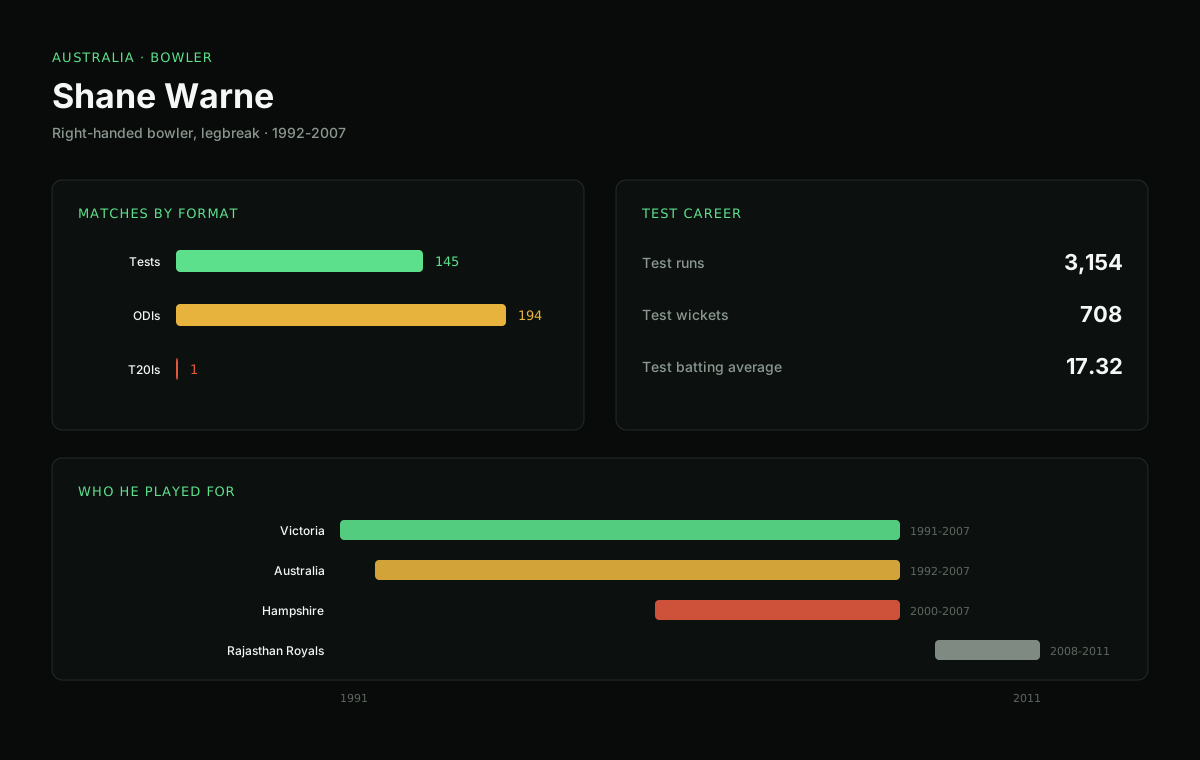
- 708 Test wickets at 25.41, from 145 Tests
- Leg spin was considered too expensive for the modern game when he started
- 3,154 Test runs, and the highest score by a man who never made a Test hundred
- He changed what captains believed a spinner could be asked to do
The record
| Format | Matches | Wickets | Average | Span |
|---|---|---|---|---|
| Tests | 145 | 708 | 25.41 | 1992-2007 |
| ODIs | 194 | 293 | 25.73 | 1993-2005 |
The full record is on his player page.
What leg spin was before him
By the late 1980s the discipline had almost disappeared from Test cricket at the highest level.
The reasoning was economic. A leg-spinner concedes more runs per over than a finger spinner, bowls more bad balls, and takes longer to control. In an era of four-man pace attacks and defensive one-day cricket, captains concluded the wickets were not worth the runs.
There were exceptions and they were treated as exceptions. The default assumption in most cricketing countries was that a young wrist-spinner would be converted to something more reliable.
What changed
Warne bowled leg spin with the accuracy of a finger spinner, which was the thing nobody thought was possible.
The stock ball turned sharply and landed on a length, over after over, for spells of twenty and thirty overs. That combination — genuine turn and genuine control — removed the entire economic objection. A captain could bowl him to contain and to attack at the same time, which is what a front-line bowler is.
The variations mattered too, and less than people assume. The flipper and the slider took wickets. The stock leg break, landing on a good length and turning, took most of them.
The 708
To take 700 Test wickets you need three things at once: to play a long time, to bowl a great many overs, and to take wickets at a rate that justifies the overs.
Warne bowled more than 40,000 deliveries in Test cricket. That is a workload only a spinner can carry, which is why the top of the wicket-taking list is dominated by spinners, and it is the reason a fast bowler with a better strike rate finishes with fewer.
His average of 25.41 is the number that separates him from bowlers who accumulated. A wicket every 57 balls at 25 runs each, over fifteen years, is the record of somebody attacking constantly rather than holding an end.
The batting, and the record nobody wants
3,154 Test runs at 17.32, with twelve fifties and no hundreds.
His highest score is 99, made against New Zealand in 2001, and it is the highest Test score by anybody who never scored a Test century. That is a genuinely brutal piece of statistical bad luck and he mentioned it often.
The runs were not incidental. A number eight averaging 17 with twelve fifties is a batter who saved sessions, and several of Australia's more comfortable positions in that era began with a partnership involving him at 250 for 7.
What he did to captains
The change he produced was tactical rather than technical, and it outlasted him.
Before Warne, a spinner in a Test side bowled when the seamers were tired, on the fourth day, or on a turning pitch. After him, sides expected to open the bowling with a spinner in the subcontinent, to bowl one in the first session on any surface, and to build a plan around one rather than around four seamers.
That change is why there are more front-line leg-spinners in international cricket now than at any point since the 1930s, and why the discipline is taught to children again rather than coached out of them.
The wickets column is the giveaway here, and the role narrows it to about four people before you even look at it.
Shane Warne — The ball of the century to Mike Gatting, and seven hundred Test wickets. Full record
The ball that made the reputation
His first delivery in an Ashes Test, at Old Trafford in 1993, pitched well outside leg stump and hit the top of off. Mike Gatting, one of the best players of spin in England, was bowled by it having played for a line that turned out to be irrelevant.
The delivery is famous partly because it was the first one — a bowler with no reputation in England producing that with his opening ball — and partly because Gatting's reaction, standing there looking at the pitch, told the story better than any replay.
What it did practically was psychological, and it lasted the rest of the decade. English batters approached him differently afterwards, which meant he took wickets with deliveries that were not remotely as good, and which is why the ball is mentioned so often by people who watched the eight Ashes series that followed.
The comeback nobody expected
He missed most of 2003 through a twelve-month suspension for a banned substance, returning at almost 34, at an age when spinners are usually declining and after a year without competitive cricket.
He took 26 wickets in his first series back, and the four years that followed were the most productive of his career by volume: he took over 250 of his 708 wickets after turning 34.
That is unusual enough to be worth stating on its own. Most bowlers' best years are in their late twenties, and the second half of his career was better than the first.
The thing the record cannot show
Warne bowled to a plan out loud. Fields were set two overs before the delivery that needed them, batters were told what was coming, and the setup was frequently visible from the boundary and worked anyway.
That is a different skill from spin bowling and it is the one his contemporaries mention first. A batter who knows the plan and still gets out to it has been beaten by execution rather than deception, and it happened repeatedly.
It also means his wickets are unusually well documented in the memory of anybody who watched them, because the setup was legible. Most bowling is a sequence you notice afterwards; his was one you could follow live.
- 708 wickets at 25.41
- 40,000 deliveries
- A highest score of 99
- 145 Tests
- Leg spin became a front-line option again
- Captains started opening with spin
- Number eights were expected to bat
- Children were taught wrist spin rather than talked out of it
Where he sits in our dataset
Difficulty tier 1 on the player list, and one of the fastest puzzles to close out once the role column is revealed.
The reason is the wickets number. Very few bowlers in the dataset are anywhere near 700, and a player who has established country, role and era and then sees 708 has one of about two possible answers.
- 708 Test wickets at 25.41 from 145 Tests
- The stock leg break, with control, is what did most of the work
- Highest Test score of 99, and no century, which is a record of its own
- The lasting change is tactical: what captains now expect a spinner to do
The short version
The wickets are the headline and the discipline's survival is the legacy. Leg spin was on its way out of Test cricket when he started, and it is a first-choice option now because he demonstrated that the objection to it was wrong.
For how the deliveries actually work, see the googly explained without jargon, and for the list he sits near the top of, most Test wickets of all time.