Don Bradman by the numbers, and the four runs that mattered
An average of 99.94 across 52 Tests, which is roughly twice anybody else. He needed four runs in his last innings to finish on a hundred and made none.
Every sport has a best-ever argument. Cricket does not, because the gap between Don Bradman and the second-best batting average in Test history is larger than the gap between second and about fiftieth.
- 6,996 Test runs at 99.94, from 52 matches
- The next-highest career average among substantial careers is in the low sixties
- He needed four runs in his final innings and was dismissed for nought
- 117 first-class centuries from 338 innings, which is one every three
The record
| Format | Matches | Runs | Average | Span |
|---|---|---|---|---|
| Tests | 52 | 6,996 | 99.94 | 1928-1948 |
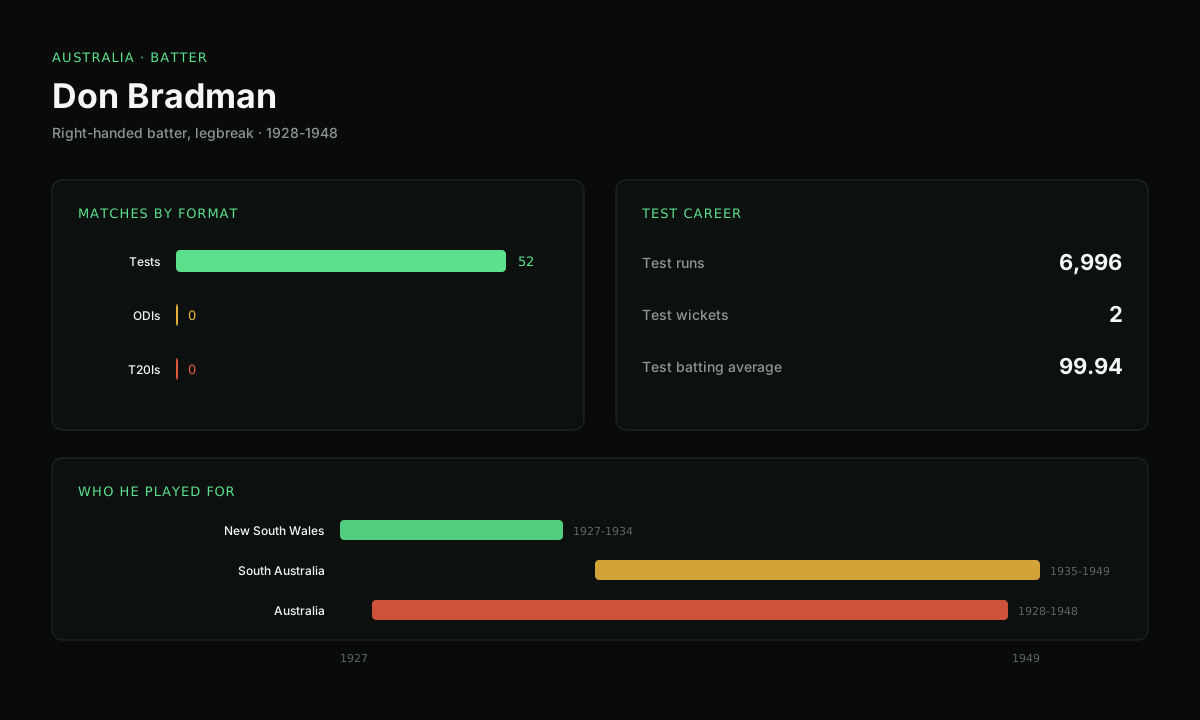
The full record is on his player page.
What 99.94 actually means
A Test batting average in the low fifties marks somebody as one of the best of their generation. The mid-fifties is exceptional. Nobody with a substantial career has averaged more than about sixty.
Bradman averaged ninety-nine point nine four.
The usual way of expressing the gap is that to be as far clear of the field in any other statistic, a batter would need to average around a hundred and ten today, or a bowler would need to take wickets at eleven runs each. Neither has happened, and the distribution of every other cricket statistic makes it clear that neither is likely to.
The honest description is that he is not an outlier within the distribution of Test batters. He is outside it.
The four runs
His final Test innings was at the Oval in August 1948. He needed four runs to finish his career with an average of exactly 100.
He was bowled second ball by Eric Hollies for nought, which left him on 99.94. It is the most famous duck in the history of the sport and it is the reason the number is memorable — an average of 100.00 would have been rounder and would have been talked about less.
Whether the crowd's ovation and the emotion of the occasion contributed is one of those questions with no answer. Bradman said afterwards that he had difficulty seeing the ball. Hollies said he bowled a googly.
Fifty-two Tests
The small number of matches is a reflection of the era and of a war.
Test cricket in the 1930s was played infrequently: a handful of matches a year, against a small number of opponents, with long gaps. And Bradman lost six years to the Second World War, from age 31 to 37 — the exact period in which most batters do their best work.
He came back afterwards, in his late thirties, in poor health, and averaged over 100 in the 1946-47 Ashes series. That is the part that answers the "he would not do it today" argument most directly: he did it before the war, and then did it again after six years without competitive cricket at an age when careers normally end.
Bodyline, which was built for him
The only strategy anybody found that worked was to bowl fast, short, at his body, with a packed leg-side field.
Bodyline reduced his average in the 1932-33 Ashes to 56.57. That is worth reading twice: the tactic that was so extreme it caused a diplomatic incident and produced two changes to the Laws succeeded in reducing him to a level most batters never reach.
He was the reason the plan existed. England's captain built it specifically because conventional bowling did not work, and every subsequent argument about it has been downstream of that fact.
The whole episode is covered in Bodyline and the law it changed.
The first-class record
117 centuries from 338 innings, which is a century roughly every three times he batted.
The scale of the individual scores is what stands out. He made 452 not out for New South Wales in 1930, a first-class record that stood for over thirty years. On the 1930 tour of England he scored 974 runs in a five-Test series, which is still the record for any Test series by a distance.
That 1930 series total is another number in the Bradman category: the second-highest series aggregate in Test history is around 200 runs behind, and it was set in a series with more innings available.
The average column ends this one immediately. Nothing else in the dataset is close.
Don Bradman — Averaged 99.94. Needed four in his final innings to finish at a hundred and made nought. Full record
What is fair to say against it
Three arguments come up and all three are partial.
He played fewer opponents. True: Australia's Test opposition in the 1930s was mostly England, with South Africa, West Indies and India appearing rarely. The attacks he faced were narrower than a modern batter faces.
Pitches were sometimes uncovered. True, and this cuts against him rather than for him. Uncovered pitches after rain were the worst batting conditions in the history of the game, and his record on them is the one part of it that is merely excellent.
Fields and Laws differed. True, and the lbw Law changed during his career in a way that made batting harder rather than easier.
None of it accounts for a gap of forty runs an innings, and no serious analysis has ever produced an adjustment that closes it.
- Different era, different bowling
- Fewer opponents
- Uncovered pitches favoured batting
- Everybody was a bit better then
- He averaged over 100 before and after the war
- And he played Bodyline, built specifically for him
- Uncovered pitches after rain are the hardest batting there is
- Nobody else from his era is near his figures
What he did afterwards
The playing record is only part of why the name carries the weight it does in Australia.
He served as a selector and an administrator for decades after retiring, held significant influence over Australian cricket into the 1980s, and was involved in the game's governance through the period that produced World Series Cricket — on the side of the board, and reportedly as one of the people who eventually negotiated the settlement.
That is unusual. Most great players leave the sport's decision-making to administrators; he became one, and the combination of an unmatched playing record and forty years of institutional authority is why his name functions in Australia as something closer to a national institution than a sporting one.
Why nobody has come close
Batting averages have not moved much in ninety years. The best batters of every generation since have clustered in the low to mid-fifties, in eras with better equipment, flatter pitches, protective gear and covered surfaces.
That stability is the strongest argument that the 99.94 is not an artefact of the period. If the 1930s were simply easier to bat in, other batters of the 1930s would show it, and they do not: his contemporaries averaged what good players average now.
Whatever the explanation is, it is specific to him rather than to the decade.
Where he sits in our dataset
Difficulty tier 1 on the player list, and the single fastest puzzle in the dataset to solve once the average column appears.
He is also the reason the Cricketer board shows a batting average at all: it is one of very few statistics where a single number identifies a person with no ambiguity whatsoever.
- 6,996 runs at 99.94 from 52 Tests, across twenty years and a war
- The gap to second place is larger than the gap from second to fiftieth
- He needed four in his last innings and made none
- Bodyline was invented for him, and it worked in the sense that he averaged 56
The short version
The average is not an achievement within cricket's normal range; it is outside it, and every attempt to explain it away has failed to account for more than a fraction of the gap. He would have finished on exactly 100 with four more runs, and it is better that he did not.
For the tactic built to stop him, see Bodyline and the law it changed, and for what a batting average is measuring in the first place, batting average is not runs per innings.