Sourav Ganguly by the numbers, and the one that gets left out
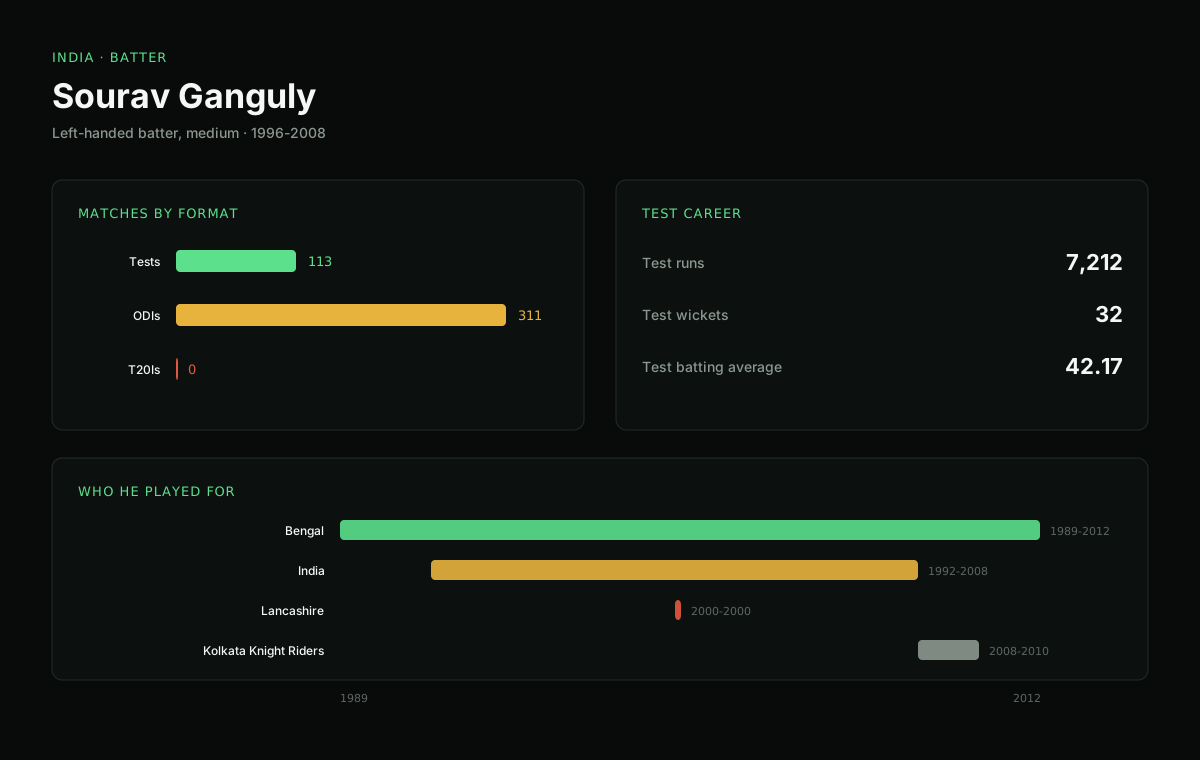
113 Tests, 7,212 runs and an average of 42.17, next to a captaincy record that those batting figures completely fail to explain. Both are true.
Sourav Ganguly's career reads oddly on paper. The batting numbers are good without being remarkable, and the reputation is enormous. Both are correct, and the gap between them is the interesting part.
The record
| Format | Matches | Runs | Average | Span |
|---|---|---|---|---|
| Tests | 113 | 7,212 | 42.17 | 1996–2008 |
| ODIs | 311 | 11,363 | 41.02 | 1992–2007 |
A Test average of 42 in that era puts him firmly in the good-not-great bracket among his own contemporaries. Rahul Dravid averaged 52.31, Sachin Tendulkar 53.78. Ganguly is comfortably behind both, and everybody involved knew it at the time.
The full record is on his player page, which is also where you can see which of our puzzles he has turned up in.
The debut nobody expected
He made a century on Test debut at Lord's in 1996, and another in the next Test at Trent Bridge. Only a handful of players have scored hundreds in each of their first two Tests, and doing it in England as a left-handed opener with a reputation for struggling against pace was not the expected outcome.
That start bought him a decade of goodwill, some of which he needed.
Where the numbers stop explaining him
Ganguly captained India in 49 Tests, and the record of the side under him is the thing that no batting column contains.
Before he took over, India's away record was poor to the point of being a running joke: a side that was formidable at home and negligible everywhere else. Under him India drew in Australia, drew in England, won in Pakistan, and reached a World Cup final. The habit of expecting to compete overseas — which every subsequent Indian captain has inherited — starts there.
He also picked and backed young players with an aggression that looked reckless at the time and looks obvious now. Virender Sehwag opening the batting was his idea and a strange one. Harbhajan Singh's thirty-two wickets against Australia in 2001 happened partly because his captain kept bowling him.
None of that is in an average.
The left-hander problem
The technical criticism was constant and not unfounded. Ganguly against genuine short-pitched fast bowling was a weakness that opposition captains planned around for his entire career.
What is easy to forget is that he scored 7,212 Test runs anyway, in an era with McGrath, Pollock, Donald, Akram, Waqar and Ambrose still bowling. Having a known flaw and averaging 42 through that is a different achievement from averaging 42 without one.
The captaincy record, stated plainly
Twenty-one wins from 49 Tests as captain, and the raw figure is not what makes the case. India had won twelve Tests away from home in their entire history before he took over. What changed was not the win column so much as the expectation attached to it.
The specific results are the argument: a drawn series in Australia in 2003-04 against the best side in the world, a series win in Pakistan in 2004, a drawn series in England, and a World Cup final in 2003. None of those had happened under previous captains and several of them have been repeated by every captain since.
| Before he captained | Under his captaincy |
|---|---|
| Formidable at home, negligible away | Competitive in Australia, England and Pakistan |
| Senior players picked on reputation | Sehwag opening, Harbhajan backed, Yuvraj and Zaheer blooded |
| Losing the toss was an excuse | Losing overseas stopped being acceptable |
The players he picked
The selection calls are the part that has aged best, and three of them were strange at the time.
Virender Sehwag opening the batting. A middle-order batter with an unorthodox technique, moved to face the new ball, on the grounds that his scoring rate would be worth more there than his defence would cost. It is routine now. It was not then.
Harbhajan Singh bowled into form. Thirty-two wickets in the 2001 series against Australia came from a bowler who had been out of the side and out of favour, and who was bowled long spells by a captain who had decided he was the answer.
Zaheer Khan, Yuvraj Singh and Ashish Nehra, all given extended runs while they were expensive and unreliable, on the theory that fast bowlers and attacking batters take longer to arrive than they are usually given.
The common thread is that all three decisions cost him in the short term and all three were still being paid off a decade later.
Two careers, one player
He is one of the few cricketers whose one-day and Test records point in different directions. Over 11,000 ODI runs and an opening partnership with Tendulkar that was, for a stretch in the late nineties, the most productive in the format. In Tests, a middle-order batter who converted less often than he should have.
The ODI record is the one that would get him picked today. The Test record is the one people argue about.
This is the row the Cricketer board would show you. Country and role narrow it to about six people; the last two columns are what separate them.
Sourav Ganguly — Century on Test debut at Lord's. As captain he rebuilt India's record away from home. Full record
Where he sits in our dataset
He is a difficulty tier 2 in the WicketYaari player list — known to anyone who watched cricket in that period, not obscure enough for a Friday.
He is a hard puzzle to close out, though, and the reason is the span column. His 1996 to 2008 window overlaps with Dravid, Laxman, Kumble and Tendulkar, so getting country, role and era all correct still leaves you with half the Indian middle order to choose between. The Tests and average columns are what separate them, which is a slightly ridiculous but genuinely useful reason to know that Dravid played 164 Tests and Ganguly 113.
Compared with the middle order he batted in
| Player | Tests | Runs | Average |
|---|---|---|---|
| Sachin Tendulkar | 200 | 15,921 | 53.78 |
| Rahul Dravid | 164 | 13,288 | 52.31 |
| VVS Laxman | 134 | 8,781 | 45.97 |
| Sourav Ganguly | 113 | 7,212 | 42.17 |
Fourth of four, on every column. He is also the only one of the four who captained the side, and the only one whose contribution is not adequately described by the row he occupies.
That is the whole argument about him, laid out in a table.
The one-day opener nobody remembers he was
The Test record gets argued about because it is the one that sits just below his contemporaries. The one-day record does not get argued about because most people have simply forgotten the shape of it.
Between 1997 and 2003 he opened the batting with Sachin Tendulkar in a partnership that produced more runs than any opening pair in the history of the format at the time. Ganguly's own 11,363 ODI runs at 41.02, with 22 hundreds, would be a career on their own for most players.
He also took 100 one-day wickets, which almost nobody remembers either. Medium pace, mostly bowled because the fifth bowler had gone missing.
That is the reason his page in our dataset lists him as an all-rounder in ODIs and a batter in Tests: the same player, doing two visibly different jobs.
- 113 Tests, 7,212 runs at 42.17 — fourth of four in his own middle order
- 11,363 ODI runs and 100 wickets, which is the record people forget
- Captained the side that started winning away from home
- The reputation and the batting average are both correct, and unrelated
The short version
Good batsman, great captain, and the only one of those two the statistics can see. If you want the career in one line: he made India expect to win away from home, and the batting average has nothing to do with it.