Ricky Ponting by the numbers, and the side he captained
13,378 Test runs at 51.85, and a captaincy record of two World Cups and 48 Test wins, in charge of the strongest side the sport has produced.
Ricky Ponting scored more Test runs than any Australian and captained a side that won almost everything for six years. The second fact makes the first harder to assess, because leading that team was both the easiest and the most exposed job in cricket.
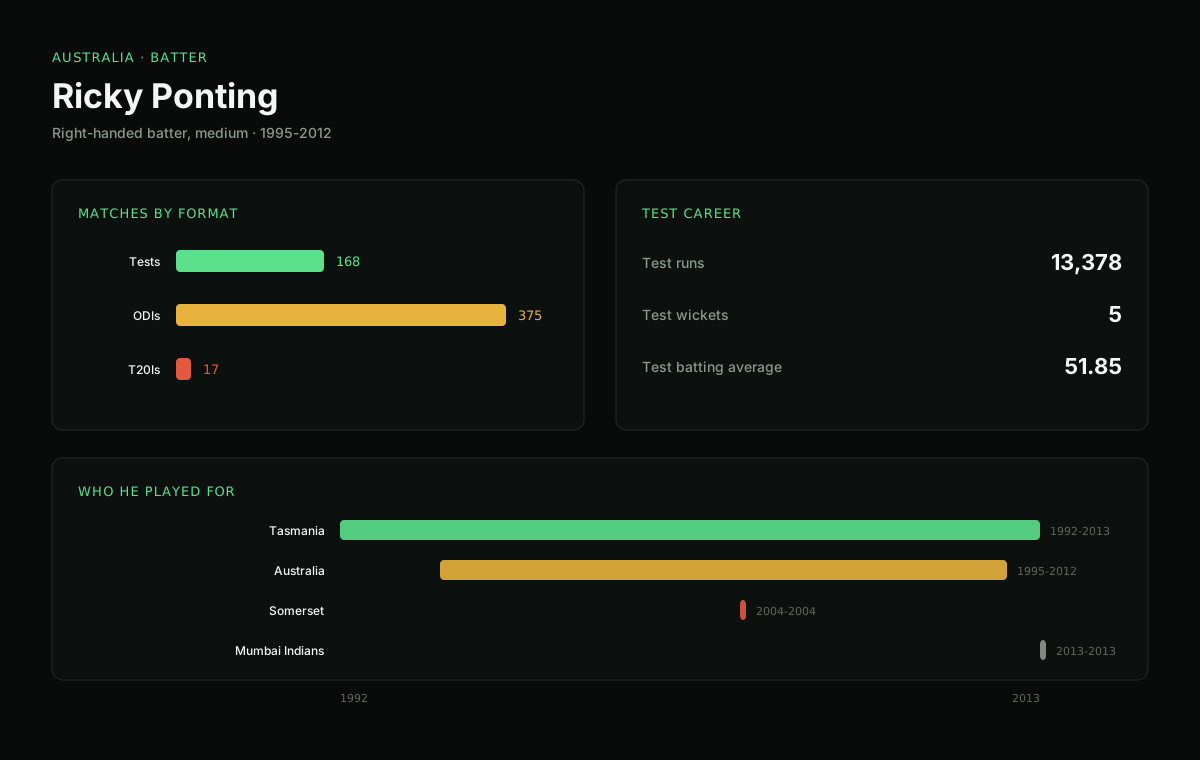
- 13,378 Test runs at 51.85, from 168 Tests
- 41 Test centuries, the most by an Australian
- Captained Australia to two World Cups and 48 Test wins
- Also lost three Ashes series, which is the number people quote
The record
| Format | Matches | Runs | Average | Span |
|---|---|---|---|---|
| Tests | 168 | 13,378 | 51.85 | 1995-2012 |
| ODIs | 375 | 13,704 | 42.03 | 1995-2012 |
The full record is on his player page.
The batting
He was, in his best years, the most destructive front-foot player of pace in the world.
The pull shot is the one everybody remembers: a short ball met early, in front of square, hit flat and hard off the front foot, which is a shot most batters play off the back foot and defensively. It was the reason bowlers found the short-ball plan against him unprofitable, and it forced them to pitch up into an area where he drove.
The peak was roughly 2002 to 2006. In that period he scored heavily in every country and against every attack, and the figures are as good as any batter of the era including Tendulkar and Lara.
His record after the 2005 Ashes is more uneven, and the last three or four years are a decline that was public and prolonged — which is what happens to batters who play until 37 and is not held against most of them.
The captaincy
He captained Australia in 77 Tests and won 48, which is a win rate over sixty per cent, and in two winning World Cup campaigns in 2003 and 2007.
The complication is that he inherited the strongest side any country has assembled: Warne, McGrath, Gilchrist, Hayden, Langer, Gillespie, Lee, Martyn, and later Clarke. Captaining that team was a job in which winning was the expectation and any defeat was a failure.
He then lost three Ashes series — 2005, 2009 and 2010-11 — which is the statistic his critics quote, and it is a fair thing to raise and an incomplete way to judge him. Two of those series came after the retirements of Warne, McGrath, Gilchrist, Langer and Hayden inside about eighteen months, which is the largest simultaneous loss of quality any side has had to absorb.
The 2003 World Cup final
140 not out from 121 balls against India in the final at Johannesburg, in an Australian total of 359.
It is the innings that defines his one-day career and one of the most dominant in a World Cup final. India, chasing 360, were never in it.
The context is that Australia won the tournament without losing a match, having done the same in 1999 and going on to do it again in 2007. Three consecutive World Cups, two of them under his captaincy.
The one-day record, which is close to the Test one
13,704 one-day runs at 42.03, from 375 matches, with 30 centuries.
That is the second-highest one-day aggregate in history and it gets discussed far less than the Test record, partly because Australia won so consistently that individual contributions blurred together.
He batted at three in that format as well, which in the Australian side of the period meant walking in at 60 for 1 after ten overs with the fielding restrictions just lifted, and being expected to bat through to the fortieth. He did it for a decade.
The fielding
He was among the best fielders of his generation and it is the part of the record that leaves no trace.
Point and cover, with a flat, fast throw and an unusually high rate of direct hits. Australia's fielding standard through that era was the highest in the world and he set a large part of it, in a period when fielding was becoming a selection criterion rather than a bonus.
Country, role and the span narrow it. The Tests and runs columns finish it against two team-mates.
Ricky Ponting — Captained Australia to two World Cups and finished second only to Tendulkar in Test runs. Full record
The 2005 Ashes
The series he is judged on most harshly is worth looking at properly, because his own performance in it was not the problem.
He scored 156 at Old Trafford, batting more than seven hours, to save a Test Australia were losing. It is one of the great rearguard innings and it happened in the middle of the series everybody remembers him losing.
England won 2-1 with a bowling attack — Flintoff, Harmison, Hoggard, Jones — that executed a reverse-swing plan Australia had no answer to, and with a batting order that scored fast enough to force results. The Australian side was ageing and the English one had been built specifically for that series over four years.
Losing it was a genuine failure and it was a failure of a team, not of a captain's tactics or of his batting. The subsequent 5-0 in 2006-07 is usually mentioned less.
Where the runs came from
The distribution is worth stating because it answers part of the context argument.
He scored Test centuries in every country that played Test cricket during his career except Bangladesh and Zimbabwe, including in India, England, South Africa and the West Indies. A batter who only scored at home would show it in the splits and he does not.
His record against the strongest attack of the era — India's, and England's in 2005 — is good rather than exceptional, which is true of nearly everybody.
What the record does not settle
The argument about him is whether the runs are diminished by the side he played in, and the honest answer is that it cuts both ways.
Batting at three for a team that regularly scored 500 means flat pitches, tired attacks and a great many innings begun at 100 for 1. That is easier than the situation Lara or Tendulkar batted in.
It also means a substantially higher standard demanded, a captaincy carried for seven years, and a decline played out in public against sides that had improved while his had aged.
The batting figures are the third-best of that generation and were built partly in easier circumstances. Both halves of that sentence are true.
- 48 Test wins from 77
- Two World Cups
- Three lost Ashes series
- A win rate over sixty per cent
- The side he inherited was the best ever assembled
- Both won by teams that lost no matches at all
- Two of them after five retirements in eighteen months
- Whether anybody else would have done better
Where he sits in our dataset
Difficulty tier 1 on the player list. Australia, batter, 1995 to 2012 is a narrow field, and the Tests column at 168 closes it against Steve Waugh, who has the same number.
That collision is one of the more satisfying ones in the dataset: two Australian batters with 168 Tests each, separated only by the runs column and the role.
- 13,378 Test runs at 51.85 and 41 centuries, the most by an Australian
- The pull shot off the front foot was the defining stroke
- 48 Test wins as captain, and three lost Ashes series
- 140 not out in the 2003 World Cup final, in a side that lost no match in three tournaments
The short version
He was the best batter in the world for about four years and captained the best side in history for about six, which are two achievements that make each other harder to evaluate. The runs are second only to Tendulkar's, and the argument is entirely about context.
For his opposite number in that era, see Sachin Tendulkar by the numbers, and for the attack he captained, Glenn McGrath by the numbers.