Allan Border by the numbers, and the side he had to rebuild
11,174 Test runs at 50.56, scored mostly for an Australian team that was the worst it has ever been, which he then captained back to the top.
Allan Border took over an Australian side that had lost most of its best players to World Series Cricket and to rebel tours, captained it for a decade while it was frequently poor, and handed over a team that then won everything for fifteen years.
- 11,174 Test runs at 50.56, from 156 Tests
- 93 consecutive Tests, which is the record for an unbroken sequence
- Captained Australia in 93 Tests, more than anybody had before
- The 1989 Ashes, won 4-0, is where the rebuild became visible
The record
| Format | Matches | Runs | Average | Span |
|---|---|---|---|---|
| Tests | 156 | 11,174 | 50.56 | 1978-1994 |
| ODIs | 273 | 6,524 | 30.62 | 1979-1994 |
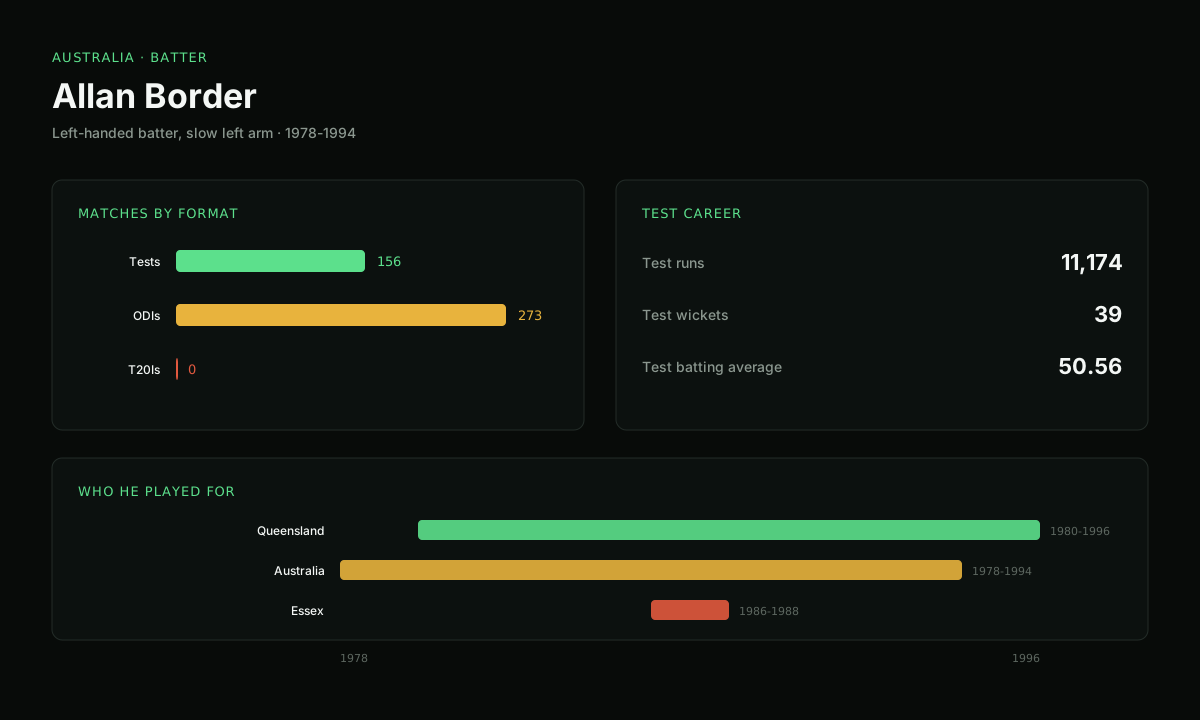
The full record is on his player page.
The side he inherited
Australian cricket in the early 1980s was in the worst state it has been in.
World Series Cricket had taken the best players out of the official game and the settlement had not restored the depth. A South African rebel tour then removed several more. The side that Border captained from 1984 lost series to West Indies, England, New Zealand and India, and there was no obvious replacement generation.
Border averaged over fifty through all of it. A batter scoring at that rate in a side being beaten regularly is doing something structurally different from one scoring in a strong team: fewer flat pitches, more innings starting at 30 for 3, and more matches in which a hundred does not change the result.
The 93 consecutive Tests
He played 153 consecutive Test matches at one stage, which is the record for an unbroken run, and it covers eleven years.
That number is worth pausing on. Eleven years without missing a Test through injury, form, rest or selection, in an era before workload management, playing every match his country played.
The captaincy overlapped almost all of it: 93 Tests in charge, which was the record when he stopped.
The rebuild
What he actually did as captain was change the culture, and the specific mechanism is well documented.
He was, by his own account and everybody else's, a nice cricketer who decided to stop being one. From about 1986 the side became noticeably harder — less friendly with opponents, more aggressive in the field, less willing to accept defeat as normal — and Border was open that the change was deliberate and that he disliked doing it.
At the same time Bob Simpson was appointed coach and a genuine training and selection structure was built, young players were picked and kept, and the side stopped changing after every defeat.
The 1987 World Cup, won against expectation, was the first evidence. The 1989 Ashes, won 4-0 in England, was the proof.
What he handed over
The side Mark Taylor inherited in 1994 contained Warne, McGrath, the Waugh brothers, Healy, Boon and Slater, with Ponting and Gilchrist to follow.
That team went on to win sixteen consecutive Tests and to be the strongest side in the history of the sport. Border played in almost none of the good years: his captaincy ended just before the results arrived.
It is the clearest example in cricket of a captain doing the work and somebody else collecting the return, and Border has been consistently gracious about it.
The batting
A left-hander with a compact, low-backlift method built for occupation rather than for scoring quickly.
He was among the best players of spin of his era and he was exceptionally difficult to dismiss when the situation required it. The two innings usually cited are 98 not out and 100 not out in the same Test at Port-of-Spain in 1984, batting through almost the entire match while Australia lost eight wickets around him.
His overall strike rate was low and the criticism at the time was that he was too defensive. The response is that a side losing regularly does not need somebody attacking; it needs somebody who does not get out.
Country and role narrow it. The span from 1978 to 1994 finishes it.
Allan Border — Held Australian cricket together through its worst decade and won the 1987 World Cup. Full record
The one-day record
6,524 runs at 30.62, plus the 1987 World Cup, which Australia won against India and Pakistan in the subcontinent as clear outsiders.
The one-day average is ordinary and the format did not suit him. What the 1987 tournament established was that the side could win something, which for a group that had lost consistently for five years was the point of it.
The fielding, and the bowling
He took 156 Test catches and 39 wickets with left-arm orthodox spin, and both are footnotes that describe the same thing: he did whatever the side needed.
The bowling was genuine part-time — he took 7 for 46 and 4 for 50 in a Test against West Indies at Sydney in 1989, which are figures no recognised part-timer produces and which he never repeated.
The catching was at slip and in the ring, for sixteen years, in a side that dropped a great many catches around him.
The captaincy record, plainly
93 Tests, 32 wins, 22 defeats, 38 draws.
Those are not the figures of a great captaincy record and they are the figures of a captain who spent the first half of the job without a bowling attack. Australia won seven of his first fifty Tests in charge and twenty-five of the last forty-three.
The turning point is identifiable: the 1989 Ashes, won 4-0 in England with Terry Alderman taking 41 wickets and Mark Taylor scoring 839 runs. From that series until he retired, Australia lost two series.
The trophy
The Border-Gavaskar Trophy, contested between Australia and India, is named for him and for Sunil Gavaskar, and it was instituted in 1996.
Naming a bilateral series after two players who never captained against each other is unusual and is a fair reflection of what both did: each of them was the batting record of a side that was not otherwise strong, for a decade, in an era when their countries mostly lost away from home.
- 11,174 runs at 50.56
- 93 Tests as captain
- 153 consecutive Tests
- No great results
- Scored for a side that was frequently beaten
- Most of them without the players to win with
- Eleven years without missing one
- A team handed over that won everything for fifteen years
Why the record is hard to place
Comparing him with the batters he is usually listed alongside runs into a problem nobody has solved.
Border, Gavaskar and Chanderpaul all averaged around fifty for sides that were frequently losing. Ponting, Sangakkara and Kallis averaged around the same or better for sides that were frequently winning. The averages are close and the tasks were not the same.
There is no accepted adjustment. What can be said is that the batters in the first group played more innings in the fourth innings, more with the score under fifty, and more in matches where a hundred did not produce a win — and that all three of them averaged fifty anyway.
Where he sits in our dataset
Difficulty tier 1 on the player list. Australia, batter, 1978 to 1994 has one answer, and the Tests column at 156 confirms it.
- 11,174 Test runs at 50.56, mostly for a losing side
- 153 consecutive Tests, an unbroken run of eleven years
- He deliberately changed the side's culture and disliked doing it
- The team he handed over won sixteen consecutive Tests without him
The short version
He batted at fifty for a decade in a side that could not win, changed how it behaved, and handed over the strongest team the sport has produced. The individual record is excellent and the more significant achievement has no column at all.
For the side that came out of it, see Steve Waugh by the numbers, and for the dispute that emptied Australian cricket in the first place, World Series Cricket.