The yorker, and why the best delivery is the hardest to land
The target is a strip of ground about a foot deep at the base of the stumps. A foot either side and it is the easiest ball in cricket to hit.
There is one delivery in cricket that a set batter cannot do much with, and it has a margin for error of roughly a foot. Everything about death bowling follows from that ratio.
- A yorker lands at the base of the stumps, under the bat
- A foot short is a half-volley; a foot full is a low full toss
- Both failures go for four, which is why the risk is so high
- It is still bowled, because when it lands there almost nothing can be done
What a yorker is
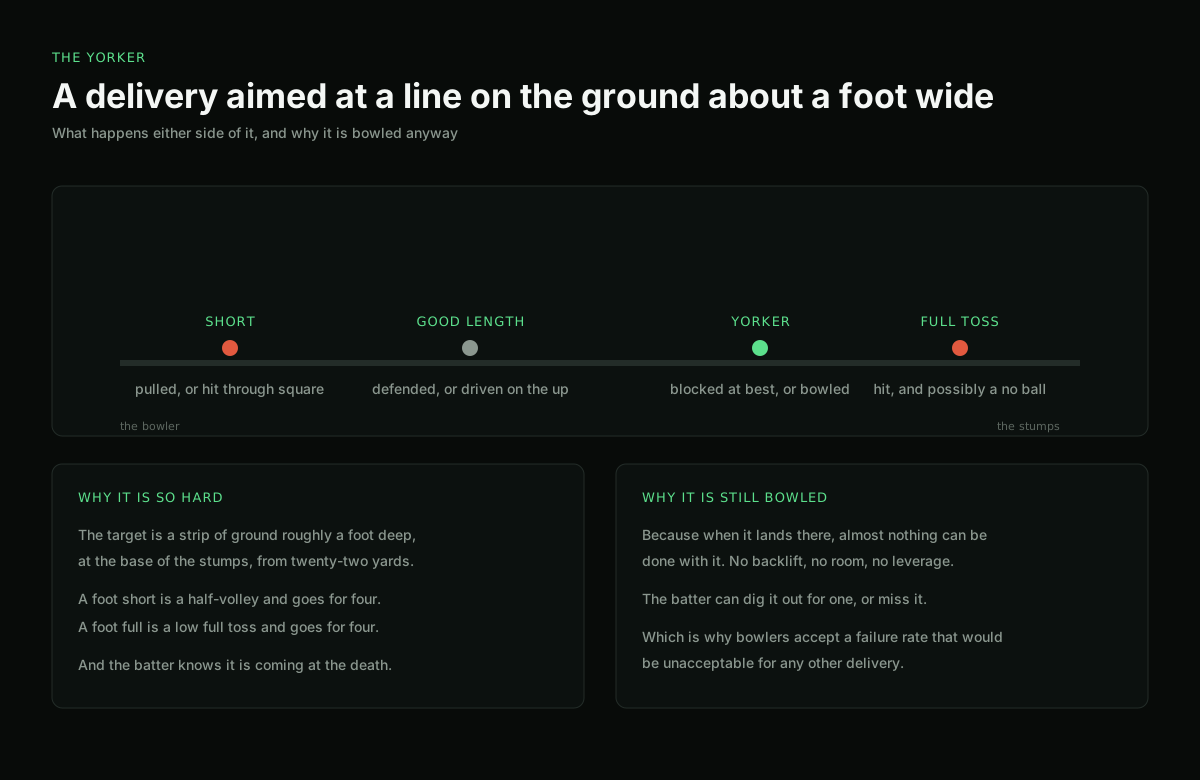
A yorker is a delivery pitching at or very near the batter's feet, at the base of the stumps. The ball arrives under the swing of the bat, in the space where the batter has no backlift available and no room to generate power.
The batter's options are limited and unattractive. They can jam the bat down on it and squeeze a single. They can attempt to dig it out and mistime it. They can miss it and be bowled. Almost nothing else is available, which is the whole point.
Why it is so hard
The target is a strip of ground about a foot deep, delivered from twenty-two yards away at eighty-five miles an hour, by somebody whose front foot has to land within an inch of a line.
A foot short and the ball becomes a half-volley: full enough to drive, short enough for the batter to swing through it, and it goes straight over the bowler's head.
A foot full and it is a low full toss: no bounce to beat, arriving at the easiest height for a horizontal-bat shot, and if it is above the waist it is also a no-ball.
Both failures produce a boundary. There is no such thing as a slightly wrong yorker that costs a single.
| Length | What the batter can do | Typical outcome |
|---|---|---|
| Short | pull, or cut | four, or a top edge |
| Good length | defend, or drive on the up | a single |
| Yorker | dig it out | a dot or a single |
| Low full toss | swing through the line | four, and possibly a no-ball |
Why it is bowled anyway
Because the successful version is close to unplayable, and in the last four overs the alternative is worse.
A good-length ball to a set batter in the nineteenth over will be hit somewhere. The batter has a full swing available, the field cannot be improved, and the shot is premeditated. The expected outcome is six to eight runs an over from good-length bowling.
A yorker that lands is a dot or a single. If a bowler lands four of six, the over costs six or seven; if they land two, it costs fourteen. The variance is enormous and the expected value is still better than the alternative, which is why bowlers accept a failure rate they would never tolerate at any other point in an innings.
What changed about it
For a long time the yorker was the answer and the good exponents could land it at will. Then batters worked out how to attack it.
The scoop and the ramp take a yorker over the keeper. The batter gets under it and uses the pace rather than fighting it, which turns the safest delivery in cricket into a boundary behind the wicket.
The premeditated step to leg creates room to swing at a ball aimed at the toes, and if the bowler follows the batter he is now bowling a full toss down the leg side.
Better bats mean a yorker jammed out with the toe of the bat now clears the infield more often.
The response has been variation. Modern death bowling is a sequence — wide yorker, slower bouncer, yorker at the stumps, hard length — chosen against what the batter has just shown. The yorker is still the best ball in the set and it is no longer the only one.
Where else it is used
The death overs are where it lives, and there are three other situations where it appears.
To a new batter, first ball. A batter who has not faced anything yet has no sense of the pace, and a yorker gives them nothing to work with.
To a tail-ender, at any point. The yorker is the fastest route through a number ten, because a batter without footwork cannot get down to it.
With an old ball that is reversing, in a Test. Reverse swing at the toes is close to impossible to keep out, and it is where the great reverse-swing spells have taken their wickets.
A bowler aims for a yorker and lands the ball a foot short. What has the batter received?
A yorker a foot short is a half-volley: full enough to drive and short enough to give the batter a full swing. It is one of the easiest deliveries in cricket to hit, which is what makes attempting the yorker so risky.
- Almost unplayable when it lands
- No backlift available to the batter
- Works against every kind of batter
- The best ball in death bowling
- Four runs when it does not
- The scoop turns it into a boundary
- The batter knows it is coming at the death
- Two failures in an over cost the match
The wide yorker, and why it took over
The version bowled most often at the death is not aimed at the stumps at all.
A wide yorker lands full and outside off stump, sometimes a foot outside, and it asks the batter to reach for it. Reaching means no leverage and no control over direction, and the shot usually goes to a fielder on the off side or to third man off the edge.
Its advantage over the straight yorker is the failure mode. A straight yorker missed by a foot short is a half-volley on the stumps, which is the easiest ball in cricket to hit straight. A wide yorker missed by a foot short is a wide half-volley, which is still difficult to hit for six because the batter has to reach.
Its cost is that missing it in the other direction is a wide: a run and another ball. Bowlers therefore aim to be just inside the tramline rather than on it, which is another foot of precision on top of the length.
How to bowl one
The technical elements, briefly, because they explain why some bowlers can and most cannot.
A consistent front-foot landing. The release point is fixed relative to where the front foot lands, so a bowler whose stride varies by six inches cannot land a yorker repeatedly.
A late release. The ball is let go slightly later than for a good-length delivery, which is a timing adjustment of a few hundredths of a second.
Full follow-through. Bowlers who pull out of the action to aim tend to bowl full tosses, because the arm decelerates and the ball is released early.
The bowlers who land them consistently are almost always the ones with the most repeatable actions rather than the fastest ones, which is why the great death bowlers are not usually the quickest in their sides.
- The target is a foot deep at the base of the stumps
- Both failure modes go for four, so there is no safe miss
- The scoop and the ramp changed it from an answer to an option
- Repeatability of action matters more than pace for landing one
The short version
The yorker is the only delivery a set batter genuinely struggles to score from, and it has a margin of about a foot. Bowlers attempt it anyway because the alternative against a batter with a full swing is worse.
For the phase where it matters most, see death bowling and what makes it hard, and for the deliveries that share the over with it, slower balls explained.