Muttiah Muralitharan by the numbers, and the 800
800 Test wickets, which is 92 more than anybody else, taken by a bowler whose action was tested three times and cleared three times.
Muttiah Muralitharan took 800 Test wickets. The next-highest total is 708. That gap is larger than the entire career of most successful Test bowlers, and it was built during a decade in which his action was one of the most argued-about subjects in the sport.
- 800 Test wickets at 22.72, from 133 Tests
- 92 more than the next bowler on the list
- 534 one-day wickets, also a record
- His action was tested in laboratories three times and cleared each time
The record
| Format | Matches | Wickets | Average | Span |
|---|---|---|---|---|
| Tests | 133 | 800 | 22.72 | 1992-2010 |
| ODIs | 350 | 534 | 23.08 | 1993-2011 |
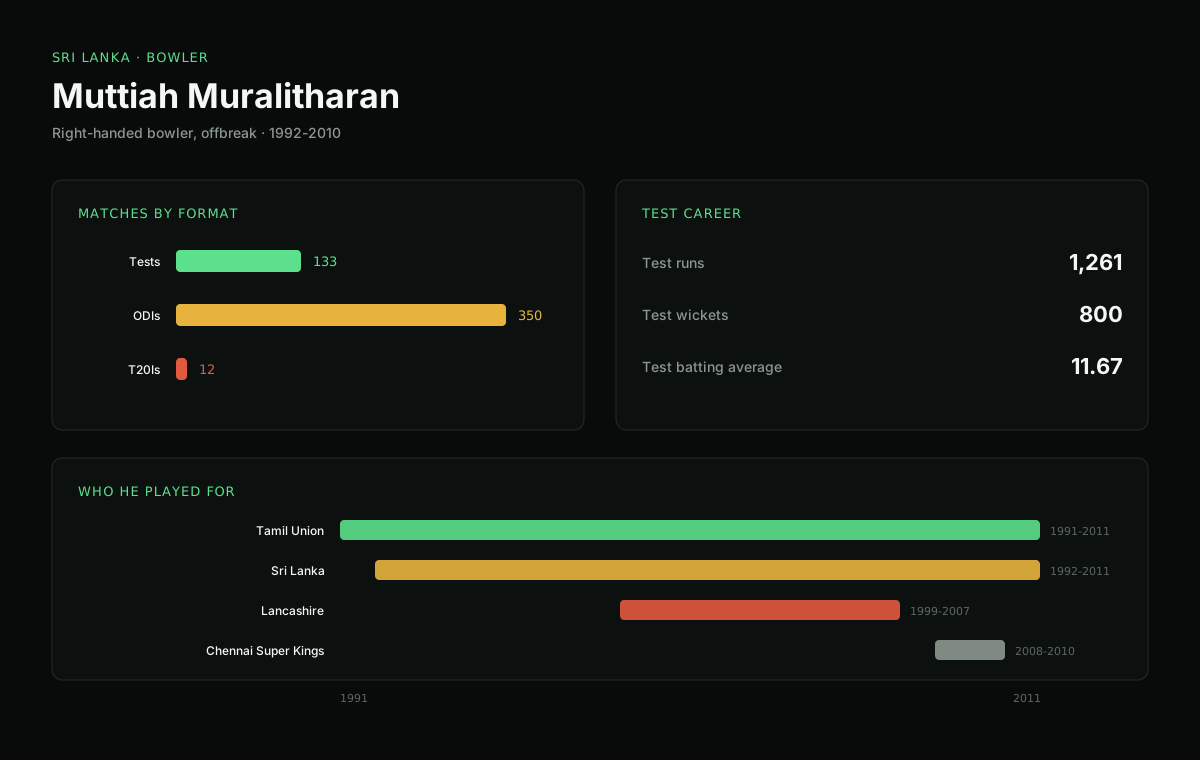
The full record is on his player page.
Six wickets a Test
The rate is the part people underrate. 800 wickets from 133 matches is an average of six per Test, sustained for eighteen years.
For comparison, taking five wickets in an innings is a notable achievement that gets a name on an honours board. He did it 67 times. He took ten in a match 22 times. Both are records and both are some distance clear of second place.
The average of 22.72 is the number that makes the total meaningful. A bowler who accumulates wickets over a long career at 32 has taken a great many wickets expensively; at 22.72 the wickets were cheap as well as numerous.
What made him different
Two things, and the second is the more important one.
An extraordinary wrist. A congenital condition means his arm cannot fully straighten, and his wrist has an unusual range of rotation. That combination let him impart revolutions on the ball that finger-spinners do not normally generate, and it is why his off break turned so far.
The doosra, from an off-spinner's action. He turned the ball both ways with no visible change, which removed the batter's ability to play him off the pitch. A finger-spinner who can only turn it one way can be played with the spin; one who turns it both ways cannot.
The combination meant a batter facing him had to read the hand, and his hand was unusually difficult to read.
The action, and the testing
His action was called for throwing in 1995 and again subsequently, and it became the longest-running technical controversy in modern cricket.
He was tested three times in biomechanics laboratories, with markers on the arm and high-speed cameras, bowling every delivery in his repertoire at match pace. He was cleared each time.
The testing also produced the finding that changed the Law. Researchers measuring a range of bowlers found that almost everybody straightens the elbow to some degree, including fast bowlers nobody had ever questioned, and that the naked eye cannot detect straightening below about fifteen degrees. The fifteen-degree tolerance in the current Laws comes out of that work.
His congenital arm condition is central to the whole subject: an arm that cannot straighten looks bent throughout the action, which is exactly what a throw looks like to an observer, and is not one.
There is one more piece of context that is easy to miss. For most of his career Sri Lanka's second spinner was not close to his standard and the pace attack rarely had a strike bowler, which meant batters could see off the other end and wait. A bowler taking 800 wickets while the opposition is deliberately playing out the overs at the other end is doing something different from one operating in a strong attack.
Bowling for Sri Lanka
The context matters and it cuts in a direction people do not expect.
Sri Lanka played substantially less Test cricket than Australia, England or India during his career, and he still reached 800. The number of matches available to him was smaller than to his rivals, which makes the total more impressive rather than less.
He also bowled enormous quantities within those matches. A Sri Lankan side without a deep pace attack used him from both ends of a session, on pitches that suited him and pitches that did not, for spells of thirty overs. That workload is part of the total and part of why nobody else has approached it.
The wickets column here does not need any other clue at all.
Muttiah Muralitharan — Eight hundred Test wickets, more than anyone, and he took the last one with his final delivery. Full record
The one that gets forgotten
534 one-day international wickets, also a record, also clear of second place.
Leg-spin and off-spin were considered luxuries in one-day cricket for most of his career, and he bowled ten overs in the middle of an innings for an economy rate under four for eighteen years. That is a completely different skill from taking wickets in a Test, and he holds the record for it too.
The 2011 World Cup final was his last international match. He was 39, was injured during it, and Sri Lanka lost.
- The action looked illegal
- He was called for throwing
- The doosra was the problem
- Fifteen degrees was invented for him
- The arm cannot fully straighten, congenitally
- Three laboratory tests cleared him
- It was tested with everything else and cleared
- It was measured across many bowlers and applies to all
The comparison with Warne
The two arrived within months of each other, retired within three years of each other, and the argument about them has never resolved because they are not the same kind of bowler.
Murali took more wickets, at a lower average, in fewer matches. On the figures alone it is not close.
The counter-arguments are two. He bowled a substantial share of his overs in Sri Lanka on surfaces that suited him, against sides that struggled with spin; and a disproportionate number of his wickets came against the weaker Test nations of the period.
Both are true and both are partially answered by his record in Australia, England and South Africa, which is good rather than outstanding.
The honest summary is that Warne bowled in a stronger side with a better supporting attack and took his wickets in harder circumstances; Murali took far more of them, more cheaply, with less help at the other end. Neither of those sentences settles anything, which is why the argument continues.
The workload nobody else carried
The overs are the part of the record that gets least attention and explains most of it.
He bowled more than 44,000 deliveries in Test cricket, from both ends, in every session, for eighteen years. Sri Lanka had no pace attack capable of taking twenty wickets, so the plan in most matches was to bowl Murali and hold on.
That is a physical achievement as much as a technical one. Fast bowlers break down; spinners wear out shoulders and fingers, and the ones who bowl that many overs usually lose their edge in their thirties.
His most productive years were his thirties.
Where he sits in our dataset
Difficulty tier 1 on the player list, and the fastest puzzle to close in the entire dataset once the wickets column appears. Eight hundred is not a number anybody else has.
He is also one of the few players where the aliases matter, because the spelling of his name is genuinely difficult and a great many people who know exactly who he is cannot produce it correctly on a first attempt.
- 800 Test wickets at 22.72, from 133 matches, which is six a Test
- 67 five-wicket hauls and 22 ten-wicket matches, both records
- A congenital arm condition, three laboratory clearances, and a Law written from the research
- 534 ODI wickets, also a record, also mostly forgotten
The short version
The total is so far clear of second place that it distorts the list, and it was taken by a bowler playing for a country with fewer Tests to play in than any of his rivals. The controversy produced the biomechanical research the Laws now rest on.
For how the delivery at the centre of the argument works, see what a doosra is, and for the board he sits at the top of, most Test wickets of all time.