Mahela Jayawardene by the numbers, and the 374
11,814 Test runs at 49.84, including a 374 in the highest partnership in the history of the game, from a batter who scored most heavily where the ball turned.
Mahela Jayawardene scored 11,814 Test runs and holds a share of the highest partnership in the history of Test cricket. He is also the second name in almost every sentence about Sri Lankan batting, which is the recurring theme of the career.
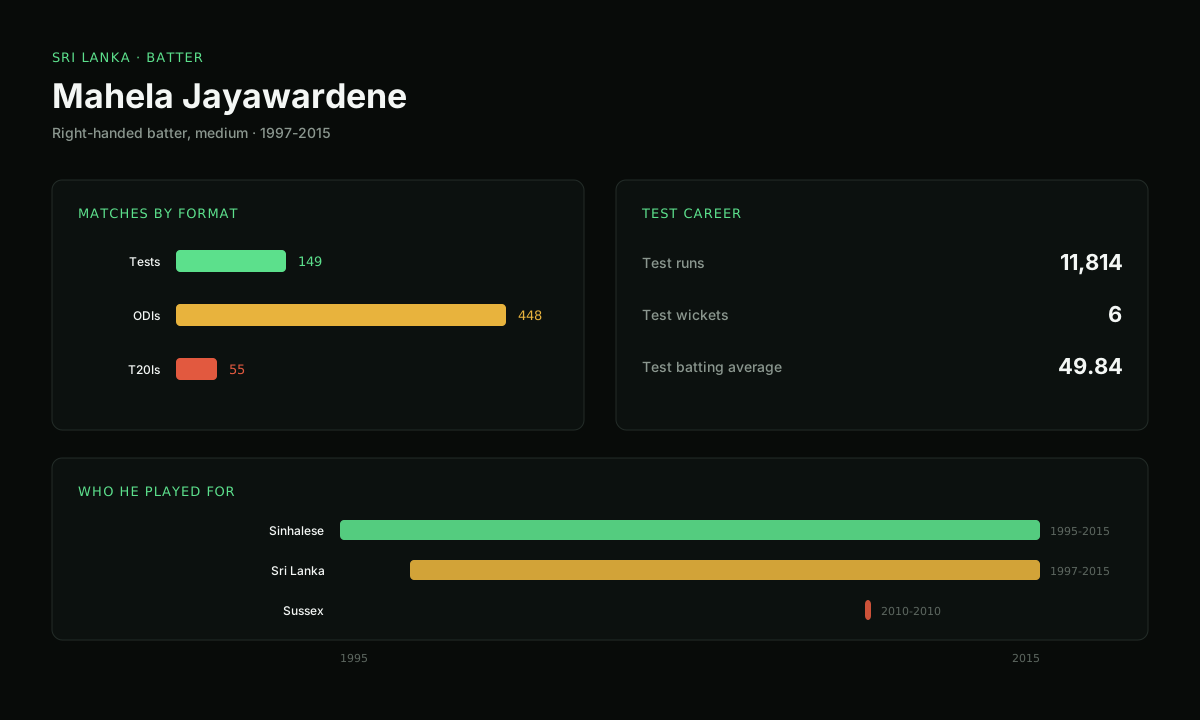
- 11,814 Test runs at 49.84, from 149 Tests
- 374 against South Africa in 2006, in a partnership of 624 with Sangakkara
- 448 one-day internationals, the second-most by anybody
- He captained Sri Lanka to a World Cup final and a World T20 final, losing both
The record
| Format | Matches | Runs | Average | Span |
|---|---|---|---|---|
| Tests | 149 | 11,814 | 49.84 | 1997-2014 |
| ODIs | 448 | 12,650 | 33.37 | 1998-2015 |
The full record is on his player page.
The 374
Colombo, July 2006, against South Africa. Sri Lanka were 14 for 2.
Jayawardene made 374 and Kumar Sangakkara 287. Their partnership of 624 for the third wicket is the highest for any wicket in the history of Test cricket, and it lasted more than two days of playing time.
The 374 is the fourth-highest individual Test score. It is also, and this matters, the highest score by anybody batting at four or lower.
The home record
His home average is substantially higher than his overseas one, and the split is larger than for most batters of his standing.
The explanation is spin. Sri Lankan pitches turn, and he was among the best players of spin of his generation — using his feet constantly, playing very late, and scoring square on both sides against turn. In conditions where the ball moved sideways off the seam rather than off the pitch, he was good rather than exceptional.
That is a real limitation and it is also the shape of most subcontinental batting records before the 2010s. The batters who averaged the same home and away in that era are a very short list.
The 2007 World Cup final, played in Barbados, finished in near-darkness in circumstances that were farcical: the umpires miscounted the overs, the players were brought back for three balls that could not be seen, and the trophy was presented on a ground where nobody could see the pitch. Sri Lanka had lost by then, on Duckworth-Lewis, and the ending is remembered as a piece of administration rather than as a match.
The captaincy
He captained Sri Lanka in 38 Tests and led them to the 2007 World Cup final and the 2009 World T20 final, both of which they lost.
Sri Lanka in that period were consistently among the best three or four sides in the world and consistently lost the last match of tournaments. Between 2007 and 2011 they reached four global finals and lost all four, which is a record no other side has.
He handed the captaincy back to Sangakkara and then took it again, which was normal for Sri Lankan cricket at the time and had more to do with board politics than with results.
He also has the unusual distinction of having scored a hundred in a World Cup final and a fifty in a World T20 final, in matches seven years apart, one lost and one won.
The one-day record
12,650 runs from 448 matches, which is the second-highest number of one-day internationals anybody has played.
The average of 33.37 is modest and the strike rate is good, and both reflect a role: he batted at four or five in a side whose openers scored quickly, and he was frequently rebuilding after a collapse or accelerating at the death.
He scored 103 not out in the 2011 World Cup final, batting through the innings, in a match Sri Lanka lost. Scoring a hundred in a World Cup final and losing is a specific kind of career footnote and it is the second time it happened to a Sri Lankan.
The partnership
He and Sangakkara batted together across fifteen years and are the most productive partnership in the history of Test cricket by aggregate runs.
The two of them were different players: Sangakkara compact and orthodox, Jayawardene wristier and more improvisational. They also complemented each other in the way the best pairs do, running exceptionally well between the wickets and rotating strike without discussion.
Sri Lanka's best period as a Test side is almost exactly the period the two of them batted together.
Country and role narrow it. The ODI column at 448 separates him from one team-mate.
Mahela Jayawardene — 374 against South Africa, and a stand of 624 with Sangakkara. Full record
Batting at four
He batted at four for most of his career, and the position matters for reading the average.
Number four in a Test side arrives either at 20 for 2 against a new ball or at 150 for 1 against a soft one, and the ratio between those two situations is decided by the openers. Sri Lanka's openers in that period were inconsistent, which meant a disproportionate share of his innings began early.
The 374 came at 14 for 2. That is the situation the position produces, and converting it into the fourth-highest individual score in Test history is the strongest single entry in his record.
The T20 career
55 T20 internationals, and he opened the batting in the format for Sri Lanka in a way that was unusual for a Test number four.
He top-scored in the 2014 World T20 final with 24 from 22 balls, in the match Sri Lanka finally won, and retired from the format immediately afterwards alongside Sangakkara. The two of them leaving together on the day they won something is one of the more deliberate exits in the sport.
What he did afterwards
He became a coach, working with franchise sides and then internationally, and is one of the more sought-after coaches in T20 cricket.
The tactical reputation is consistent with the captaincy: analytical, calm, and focused on matchups rather than on motivation. Several of the players he has coached describe him in the same terms his team-mates did.
- 11,814 Test runs at 49.84
- The 374 and the 624 partnership
- Four lost global finals
- 448 one-day internationals
- A home average well above the overseas one
- Both of them in the same innings
- Sri Lanka reached all four
- Second only to Sachin Tendulkar
The catching
He took 205 Test catches, which is among the highest totals by a non-wicketkeeper, almost all of them at slip.
Slip catching to Muralitharan is a specific skill and not a comfortable one: the ball turns and bounces sharply, comes off the edge at unpredictable angles, and the fielder is standing much closer than for a fast bowler. He did it for fifteen years, and a substantial share of Muralitharan's 800 wickets went through his hands.
That is the sort of contribution that appears in a record as a number nobody reads, and it is worth reading here.
Where he sits in our dataset
Difficulty tier 1 on the player list. Sri Lanka, batter, 1997 to 2014 puts him next to Sangakkara, and the role and ODI columns separate them.
- 11,814 Test runs at 49.84, and the fourth-highest individual score
- The 624 partnership with Sangakkara, the highest for any wicket
- Four global finals as part of the side, all lost
- The most productive Test partnership in history, with the same team-mate
The short version
He scored 374 in the highest partnership ever recorded, played 448 one-day internationals, and reached four global finals without winning one. The Test record is excellent and the shape of it — outstanding at home, good away, always alongside Sangakkara — is why it is discussed less than it should be.
For the batter he is permanently paired with, see Kumar Sangakkara by the numbers, and for the list his 374 sits on, highest individual scores in Test cricket.