MS Dhoni by the numbers, and the parts that are not countable
Two world titles, a Test mace, and a finishing record built on a method — take it deep, then win it — that nobody has successfully copied.
MS Dhoni's statistics are good and are not the reason anybody remembers him. That is unusual for a player of his standing and it is the most interesting thing about the record.
- 90 Tests, 350 ODIs and 98 T20 internationals, as a keeper and captain
- The only captain to win the T20 World Cup, the ODI World Cup and the Test mace
- A finishing method built on taking chases as deep as possible
- His keeping was faster than anyone's and is barely reflected in any statistic
The record
| Format | Matches | Runs | Average | Span |
|---|---|---|---|---|
| Tests | 90 | 4,876 | 38.09 | 2005-2014 |
| ODIs | 350 | 10,773 | 50.57 | 2004-2019 |
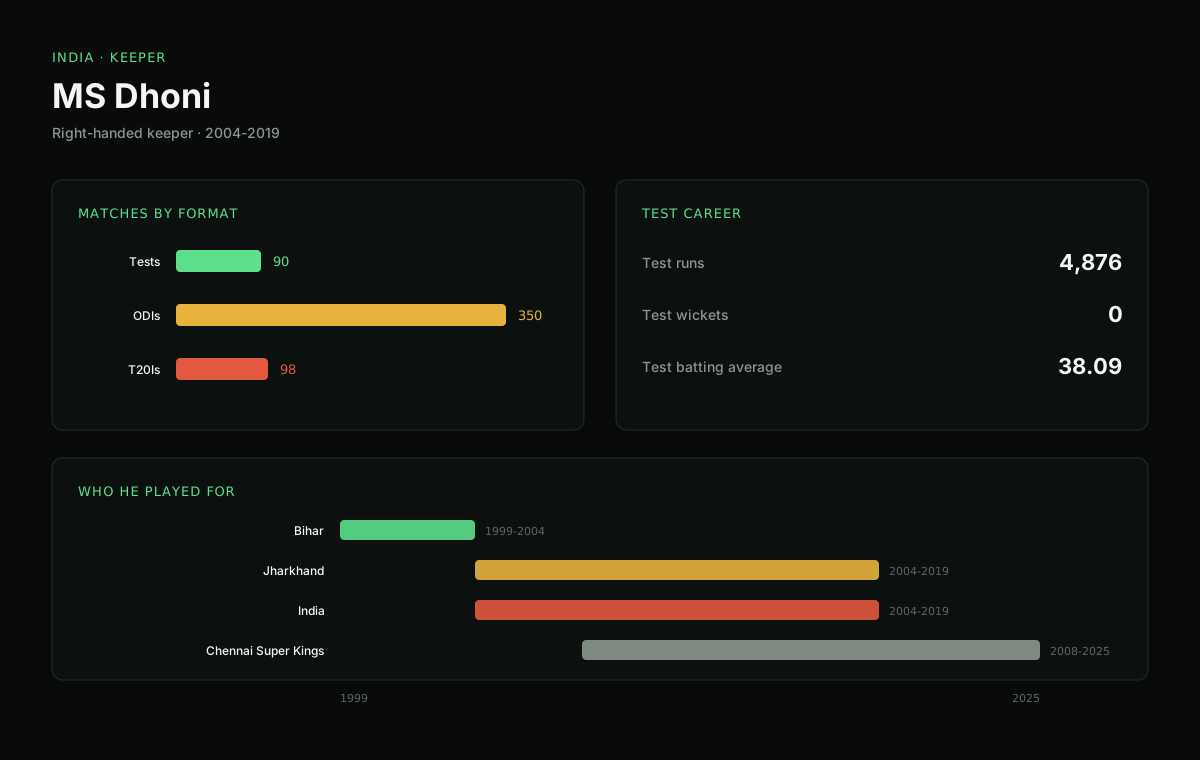
The full record is on his player page.
The ODI average nobody mentions
50.57, batting at five or six, as a finisher.
That figure is extraordinary and it is under-discussed because finishers are supposed to have low averages and high strike rates. A batter arriving in the thirty-fifth over of a chase is expected to take risks, get out often, and be judged on impact rather than accumulation.
He averaged over fifty doing it, which means he was both taking the risk and not getting out. The not-outs contribute — a finisher is unbeaten often — but the volume is too large for that to be the whole story.
The method
His approach to chases was consistent enough to be described as a method rather than a style, and it is the opposite of what modern coaching teaches.
He took chases deeper than anybody was comfortable with. Required rates climbed to nine, ten, eleven an over while he refused to accelerate, and then he finished it in the last three overs.
The theory behind it is defensible. Wickets in hand at the death are worth more than runs on the board earlier, because the last three overs can produce forty with wickets standing and fifteen without. Batting deep also transfers the pressure to the bowling side, who have to execute perfectly at the end rather than merely bowl well in the middle.
The reason nobody has copied it successfully is that it requires an unusual combination: the ability to hit boundaries to order at the death, the temperament to sit through the period where the required rate looks impossible, and a captain who will not tell you to get on with it.
The keeping
The part of his game that is genuinely hardest to find in any statistic.
His hands were the fastest in the world at the stumps, and his stumpings were frequently completed in a fraction of the time other keepers needed. Batters who lifted a back foot for an instant against spin were dismissed by a movement that looks, on replay, like it happened before the ball arrived.
Technically he was unorthodox. His footwork was not textbook, his glovework was described as untidy by purists for most of his career, and the results were better than the technique suggested they should be.
The countable part — dismissals — puts him high on the all-time lists. The uncountable part is that his presence changed how batters used the crease against Indian spinners, which is worth more than the numbers.
The captaincy
He captained India to the World T20 in 2007, the World Cup in 2011, the Champions Trophy in 2013, and to the top of the Test rankings.
His method was distinctive and was criticised for it. He was conservative in the field, preferring to defend a total rather than attack for wickets, and he was famously undemonstrative in a role where visible passion is expected.
The tactical signature was patience: setting fields for the mistake rather than the edge, using part-time bowlers to break partnerships, and accepting singles to protect the boundary. It won a great deal and it produced a persistent argument that he was too defensive.
The Test record is the weaker part. India were dominant at home under him and poor away, and he stepped down mid-series in Australia in 2014 having decided he was no longer the right person for the format.
The role column narrows it hard, and the T20I number is the one that separates him from the other keepers in the dataset.
MS Dhoni — The only captain to win all three ICC white-ball trophies. Full record
The 2011 final
He promoted himself above an in-form Yuva Singh in the World Cup final, at 114 for 3 chasing 275, and made 91 not out to win it.
The decision was made in the middle, on the basis that Sri Lanka's spinner was turning the ball away from the left-hander and into him. It worked, and it would have been the subject of a decade of criticism if it had not.
That is the clearest single illustration of the way he captained: a decision made on a specific matchup, taken quietly, with the consequences accepted personally.
- An ODI average of 50.57
- 90 Tests as a keeper-batter
- Three global titles
- 4,876 Test runs at 38
- A method of chasing nobody else can execute
- The fastest hands at the stumps of his generation
- A captaincy style people argued about for a decade
- A Test record that was excellent at home and poor away
The retirement, and the way it happened
Both of them were characteristic and both were unusual.
He retired from Test cricket mid-series in Australia in December 2014, announcing it after the third Test with one to play. There was no farewell match, no announcement in advance, and no ceremony.
He retired from international cricket entirely in August 2020, via a social media post, more than a year after his last match. There was again no farewell.
That is not modesty for its own sake. It is consistent with how he captained: the decision is made, the consequences are accepted, and the discussion afterwards is somebody else's business. A player of his standing could have had a farewell Test at a full ground in either format and declined both.
What he changed about Indian cricket
Two things outlasted his playing career.
He normalised the keeper-batter as a top-order asset. India had picked keepers for keeping for decades. After Dhoni the position was expected to produce runs, and every Indian keeper since has been selected on that basis.
He came from outside the system. He grew up in Ranchi, played for Bihar and Jharkhand rather than a traditional cricketing state, and worked as a railway ticket inspector before being selected. That route into the national side was almost unheard of at the time and is now common enough that nobody remarks on it.
The second is the larger legacy and it has nothing to do with anything he did on a field.
Where he sits in our dataset
Difficulty tier 1 on the player list, and one of the few keepers in the dataset whose T20I column is large enough to identify him on its own.
He is also one of the players where the alias list matters most, because a substantial proportion of people know him only by the initials.
- An ODI average of 50.57 as a finisher, which should be discussed more than it is
- The method — take it deep, finish it late — has not been successfully copied
- His keeping speed changed how batters used the crease against Indian spin
- Three global titles as captain, and a Test record that did not travel
The short version
The numbers are good, the trophies are the record, and the thing that made him unusual is a way of chasing that requires temperament rather than technique. That is why he is difficult to write about statistically and easy to remember.
For the format his method was built for, see one-day international cricket explained, and for what a keeper is actually judged on, what a wicketkeeper is judged on.