Virat Kohli by the numbers, and the chase that defined him
An ODI average above fifty built almost entirely in run chases, plus a Test captaincy that made India believe they could win away from home.
Virat Kohli's one-day record is the most complete of the modern era and his Test captaincy changed something structural about Indian cricket. Those are two separate achievements and they are usually discussed as one.
- 9,230 Test runs at 46.85, from 123 Tests
- An ODI average above fifty, built disproportionately in run chases
- As Test captain, India won more away Tests than under anybody before
- He made fast bowling the priority for a country that had never prioritised it
The record
| Format | Matches | Runs | Average | Span |
|---|---|---|---|---|
| Tests | 123 | 9,230 | 46.85 | 2011-2025 |
| ODIs | 302 | 14,181 | 57.88 | 2008- |
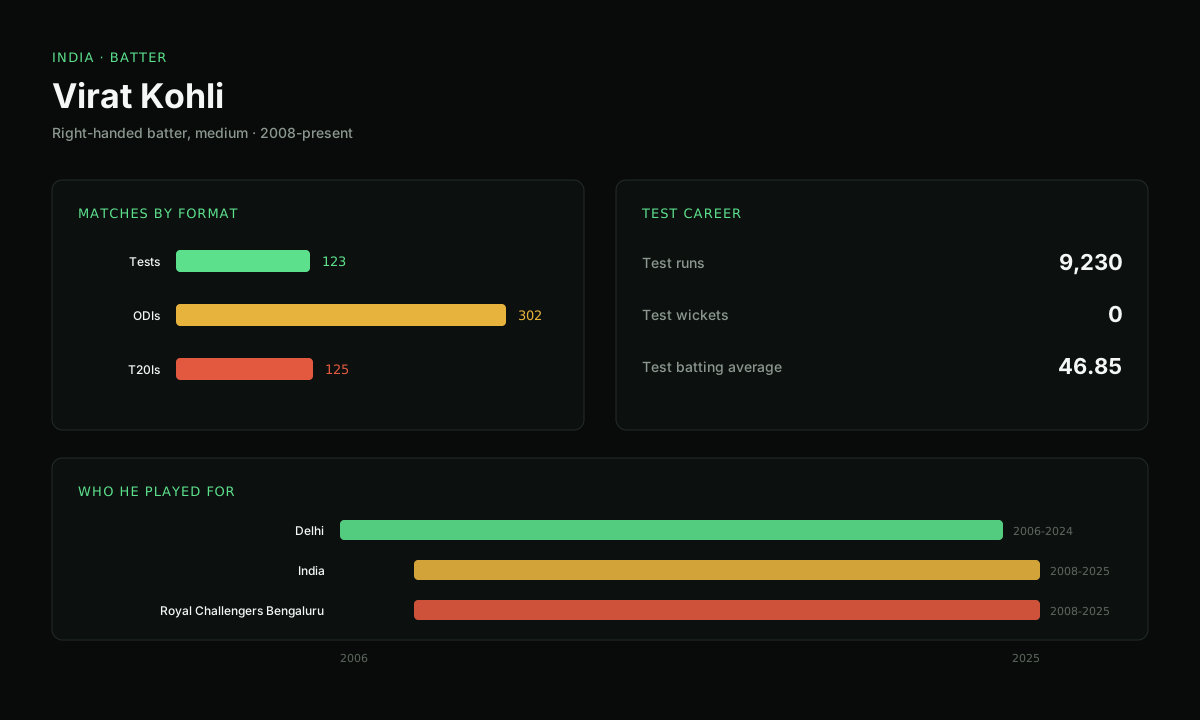
The full record is on his player page.
The chase record
The number that makes his one-day career unusual is not the overall average. It is the split.
He averages materially higher batting second than batting first, and the great majority of his one-day centuries have come in successful chases. That pattern is the opposite of most batters, who find setting a total easier because there is no required rate to manage.
The reason is a specific skill: pacing. A chase is an arithmetic problem with a constantly updating answer, and a batter who can hold the required rate at six an over for thirty overs and then move to eight without taking excessive risk is solving it continuously. He did that as reliably as anybody has.
The corollary is that his innings frequently look unspectacular until the end. A hundred off 110 balls in a chase of 300 contains almost no risk and almost no memorable shots, and it wins the match.
The Test career
9,230 runs at 46.85 is a very good Test record. It is not, on the numbers, the equal of his one-day one, and the shape of it explains why.
The peak years were 2016 to 2019, in which he scored heavily everywhere including Australia, England and South Africa. That period is as good as any modern batter's.
The years after it were substantially leaner, with a long gap without a century, and the career average carries both periods. A batter whose figures are split into an outstanding period and an ordinary one finishes with a number describing neither, which is a general problem with career averages and a specific one here.
The 2014 tour that changed him
His first tour of England, in 2014, produced 134 runs in ten innings at 13.40. James Anderson dismissed him four times, all in a corridor outside off stump, and the technical flaw — a front foot that pushed hard at the ball, leaving a gap between bat and pad — was diagnosed publicly by every commentator in the country.
Four years later he returned and scored 593 runs in the series.
That is the part of the record worth dwelling on, because a well-documented technical failure being corrected at international level is rare. Most batters exposed that comprehensively either do not come back or come back the same. The change was specific: a smaller trigger movement, playing later and closer to the body, and leaving far more.
The captaincy, which is the larger achievement
He captained India in 68 Tests and won 40, which is more than any other Indian captain and a higher win rate than most captains of any country.
The specific change was overseas. India had been formidable at home and poor away for decades, with a brief exception under Ganguly and Dravid. Under Kohli they won in Australia — twice — and were competitive in England and South Africa in ways previous sides had not been.
The mechanism was selection. He decided India would win Tests by taking twenty wickets and that this required a fast bowling attack, and then he backed one: Bumrah, Shami, Ishant, Umesh, Siraj. India had never had four seamers who could share a workload abroad. He also made fitness non-negotiable, introducing testing standards that were resented and then adopted everywhere.
The result is that the current Indian side's default assumption — that it can win a Test in Australia — did not exist before him.
The fitness point, in more detail
It sounds like a footnote and it is not.
Indian cricket's traditional weakness abroad was partly technical and substantially physical: fast bowlers who could not sustain a spell across five days, fielders who leaked runs, and batters who tired in the fourth innings.
The yo-yo test became a selection criterion, players who failed it were left out regardless of form, and the standard across the squad rose within about two years. That is a cultural change enforced through a mechanism, and it is the kind of thing that outlasts the person who introduced it.
Every subsequent Indian side has been fitter than the ones before it, and the overseas record has stayed better than it was.
Country and role are quick. The T20I column and an open final year narrow it to a very small group.
Virat Kohli — Chased down more successful ODI targets than anyone. Captained India to its first Test series win in Australia. Full record
There is a straightforward version of the same point. He has more international centuries than anybody except Tendulkar, across three formats, over more than fifteen years, and the argument about his strike rate concerns a period of two or three years within that. Careers are long enough to contain a weak phase without it being the story.
The T20 record
125 T20 internationals and a strike rate that is good rather than exceptional by modern standards, with an average well above what the format normally produces.
The criticism during the later part of his T20 career was that the average was coming at the cost of the strike rate — that a batter accumulating at 130 in a format that rewards 150 is using deliveries somebody else could use better. That is a legitimate argument and it was made loudly.
The counter is that the format has a middle-overs problem which somebody has to solve, and a batter who does not get out is solving it. Both positions are defensible, which is why the debate ran for several years without either side convincing the other.
- 9,230 Test runs at 46.85
- An ODI average near 58
- 40 Test wins as captain
- A T20 strike rate that was argued about
- A peak from 2016 to 2019 as good as anybody's
- Almost all of it built in chases
- India learning to expect to win abroad
- A fitness standard the whole squad had to meet
The way he changed the temperature
There is a part of his effect that no statistic reaches and that everybody who watched Indian cricket before and after him recognises.
Indian sides were traditionally polite abroad. They were beaten in Australia by teams that sledged them, and the response was to absorb it. Under Kohli that stopped: India answered back, physically and verbally, and the change in posture was immediate and deliberate.
It made him a divisive figure. A captain shouting on a field is easy to criticise, and the criticism was constant. It also transmitted something to a dressing room that had spent decades being told, implicitly, that it was visiting.
Whether that behaviour is admirable is a separate question from whether it worked. The overseas results changed at the same time as the temperament did, and the players who were in those sides have consistently said the two were connected.
Where he sits in our dataset
Difficulty tier 1 on the player list, and one of the small number of active players in it.
The blank final year is the giveaway. A player who is still playing narrows the field enormously in a dataset that reaches back to 1877, and combined with the T20I column it closes quickly.
- 9,230 Test runs at 46.85, with a peak period as strong as any modern batter's
- The ODI record is built in chases, which is the harder half of the format
- 40 Test wins as captain, and an overseas record India had never had
- The fitness standard he enforced is the change most likely to outlast him
The short version
The batting record is excellent and the captaincy record is the more consequential one. India were a side that won at home before him and a side that expects to compete anywhere after him, and that shift came from selection and fitness rather than from runs.
For the format his record is strongest in, see one-day international cricket explained, and for the era of Indian cricket that preceded it, Sourav Ganguly by the numbers.