James Anderson by the numbers, and 704 wickets as a seam bowler
704 Test wickets from 188 matches, more than any fast bowler in history, taken by somebody who was faster at 25 and much better at 35.
James Anderson took 704 Test wickets, which is more than any fast bowler has ever taken and 141 more than the next one. He also played until he was 41, which is the part that made it possible.
- 704 Test wickets at 26.45, from 188 Tests
- The most by any fast bowler, and more than 140 clear of second
- He lost pace in his late twenties and took more wickets afterwards
- 188 Tests is more than any fast bowler has played
The record
| Format | Matches | Wickets | Average | Span |
|---|---|---|---|---|
| Tests | 188 | 704 | 26.45 | 2003-2024 |
| ODIs | 194 | 269 | 29.22 | 2002-2015 |
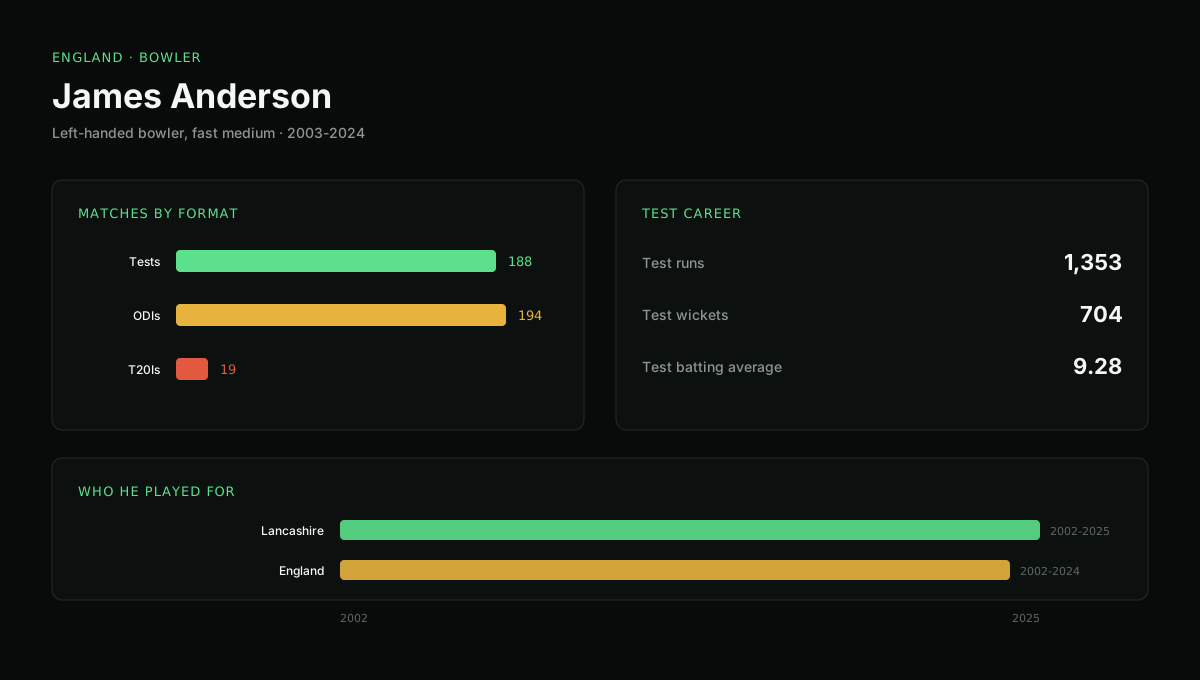
The full record is on his player page.
The number of matches
188 Tests is the record for a fast bowler and is a long way clear.
The reason is not luck. Fast bowling breaks bodies, and the standard career for a front-line seamer is ten to twelve years with two or three long injury absences. He played twenty-one years and missed comparatively few matches.
The mechanism appears to have been a combination of an efficient, low-stress action, an unusual commitment to conditioning, and a willingness to bowl within himself rather than for pace after his late twenties.
The reinvention
He was a genuinely fast bowler in his early career, operating in the high 130s and occasionally faster, with a remodelled action and inconsistent control.
By his early thirties the pace had gone to the low 130s. Most bowlers who lose that are finished. He took more than half his 704 wickets afterwards.
What replaced the pace was control of the ball's movement: conventional swing both ways with a new ball, wobble seam, and a length so consistently on off stump that a batter had no safe option. It is the same insight as Glenn McGrath's method arrived at from a different direction.
The wobble seam
The delivery most associated with him in the second half of his career, and it is worth explaining because it is not swing.
The ball is released with the seam wobbling rather than upright or angled. It does not swing in the air predictably; instead, whichever part of the seam lands first sends it sideways off the pitch, and neither the bowler nor the batter knows which way in advance.
That is a deliberate use of uncertainty. A batter facing a bowler who can swing it both ways has to play the line; a batter facing one who does not know himself which way it will go has to play the ball, late, which is much harder.
It is now bowled everywhere. He was among the first to use it as a stock delivery rather than an accident.
The other number
269 one-day wickets and a World Cup semi-final, which is a good career on its own and is essentially never mentioned.
He bowled the first ten overs for England for a decade and was dropped from the format after the 2015 World Cup, at 32, in a rebuild that produced the side that won in 2019. That decision looks correct in retrospect and was not obviously correct at the time, and he responded to it by taking another 250 Test wickets.
In England, and elsewhere
The standing criticism is that the record is inflated by English conditions, and it is partly fair.
He averages materially better in England than overseas, and English conditions — Dukes ball, cloud cover, grassy surfaces — suit a swing bowler more than anywhere else. A bowler who plays half his Tests at home in the best swing-bowling conditions in the world has an advantage.
The counter is two things. Every bowler averages better at home, and his overseas average is good rather than poor. And in the second half of his career, after the reinvention, his overseas record improved substantially — the wobble seam works on surfaces where the ball does not swing.
The Ashes record
He played in ten Ashes series across twenty years, which is more than anybody else has, and took over a hundred wickets in them.
The 2010-11 series in Australia is the one usually cited: 24 wickets at 26.04 on pitches that historically give a swing bowler nothing, in a series England won 3-1 in Australia for the first time since 1986.
That series is also the best evidence against the "only good at home" reading. The Kookaburra ball stops swinging after fifteen overs and Australian surfaces are flat; he took the most wickets in the series anyway, mostly with reverse swing and a full length at the stumps.
The partnership with Broad
He and Stuart Broad opened the bowling together in 138 Tests, which is the most by any pair in the history of the game.
The pairing worked because they were different: Anderson swinging it late at a full length, Broad hitting the pitch harder from a greater height with steeper bounce. A batter who got through one over had a different problem the next.
Between them they took more than 1,300 Test wickets, which is more than any new-ball pair has managed and is unlikely to be approached, because it required both of them to play unusually long careers at the same time.
The Tests column is the giveaway. Almost no fast bowler in the dataset has played anywhere near that many.
James Anderson — More Test wickets than any fast bowler in the history of the game, and he was still swinging it at forty-two. Full record
What he was before the reinvention
The early career is worth stating because it was not obviously heading anywhere.
He took five wickets on one-day debut and looked like a genuine prospect. Then England's coaching staff remodelled his action to reduce a perceived stress-fracture risk, and for two or three years he was a bowler who had lost what he had without gaining anything.
He was dropped, went back to something closer to his original action, and rebuilt. Between 2003 and 2008 he averaged over 30 with the ball and was in and out of the side; after 2008 he averaged in the low twenties for most of a decade.
An England fast bowler who averaged 30 through his mid-twenties would not survive selection today, and the record he ended with exists because he did.
The end
He played his last Test at Lord's in July 2024, at 41, having been told by the selectors that England were rebuilding towards the next Ashes.
He was still taking wickets. That is unusual and it is the honest reading of the decision: he was dropped from a side he could still have played in, for reasons of succession rather than form, and he said publicly that he did not agree with it.
The last wicket of his career took him to 704, and he finished third on the all-time list behind two spinners.
- Injury from a high-stress action
- Losing pace in the late twenties
- Ten to twelve years
- Bowling for pace
- A low-stress action and heavy conditioning
- Took over half his wickets after losing it
- Twenty-one
- Bowling for movement and length
Where he sits in our dataset
Difficulty tier 1 on the player list, and one of the quickest to close. England, bowler, and 188 Tests is a combination with exactly one answer, and the Tests column alone nearly does it.
- 704 Test wickets, the most by any fast bowler, from 188 Tests
- Over half of them taken after his pace declined
- The wobble seam, used as a stock delivery rather than an accident
- 138 Tests opening with Stuart Broad, the most by any pair
The short version
He is the leading fast bowler in the history of Test cricket because he found a way to keep taking wickets after the thing that made him a fast bowler had gone. The 704 is a record of adaptation more than of pace.
For the method he converged on, see Glenn McGrath by the numbers, and for the ball that made English conditions what they are, what a Kookaburra ball does that a Dukes does not.