Alastair Cook by the numbers, and 12,472 runs from an opener
The leading run-scorer in England's history, and the leading run-scorer among all Test openers, made in a career of almost no injuries and no dropped scores.
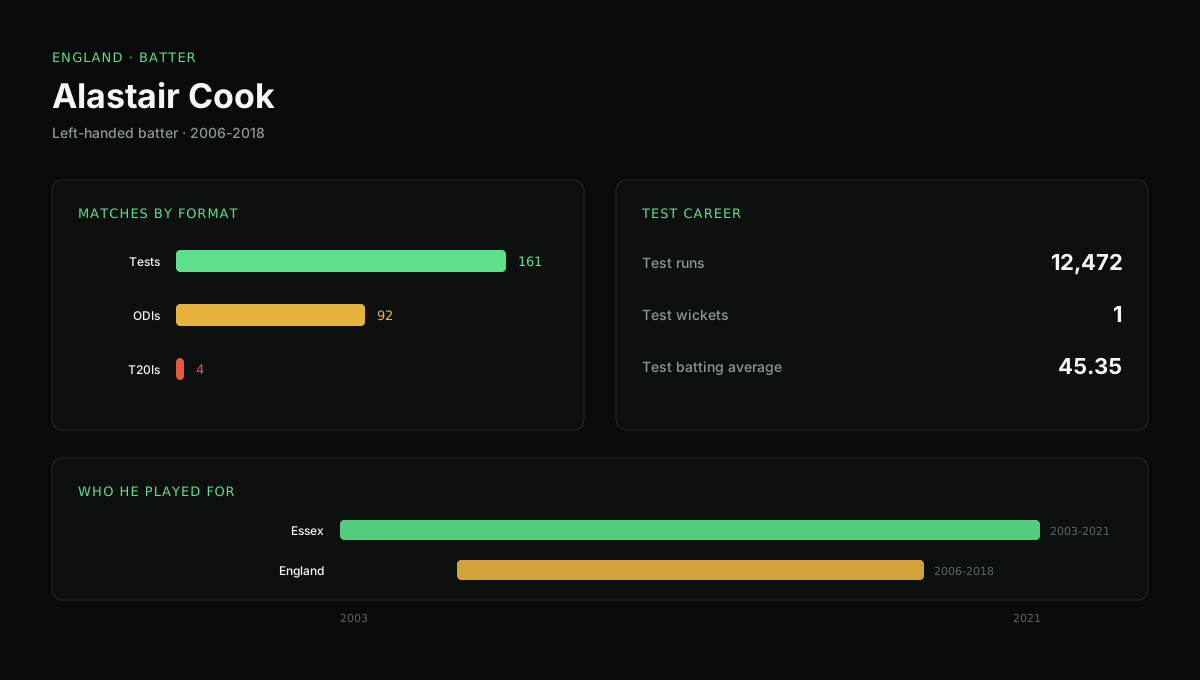
Alastair Cook scored 12,472 Test runs opening the batting, which is the most by any opener in the history of Test cricket and the most by any England player of any kind.
- 12,472 Test runs at 45.35, from 161 Tests
- The most by any Test opener, and the most by any England player
- 33 centuries, and a hundred on debut and in his final innings
- 159 consecutive Tests, the longest unbroken run by any player
The record
| Format | Matches | Runs | Average | Span |
|---|---|---|---|---|
| Tests | 161 | 12,472 | 45.35 | 2006-2018 |
| ODIs | 92 | 3,204 | 36.40 | 2006-2014 |
The full record is on his player page.
Opening, and what the average means
45.35 as an opener is worth substantially more than the same number in the middle order.
An opener faces the new ball, with the seam standing proud, in the first hour, with three slips and a gully waiting. In England, with a Dukes ball that swings for forty overs, that is the hardest batting in world cricket. Cook did it for twelve years.
The comparison worth making is with the middle order of the same side: batters averaging in the high forties who arrived at 100 for 2 against a softer ball. The average column ranks them above him and the jobs are not comparable.
The consecutive run
159 consecutive Test matches, which is the longest unbroken sequence by any player in the history of the game.
Twelve years without missing a Test through injury, illness, form or rest. For an opener, who is on the field for every ball of every innings and bats in every one, that is a physical achievement as much as a cricketing one.
He also captained for 59 of them, which is the England record.
The endurance was the other half of it. He batted for more than 36 hours in a single Ashes series in Australia, which requires a physical base most batters do not have, and he ran between the wickets for twelve years without the fitness dips that usually show up in a batter's mid-thirties.
The method
Almost no backlift, very little footwork, and a leg-side scoring game built on the nudge and the pull.
He was frequently described as technically limited and the description was accurate and beside the point. What he had was an extraordinary ability to leave the ball, a defence that did not fail under pressure, and a temperament that made a three-hour period without a scoring shot entirely acceptable to him.
The scoring came square on the leg side and through the covers off the back foot. Bowlers who bowled straight at him were worked away for singles for hours; bowlers who went wide of off stump were left. There was no third option that worked reliably.
The one-day career
3,204 runs at 36.40 from 92 matches, and he captained England in the format for three years before being removed shortly before the 2015 World Cup.
The removal was correct and was handled badly. England's one-day cricket was several years behind the rest of the world, built around accumulation rather than scoring rate, and Cook's method was the clearest expression of the approach that had stopped working. He was dropped seven weeks before the tournament, England went out in the group stage anyway, and the rebuild that followed produced the side that won in 2019.
He never played a one-day international again. It is the one part of the record where the criticism of the method was straightforwardly right.
The hundreds at both ends
He scored 60 and 104 not out on Test debut in Nagpur in 2006, having been flown out mid-tour as a replacement, arriving from a tour of the West Indies with about a day's notice.
He scored 71 and 147 in his final Test at the Oval in 2018, having already announced his retirement.
Very few players score a hundred in their first Test and their last. It bookends a career that in between contained two double centuries in Australia, 766 runs in the 2010-11 Ashes, and a period as captain that was more difficult than either.
Australia, 2010-11
England won 3-1 in Australia, which they had not done since 1986, and Cook scored 766 runs at 127.66.
He batted for more than 36 hours across the series. The 235 not out at Brisbane, in a second innings after England had followed on 221 behind, turned a match they were losing into a draw and set the tone for everything that followed.
That series is the peak of his career and one of the outstanding individual efforts in Ashes history.
Country, role and a 2006 debut narrow it fast. The Tests column finishes it.
Alastair Cook — England's leading Test run scorer, and he made a hundred in his last innings. Full record
What the average understates
45.35 looks ordinary next to the 50-plus averages of his contemporaries, and there are three specific reasons it should not be read that way.
Position. He opened. The batters he is compared with mostly did not.
Conditions. He played roughly half his cricket in England, with a Dukes ball that swings for forty overs, on surfaces prepared for results. English openers of every generation average less than openers elsewhere.
Duration. He played 161 Tests, which includes the two or three years at the end when he was clearly declining and the side kept picking him. A career average includes that period; a peak average would not.
His average through the first hundred Tests is several runs higher, which is true of almost everybody who plays long enough to reach 160.
The captaincy
59 Tests, 24 wins, and a period that included an Ashes win in 2015 and a 5-0 defeat in Australia in 2013-14.
The captaincy is the contested part of the record. He was criticised as tactically conservative and as a poor communicator, and his own batting suffered noticeably during the worst of it — his average as captain is several runs lower than his career figure.
The other side is that he held the job through a period of substantial upheaval, including the Kevin Pietersen dispute that split English cricket for two years, and that England won two Ashes series under him.
- No backlift, limited footwork
- Only scores on the leg side
- Too slow
- Not technically correct
- 12,472 runs, the most by any opener
- 33 centuries, including two doubles in Australia
- 766 runs in an Ashes series in Australia
- 159 consecutive Tests in the hardest position
The Pietersen affair
The most difficult period of his captaincy had nothing to do with a match.
Kevin Pietersen was England's most talented batter and was removed from the side in 2014 after a 5-0 defeat in Australia, in circumstances that were disputed at length and publicly. Cook was captain, and the argument about whether he had driven the decision or merely presided over it ran for years.
It cost English cricket two years of coherence and it cost Cook a large amount of personal credit at a point when his own batting was at its lowest. He said very little about it at the time and not much since.
Whatever the merits, it is the part of the captaincy record that has nothing to do with tactics and is the reason that period is remembered the way it is.
Where he sits in our dataset
Difficulty tier 1 on the player list. England, batter, 2006 to 2018 is a narrow field, and 161 Tests separates him from everybody in it.
- 12,472 runs, the most by any Test opener and the most by any England player
- 159 consecutive Tests, the longest unbroken run in the sport's history
- Hundreds on debut and in his final innings
- 766 runs in the 2010-11 Ashes, at 127.66
The short version
He was told for a decade that his technique was insufficient and finished with more Test runs than any opener has scored. The method was narrow and it did not fail, and the consecutive-match record is the part that will outlast the runs.
For what the position actually requires, see what an opening batter is actually for, and for the ball that makes English conditions what they are, what a Kookaburra ball does that a Dukes does not.