Stuart Broad by the numbers, and the spells that broke matches
604 Test wickets, and a career defined by half a dozen spells in which he took five or six wickets in an hour and turned a losing position into a won one.
Stuart Broad took 604 Test wickets, which is second among fast bowlers, and he is remembered for a specific thing that does not show up in a career average: he could take five wickets in forty minutes and end a match.
- 604 Test wickets at 27.68, from 167 Tests
- 8 for 15 at Trent Bridge in 2015, when Australia were bowled out for 60
- Nineteen five-wicket hauls, and several of them decided series
- 138 Tests opening the bowling with James Anderson, the most by any pair
The record
| Format | Matches | Wickets | Average | Runs |
|---|---|---|---|---|
| Tests | 167 | 604 | 27.68 | 3,662 |
| ODIs | 121 | 178 | 30.13 | 529 |
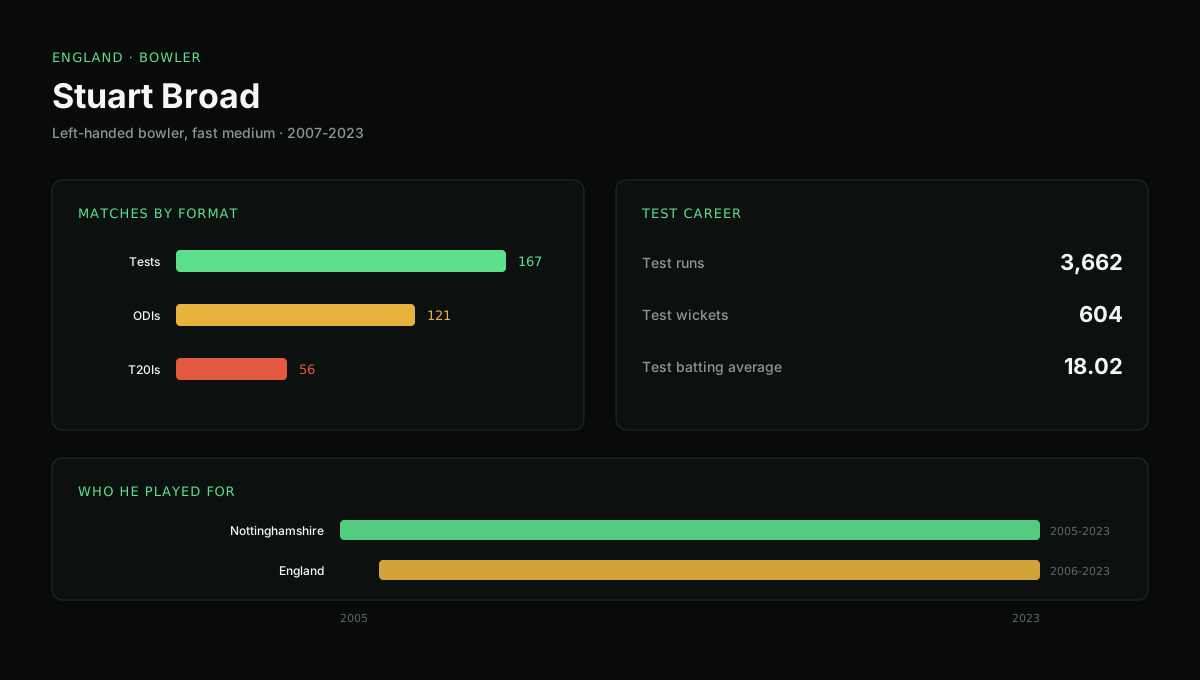
The full record is on his player page.
The spells
The career average of 27.68 is good and not exceptional, and it understates him for a specific structural reason.
He produced, several times, a spell of five or six wickets in under an hour that turned a match. Trent Bridge 2015, when Australia were bowled out for 60 in the first session of an Ashes Test and he took 8 for 15. The Ashes at Chester-le-Street in 2013, 6 for 20. Johannesburg 2016, 6 for 17. Several more.
A career average treats those overs identically to any others. What they actually did was end Test matches inside a session, which is worth substantially more than the same wickets spread over three days.
There is no accepted statistic for it. The nearest is that he took five wickets in an innings nineteen times and a strikingly high proportion of them came in matches England went on to win from a position they had not been in beforehand.
The height
He is close to two metres tall and the bowling depended on it.
The length he bowled — slightly shorter than a conventional good length, on or just outside off stump — produced a ball that arrived at the batter's ribs or gloves rather than at the pads. That is not a length most bowlers can use, because from a lower release point the same delivery is a half-volley or a long hop.
The seam movement came off the pitch rather than through the air, which is why he was more effective on surfaces with something in them and less so on flat ones. His record in Asia is the weakest part of it, and it is the direct consequence of the same method that made him so dangerous in England.
The wobble seam and the round-the-wicket angle
Two adjustments in the second half of his career extended it considerably.
The wobble seam, adopted alongside Anderson, produced movement off the pitch in both directions without the bowler knowing which, which suited his length exactly.
Bowling round the wicket to left-handers became a specific plan and a very productive one. David Warner was dismissed by him seventeen times in Tests, most of them from round the wicket to a length outside off, and the sequence became one of the more studied matchups in the sport.
The batting
3,662 runs at 18.02, with one century — 169 against Pakistan at Lord's in 2010, batting at nine, in a partnership of 332 with Jonathan Trott.
That innings is one of the stranger entries in the record books: a number nine scoring 169 in a Test, in a match remembered for entirely different reasons, and then never scoring another Test fifty for six years.
His batting was substantially better before he was hit in the face by a bouncer in 2014, and he has said as much. It is one of the clearer examples of a specific incident changing a player's technique, and it is not a comfortable one.
The partnership with Anderson
138 Tests opening the bowling together, which is the most by any pair in Test history.
They were complementary rather than similar. Anderson swung it late at a fuller length from a lower release; Broad hit the pitch harder from a great height with steeper bounce. A batter who worked out one was facing a different problem the next over.
Between them they took over 1,300 Test wickets, which is the most by any new-ball pairing and required both to have unusually long careers at the same time.
Country and role narrow it to two. The Tests column and the batting runs separate them.
Stuart Broad — Eight for fifteen at Trent Bridge in 2015, in a spell that lasted under an hour. Full record
The Ashes
He played in ten Ashes series and took 153 wickets in them, which is the most by anybody in the fixture's modern era.
The relationship with Australian crowds became a running feature — a consequence of the 2013 Trent Bridge Test in which he did not walk after edging to slip and was not given out — and he leaned into it thoroughly for the following decade.
His last Test was the final match of the 2023 Ashes at the Oval. He hit a six off the last ball he faced, and took a wicket with the last ball he bowled, which is a way of finishing a career that nobody could have arranged.
- 27.68, good rather than great
- 604 wickets over sixteen years
- A record built on longevity
- Weaker in Asia
- 8 for 15 in a session at Trent Bridge
- Several matches ended inside a day
- Nineteen five-wicket hauls, many of them decisive
- Because the same length that worked in England did not there
The Warner sequence
Seventeen dismissals of David Warner in Test cricket is the most any bowler has dismissed him, and the pattern is worth stating because it is the clearest documented plan in modern cricket.
Round the wicket, angling in, on a length outside off, with the wobble seam so the ball might straighten or might hold its line. Warner, a left-hander who scores heavily square on the off side, has to play at it, and the ball that straightens takes the edge.
The 2019 Ashes is where it became total: Warner scored 95 runs in ten innings in the series, dismissed by Broad seven times.
It is also the clearest illustration of why a career average understates him. Those dismissals came in a series England drew from 2-1 down, and they came from a bowler whose figures for the series look ordinary next to what he actually did.
The T20 record
56 T20 internationals, and he captained England in the format before being replaced.
The most-cited moment of it is being hit for six sixes in an over by Yuvraj Singh in the 2007 World T20, at 21, in his first major tournament. He has been consistently good-natured about it since and has pointed out, correctly, that it is the sort of thing that either ends a career or does not matter at all.
It did not matter.
Where he sits in our dataset
Difficulty tier 1 on the player list. England, bowler, 2007 to 2023 puts him next to Anderson, and the Tests and wickets columns separate the two.
- 604 Test wickets at 27.68, second among fast bowlers
- 8 for 15 at Trent Bridge, and several other match-ending spells
- Height and a slightly short length, which worked in England and not in Asia
- A six off his last ball and a wicket with his last delivery
The short version
The career figures describe a very good fast bowler and the career itself was something more specific: somebody who, half a dozen times, took a match away from the opposition inside an hour. That does not average out and it is what he was for.
For the bowler at the other end, see James Anderson by the numbers, and for the ball that made English conditions suit both of them, what a Kookaburra ball does that a Dukes does not.