Imran Khan by the numbers, and the side he built
362 Test wickets and 3,807 runs, plus a captaincy that took Pakistan from unreliable to a World Cup, largely by finding fast bowlers nobody else had noticed.
Imran Khan took 362 Test wickets and scored 3,807 runs, which puts him in the all-rounder argument on the figures. The stronger case is what happened to Pakistan cricket while he was in charge of it.
- 362 Test wickets at 22.81, and 3,807 runs at 37.69
- His bowling average is the best of the four great all-rounders of his era
- Captained Pakistan to the 1992 World Cup at 39
- He found and developed Wasim Akram and Waqar Younis
The record
| Format | Matches | Wickets | Runs | Batting average |
|---|---|---|---|---|
| Tests | 88 | 362 | 3,807 | 37.69 |
| ODIs | 175 | 182 | 3,709 | 33.41 |
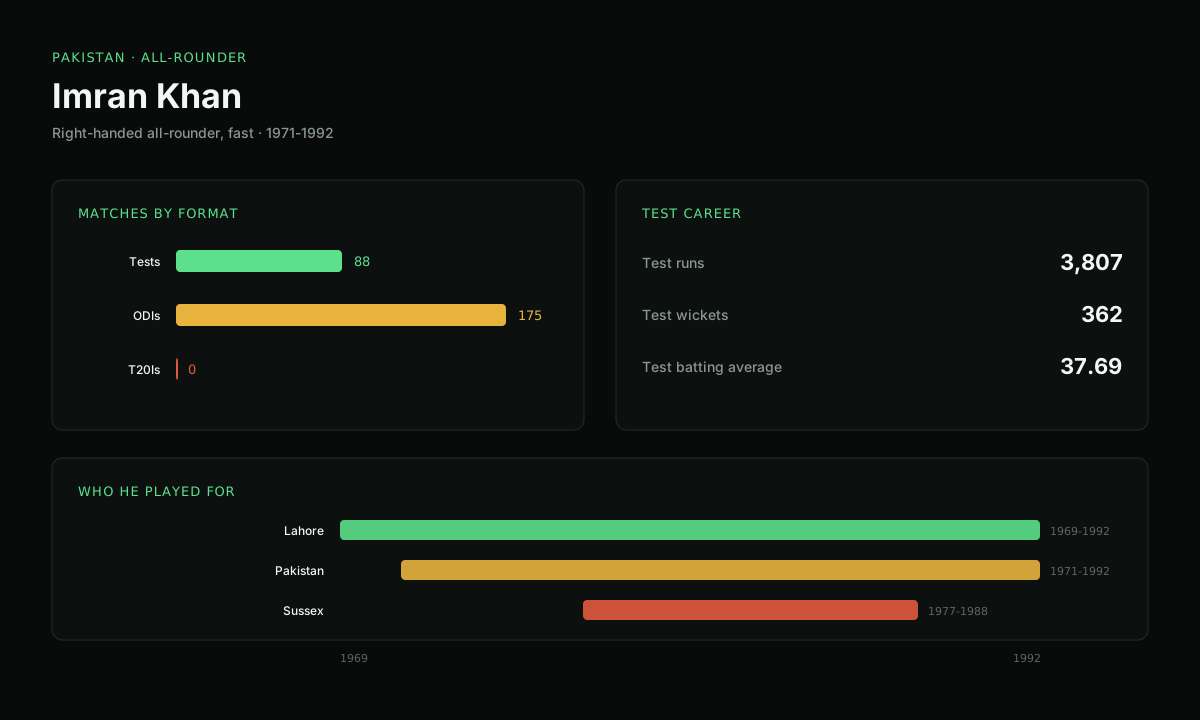
The full record is on his player page.
The bowling
He bowled genuine fast at his peak, with an outswinger to the right-hander delivered from a leaping, side-on action that generated pace from the whole body rather than just the arm.
His Test bowling average of 22.81 is the best of the four all-rounders he is routinely compared with — better than Hadlee's 22.29 is close, and better than Botham's 28.40 and Kapil Dev's 29.64 comfortably.
In the second half of his career, after a stress fracture in his shin cost him nearly two years, he came back with less pace and more skill, and became one of the first exponents of reverse swing along with Sarfraz Nawaz.
The batting
3,807 runs at 37.69, with six centuries, batting at six or seven.
The average is the second-highest of the four all-rounders and the more relevant detail is when the runs came: he averaged over fifty as captain, which is the reverse of the usual pattern, and a substantial number of his hundreds came in matches Pakistan needed to save.
A batting average of 37.69 against a bowling average of 22.81 clears the all-rounder test by nearly fifteen runs, which is a large margin for somebody whose primary discipline was bowling.
The captaincy
He captained Pakistan in 48 Tests, winning 14 and losing 8, in an era when Pakistan away results were historically poor.
What he actually changed was selection and structure. Pakistan cricket in the 1970s was factional, regionally divided and unpredictable in team selection. He demanded and got control over selection, picked on ability rather than on the politics, and enforced a standard of fitness and professionalism the side had not previously had.
The most consequential part was fast bowling. He found Wasim Akram in a net session and picked him almost immediately; he did the same with Waqar Younis, having seen him on television. Both were in the Test side inside months of being noticed.
That pipeline — a captain personally identifying and installing fast bowlers — is the single largest reason Pakistan produced the best new-ball pairing in the world for a decade.
1992
Pakistan lost three of their first five matches in the 1992 World Cup, were rained out of a game against England they were losing badly, and qualified for the semi-finals on the last day of the group stage.
They then beat New Zealand in the semi-final and England in the final at Melbourne. Imran was 39, batted at three, made 72 in the final, and took the last wicket.
The tournament is the one Pakistani sporting achievement everybody in the country can date, and it is the last World Cup they have won.
Reverse swing
He and Sarfraz Nawaz were among the first bowlers to systematically use reverse swing, and he taught it to the generation that followed.
The rest of the cricket world spent the next fifteen years assuming that anything a forty-over-old ball did must involve tampering, and the argument only closed when other countries learned the skill themselves. The mechanism is covered in reverse swing explained.
That transmission — from Sarfraz to Imran to Wasim and Waqar to everybody — is one of the clearest cases in cricket of a skill being invented in one place and taking two decades to travel.
Country and role narrow it to two or three. The wickets column and the span finish it.
Imran Khan — Came out of retirement to captain Pakistan to the 1992 World Cup. Full record
The two halves of the bowling career
His bowling divides cleanly into two periods with a stress fracture between them, and the second half is the more interesting one.
Before 1983 he was genuinely fast — among the quickest in the world — with an outswinger delivered from a leaping, side-on action. A stress fracture in his left shin then kept him out of bowling for nearly two years, and he played several Tests as a batter only.
He came back slower and with more skill, and the second half of the career contains the reverse swing, the inswinging yorker, and the tactical bowling that made him a captain rather than a strike bowler. His best series figures came after the injury.
The 40 wickets at 13.95 in the 1982-83 home series against India, and the six for 98 and eight for 60 in the same match at Karachi, belong to the earlier period. What came after was different and lasted longer.
The all-rounder comparison
The four are Imran, Botham, Hadlee and Kapil Dev, and they overlap almost exactly in career.
| Player | Batting average | Bowling average | Margin |
|---|---|---|---|
| Imran Khan | 37.69 | 22.81 | 14.88 |
| Richard Hadlee | 27.16 | 22.29 | 4.87 |
| Ian Botham | 33.54 | 28.40 | 5.14 |
| Kapil Dev | 31.05 | 29.64 | 1.41 |
On that measure Imran is clear. Hadlee was the better bowler by a small margin; Botham the more destructive match-winner at his peak; Kapil Dev the one who transformed his country's cricket most. The margin above is the reason Imran usually wins the argument on figures.
- 362 wickets at 22.81
- 3,807 runs at 37.69
- A World Cup at 39
- 88 Tests
- Wasim Akram and Waqar Younis, both personally found
- Reverse swing, taught to a generation
- Selection on ability rather than regional politics
- A cancer hospital, and a career in politics
After cricket
He founded a cancer hospital in Lahore, named for his mother, funded largely through public donations he raised personally over several years. It opened in 1994 and is the thing he has most consistently said he is proudest of.
He then entered politics, founded a party, and became Prime Minister of Pakistan in 2018 before being removed by a no-confidence vote in 2022 and subsequently imprisoned. That is a political record rather than a cricketing one and it is outside what this page is for.
What is relevant to the cricket is that the same qualities show up in both accounts: an unusual willingness to take control of an institution, and an assumption that the way things had been done was not the way they had to be done.
Where he sits in our dataset
Difficulty tier 1 on the player list. Pakistan, all-rounder, 1971 to 1992 is a unique combination, and the span is the fastest route to it.
- 362 Test wickets at 22.81, the best average of the four great all-rounders
- A batting average of 37.69, clearing the all-rounder test by nearly fifteen runs
- He found Wasim Akram in a net and Waqar Younis on television
- The 1992 World Cup, at 39, and it remains Pakistan's only one
The short version
The figures put him at the top of the all-rounder argument and the more durable achievement is a bowling pipeline that outlasted his career by fifteen years. He found two of the best fast bowlers in history and taught them a skill nobody else in the world understood.
For the pair he found, see Wasim Akram by the numbers, and for the definitions the comparison turns on, what counts as an all-rounder.