Ball tracking, and how confident it actually is
Half of a ball-tracking graphic is filmed and half is a prediction, and umpire's call is the system stating exactly where its confidence runs out.
The graphic that decides lbw reviews looks like a measurement. Half of it is. The other half is a projection, and almost every argument about the system is really an argument about that second half.
- Everything before the impact is filmed; everything after it is predicted
- Umpire's call is the system saying its prediction is not confident enough
- Very short distances between pitching and impact disable tracking entirely
- The error grows with the distance from impact to the stumps
What it actually does
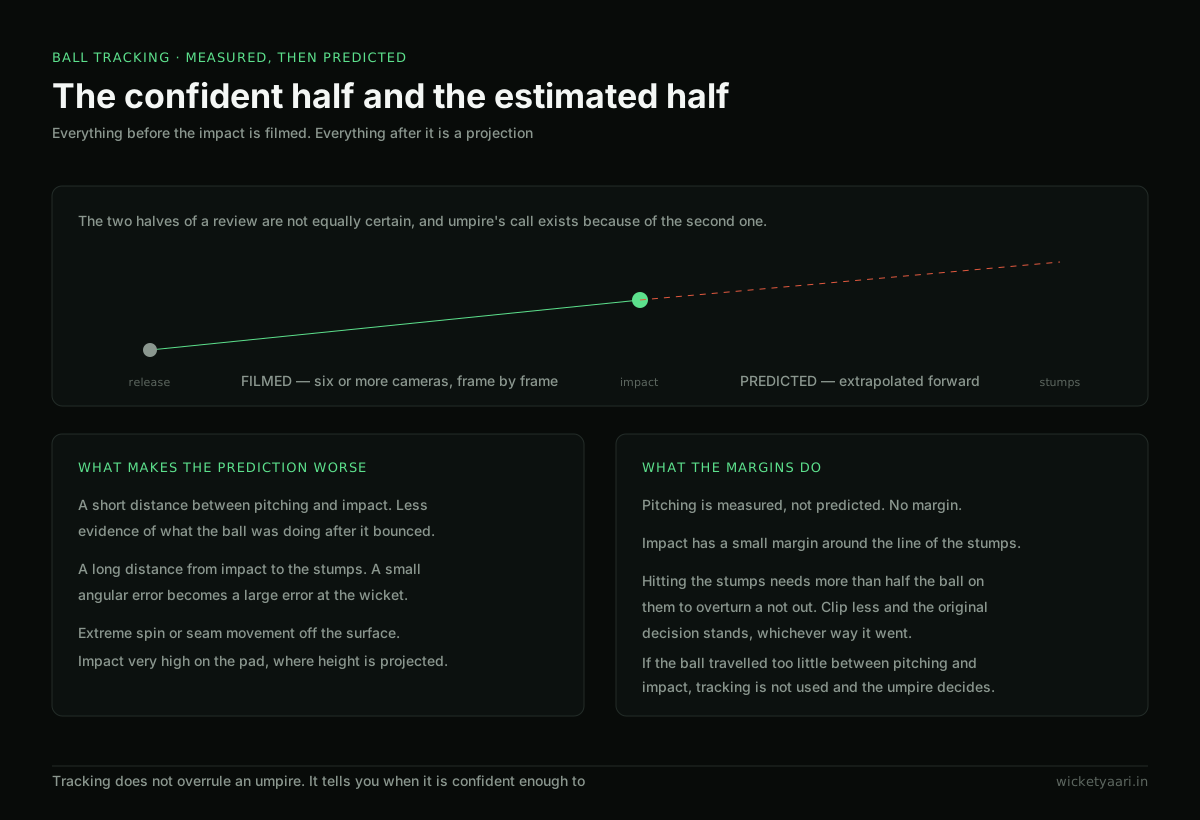
Six or more high-frame-rate cameras around the ground find the ball in every frame. The system builds the path from those positions — where it was released, where it pitched, how it deviated after bouncing, and where it struck the batter. All of that is measurement. The cameras saw it.
Then it extrapolates. Given the ball's speed, direction and the deviation observed after pitching, it projects the path forward from the point of impact to the stumps. Nothing filmed that. It is a model of what would have happened.
The two halves are presented in the same graphic and they do not deserve the same confidence, which is what umpire's call exists to express.
Why the prediction gets worse
Four things degrade it, and a review that fails on any of them is a review the system will be cautious about.
A short distance between pitching and impact. The system learns what the ball is doing after it bounces from watching it do it. A ball that pitches and strikes the pad almost immediately gives it very little to learn from. In most playing conditions, if that distance falls below a specified threshold, ball tracking is not used at all and the on-field decision stands.
A long distance from impact to the stumps. A small angular error at the point of impact becomes a large positional error two metres later. A batter struck well forward is a harder projection than one struck on the crease.
Large deviation off the pitch. A ball turning or seaming sharply is doing something the model has to infer from a short observation, and the inference is less certain the more extreme the movement.
Impact high on the pad. Height is projected the same way line is, and a ball struck high has more room to be going over than the eye suggests.
What the margins actually are
Three checks, three different treatments, and this is where most of the confusion comes from.
| Check | Measured or predicted | Margin |
|---|---|---|
| Where it pitched | measured | none — the cameras saw it |
| Where it struck the batter | measured | a small margin on the line of the stumps |
| Whether it would hit | predicted | more than half the ball must be on the stumps to overturn |
Pitching outside leg is never umpire's call, because nothing about it is predicted. The camera saw where the ball landed.
The wicket check is the one that produces the arguments. To overturn a not-out decision, the projection must show the ball hitting the stumps by a clear margin. Clip the stumps by less than that and the original decision stands — so the same ball can be out or not out depending on what the on-field umpire said first.
Why that is not a fudge
The complaint is always the same: two identical deliveries, two different results, because of a human decision made before the technology was consulted.
The answer is that the system is not claiming to know. It is saying: this projection is within the range where I might be wrong, and in that range the person who was standing there watching it gets the benefit. That is a reasonable thing for a measuring instrument to say about its own tolerance, and the alternative — pretending the projection is exact — would be worse.
What is fair criticism is that the size of the margin is a choice, and it has been changed. Making it smaller means more decisions are overturned and more of them are wrong. Making it larger means the umpire's original view stands more often. There is no neutral setting; there is only a trade-off somebody has to pick.
What it changed about the game
Tracking did not just correct mistakes. It changed how lbw is umpired.
Before it, the convention was that a batter well forward to a spinner was rarely given out, because no umpire could be confident about the bounce over that distance. Tracking made the bounce measurable, umpires saw thousands of projections, and decisions that used to be unmakeable became routine. More lbws are given now than at any point in the history of the game, and the largest single reason is that umpires learned what the ball actually does.
It also changed how batters play. Padding away a ball outside off is a much worse idea when the impact point will be measured, and the sweep against turn carries a risk it did not carry in 1995.
A ball pitches and strikes the pad almost immediately, with only a few centimetres between the two points. What normally happens on review?
With too little distance between pitching and impact, the system has almost nothing to learn about the ball's post-bounce behaviour. Most playing conditions specify a minimum distance below which tracking is not consulted.
The other two technologies
Ball tracking answers one question. Two more systems answer the others, and they work completely differently.
Edge detection is a directional microphone in the stumps, synchronised to the frame in which the ball passes the bat. It shows a spike. It cannot tell you what made the spike — bat on pad, bat on ground and pad on shirt all produce one — which is why the third umpire watches the picture alongside the trace.
Thermal imaging, where a competition uses it, shows friction as heat. It is slower to read, works less well in some climates, and is not universally deployed, which is why you see it in some series and not others.
None of the three is present everywhere. A domestic competition with two broadcast cameras has no tracking at all, and its reviews are edge-and-replay only. When somebody says a decision "would have been overturned with DRS", the honest answer is that it depends entirely on which DRS.
- The ball was going to hit middle
- The technology is certain
- The umpire was wrong
- This is a measurement
- The model projects middle, within a margin
- The technology publishes its tolerance
- The umpire was outside the confident range, or inside it
- The first half is. The second is an estimate
- Filmed up to impact, projected after it, and only the second half has a margin
- Umpire's call is the tolerance being stated out loud, not a compromise
- The size of the margin is a choice, and choosing it is a trade-off with no neutral setting
- Tracking changed umpiring more than it changed results
The short version
Ball tracking is confident about where the ball has been and honest about not being certain where it was going. Umpire's call is that honesty made visible, and it is the part of the system people most want removed.
For the order the checks happen in, see the decision review system step by step, and for the Law it is adjudicating, how lbw actually works.