What a cricket ball is made of, and why it matters
Cork, wound string, four quarters of leather and six rows of stitching. Every behaviour a bowler relies on comes from one of those four components.
A cricket ball weighs about 160 grams, costs a fraction of a bat, and determines more about what happens in a day's play than any other object on the field. It is worth knowing what is inside one.
- A cork core, wound with string, covered in four quarters of leather
- Six rows of stitching form the seam, hand or machine sewn
- The seam produces grip and deviation; the leather produces swing
- The winding is why a ball goes soft, and a soft ball changes the cricket
The four parts
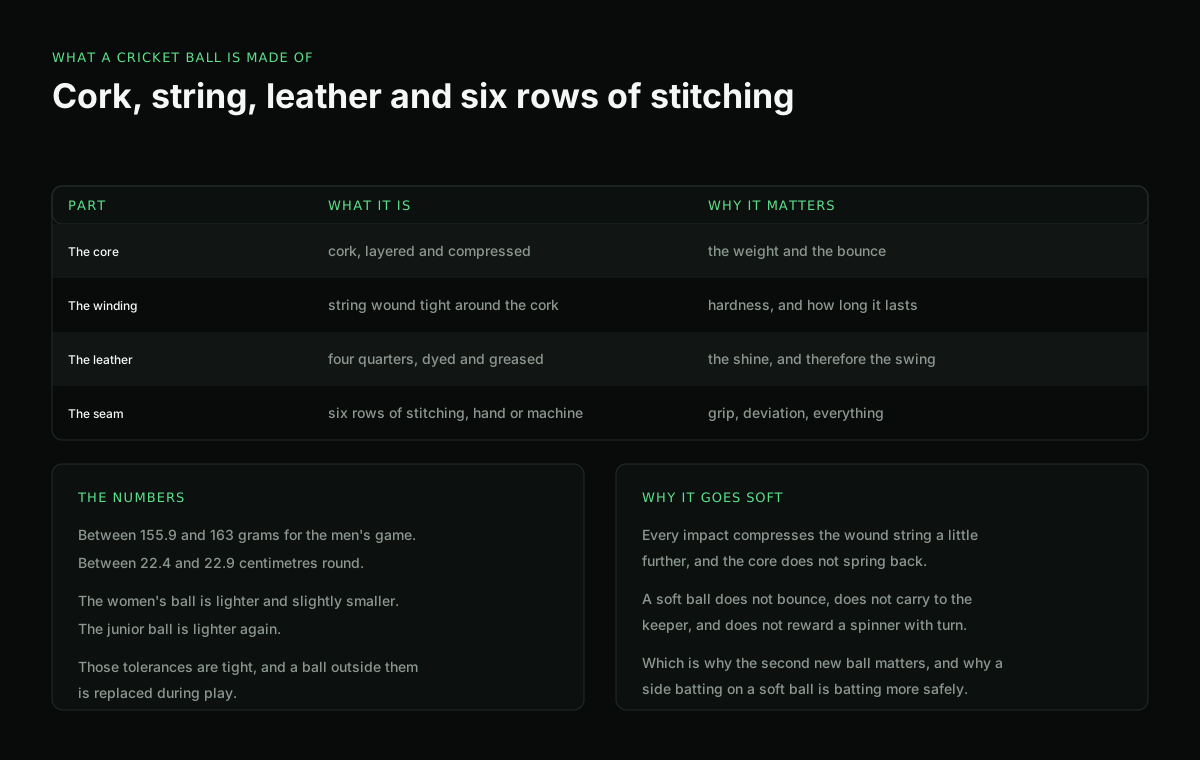
The core is cork, layered and compressed, sometimes with a rubber component. It provides the weight and most of the bounce.
The winding is string wound tightly around the core, and it is what makes the ball hard. How tightly it is wound and how much string is used determines how long the ball stays hard.
The leather is four quarters, cut, moulded, dyed and greased. It is what takes a shine, which is what produces swing.
The seam is six rows of stitching joining the halves. It is the only raised feature on the ball and it is responsible for grip, for deviation off the pitch, and for the airflow asymmetry that makes swing possible.
The legal dimensions
The Laws are tight. A men's ball weighs between 155.9 and 163 grams and measures between 22.4 and 22.9 centimetres in circumference.
The women's ball is lighter and slightly smaller. Junior balls are lighter again. The tolerances exist because a ball outside them behaves differently enough to matter, and a ball that goes out of shape during play is replaced with one of similar wear rather than a new one.
That replacement rule is worth knowing. A ball hit into a stand and lost is replaced with a used ball of comparable age, selected from a box the umpires carry, not with a new one. Fielding sides have been known to hope for a favourable substitution.
Why the seam does so much
Six rows of stitching produce a ridge a couple of millimetres high, and almost every skill in bowling comes back to it.
Grip for the bowler. A seam bowler holds the ball with fingers either side of the seam; a spinner grips across it. Without a raised seam neither has anything to hold.
Deviation off the pitch. A ball landing on its seam bounces unpredictably, because the seam is a hard, narrow edge striking the surface rather than a smooth curve. That is seam movement, and it is different from swing.
Airflow. The seam disrupts air on one side of the ball, which combined with a polished surface on the other creates the pressure difference that produces conventional swing.
A ball with a flattened seam does none of these things well, which is why the manufacturing differences between Dukes, SG and Kookaburra matter so much.
| Component | Responsible for | What happens when it degrades |
|---|---|---|
| Core and winding | weight, hardness, bounce | the ball goes soft, and stops bouncing |
| Leather | shine, and therefore swing | the shine goes, then it scuffs |
| Seam | grip, seam movement, swing | it flattens, and the ball does nothing |
| The whole thing | the contest | a soft, smooth ball is a batting aid |
Why a ball goes soft
Every impact compresses the wound string a little further, and it does not spring back. After sixty or seventy overs a ball is materially softer than it was.
A soft ball does not bounce, does not carry to the keeper or the slips, and does not give a spinner the bounce that turns an edge into a catch. It also comes off the bat more slowly, so it is harder to hit for four but easier to survive against.
That is the mechanism behind the whole second-new-ball decision. A side batting against a soft ball is batting more safely than the scoreboard suggests, and a captain has to decide whether hardness is worth losing everything the old ball has developed.
The shine, and what is allowed
Maintaining the ball is legal and universal. Polishing one side on the trousers, using sweat, and leaving the other side alone is what every fielding side has done since anybody noticed it worked.
Saliva was permitted for most of cricket's history, prohibited during the pandemic, and the prohibition became permanent. Sweat still works. The practical effect was that the ball takes slightly longer to get into a condition where it reverses.
What is illegal is changing the condition of the ball by any other means: scratching, lifting the seam, applying an artificial substance, or using the ground. The line is about method rather than intent, which is the only thing an umpire can actually adjudicate.
Hand stitched against machine stitched
The seam can be sewn either way and it is the largest single difference between manufacturers.
A hand-stitched seam is sewn by a person, row by row, and sits proud of the leather with the thread tightly pulled. It stays proud for a long time, because the tension in each stitch holds it up.
A machine-stitched seam — usually with the two inner rows machined and the outer rows done by hand, or all of it machined depending on the maker — sits flatter to begin with and flattens further under impact.
That single manufacturing choice is why a ball can stop moving after fifteen overs in one country and still be doing something at forty in another, with no difference in the pitch, the bowler or the conditions. It is also why hand-stitched balls cost several times what machine-stitched ones do, and why club cricket mostly does not use them.
The white ball, and why it is different
Same construction, different finish. A white ball is coated in a heavier lacquer to keep it visible, and that coating changes two things.
It shines hard for the first few overs, which produces sharp early swing. Then it wears through, the leather underneath scuffs and greys, and the ball goes soft faster than a red one because the coating was doing some of the structural work.
That degradation is why one-day cricket uses two new balls rather than one, which solved a visibility problem and removed reverse swing from the format as a side effect.
A ball is hit into the crowd and not returned. What replaces it?
The umpires carry a box of used balls at various stages of wear and select one comparable to the lost ball. Replacing it with a new one would hand the fielding side an advantage they had not earned.
- The pitch
- The bowler's wrist
- Humidity
- Luck
- The seam, landing on its edge
- The seam position at release
- The polished side, and the airflow over it
- A ball whose two sides are in different conditions
- Cork, string, leather and six rows of stitching
- The seam does the grip, the deviation and half of the swing
- The winding is why a ball softens, and a soft ball is a batting aid
- Maintaining the shine is legal; changing the surface any other way is not
The short version
Everything a bowler can do comes from one of four components, and three of them degrade during an innings. That degradation, over eighty overs, is most of what a day of Test cricket actually is.
For the differences between manufacturers, see what a Kookaburra ball does that a Dukes does not, and for what happens when the ball is old enough, reverse swing explained.