Extras explained: byes, leg byes, wides and no-balls
Four kinds of extra, and the only distinction that matters is whether the bowler is charged for it. Two of them are, two are not, and the reason is fault.
Every scorecard has a line near the bottom that reads something like "Extras 24 (b 4, lb 7, w 9, nb 4)". It is the most skipped line on the card and it decides a startling number of tight matches.
- Four kinds: byes, leg byes, wides and no-balls
- Wides and no-balls are charged to the bowler and the ball is rebowled
- Byes and leg byes are charged to nobody and the ball counts
- The dividing line is fault, not who benefits
The four, in one table
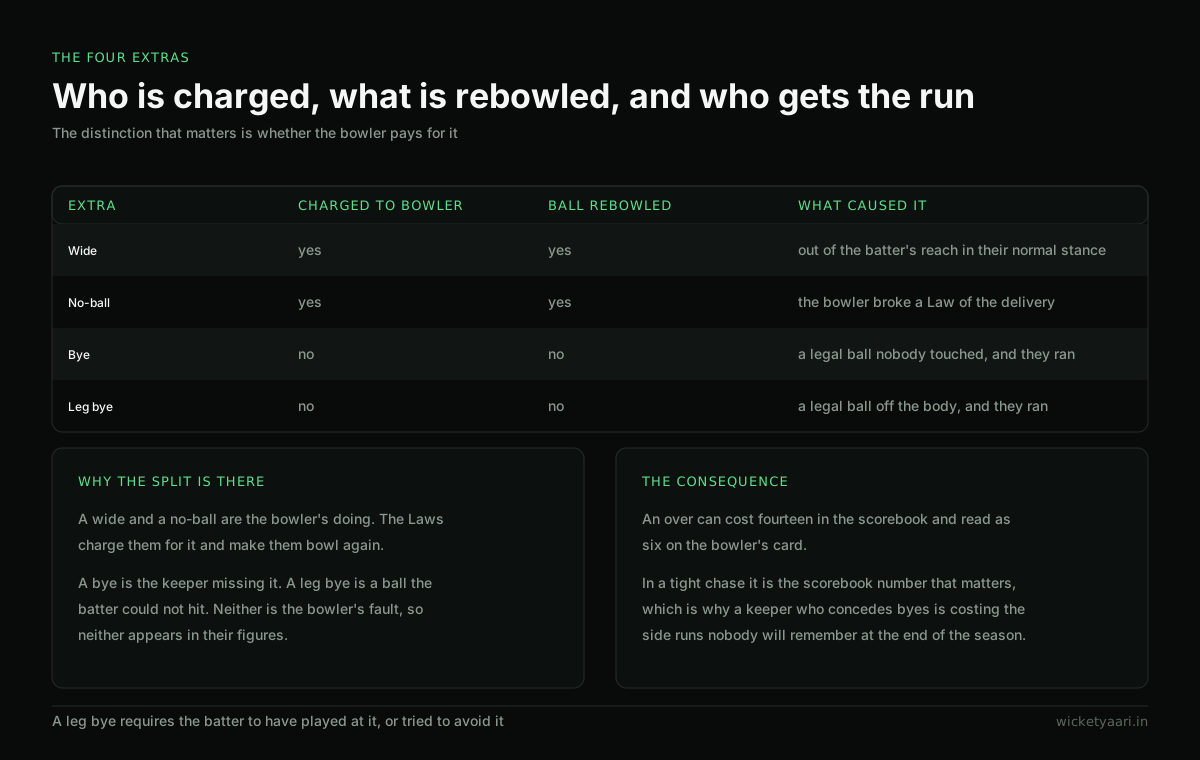
A wide is a delivery the batter could not reasonably have hit from a normal stance. One run to the batting side, charged to the bowler, and the ball is bowled again.
A no-ball is a delivery that broke one of the Laws about how a ball may be bowled — the front foot, the height, the bounce, the field placing, the action. One run, charged to the bowler, bowled again, and in most white-ball cricket the next ball is a free hit.
A bye is a legal delivery that nobody touched, which the batters ran. Charged to no one. The ball counts.
A leg bye is a legal delivery that hit the batter's body rather than the bat, which the batters ran. Charged to no one. The ball counts.
Why the split falls where it does
The Laws are trying to answer a single question: whose fault was it?
A wide and a no-ball are things the bowler did. The delivery was outside the batter's reach, or it broke a rule about how it was delivered. The bowler pays a run and has to do it again, which is a penalty in both directions.
A bye is the wicketkeeper missing a legal ball. That is not the bowler's doing, so it does not touch their figures — though it does go on the batting side's total, because runs were scored and somebody has to be credited with them.
A leg bye is a legal ball the batter could not hit with the bat. Again, nobody bowled badly, so nobody pays.
The consequence is that a bowler's economy rate and the runs their overs actually cost can be different numbers. An over that reads 14 in the scorebook can read 6 on the bowler's card, and in a chase it is the scorebook number that decides the match.
The leg bye has a condition attached
This is the detail almost nobody knows, and umpires apply it every match.
A leg bye is only signalled if the batter either attempted to play the ball with the bat, or attempted to avoid being hit by it. A batter who simply stands there and lets the ball hit their pad, then runs, is not entitled to leg byes: the umpire calls dead ball and no runs are scored.
The reason is obvious once stated. Without that condition, a batting side facing a tight over could simply kick every ball to fine leg and run. The condition makes the pad a defensive tool rather than a scoring one.
It is also a genuine judgement call. Whether a bat swung with intent or was hidden behind a pad is exactly the kind of decision that produces disagreement, and it is not reviewable.
Which extras hurt most
Not all extras are equal, and the ranking changes with the format.
| Extra | Cost in a Test | Cost in a T20 |
|---|---|---|
| Bye | irritating | irritating |
| Leg bye | almost nothing | a rotated strike, sometimes valuable |
| Wide | one run | one run and one more ball to a set batter |
| No-ball | one run, and a wicket if there was one | a free hit, worth roughly two more runs |
In Test cricket the expensive extra is the no-ball that cancels a wicket. A bowler who beats the edge, hits off stump, and hears the call has taken nothing — and in a long match a single wicket is worth far more than the run.
In T20 it is the reverse. The run is trivial. The extra delivery is what costs, because a batter facing a free hit in the nineteenth over has a swing with no consequence attached, and the expected value of that swing is a great deal more than one.
The byes that are actually the keeper's fault, and the ones that are not
A keeper standing up to the stumps to a spinner on a turning pitch will concede byes. So will a keeper standing back to a bowler getting reverse swing at pace on day four.
Byes are recorded against the fielding side and traditionally treated as a reflection on the keeper, which is fair on a flat pitch and unfair on a bad one. A ball that leaps off a crack and beats a bowler, a batter and a keeper is recorded identically to one the keeper simply dropped.
This is why byes conceded is a poor keeping statistic in isolation, and why the better keeping sides are not always the ones with the lowest bye counts. The keepers who concede fewest byes are frequently the ones standing back to medium pace on flat surfaces.
A ball pitches, turns, beats the bat, hits the batter on the thigh and runs away to fine leg. The batter had made no attempt to play it and no attempt to avoid it. What is signalled?
A leg bye requires the batter to have played at the ball or tried to avoid it. Neither happened, so the umpire calls dead ball and no runs are scored.
The overthrow, which belongs to nobody
There is a fifth thing that lands in the extras conversation and is not an extra at all: the overthrow.
If a fielder throws at the stumps, misses, and the ball runs away, the batters may run again. Those runs are credited exactly as the original runs were — to the batter if the ball came off the bat, as byes if it did not. Nothing is charged to the fielder who threw it, and nothing appears anywhere on the card to say that four of the batting side's runs came from a wild throw.
There is one famous edge case. If the ball strikes a running batter's bat or body on its way to the boundary, the boundary counts along with the runs already completed, and whether the batters had crossed at the moment of the throw determines who is on strike afterwards. That clause was rewritten after the 2019 World Cup final, where its interpretation decided the outcome of a tournament.
How extras read in the total
The extras line is written as one number with a breakdown in brackets, and the order is conventional: byes, leg byes, wides, no-balls. Some cards add penalty runs, which are the fifth category and cover things like the ball hitting a helmet placed on the ground behind the keeper.
A side conceding thirty extras in a fifty-over innings is conceding an entire over's worth of runs for nothing, and a side conceding six is bowling very straight and keeping very cleanly. The number rewards discipline more directly than any other figure on the card.
- Wides
- No-balls
- Runs off the bat
- Byes
- Leg byes
- Penalty runs
- Runs from overthrows off a fielder
- Wides and no-balls are the bowler's fault, charged and rebowled
- Byes and leg byes are nobody's fault, charged to nobody, and count as a ball
- A leg bye needs the batter to have played at it or tried to avoid it
- The bowler's card and the team total can differ by an entire over
The short version
Two extras cost the bowler, two do not, and the rule that separates them is fault. That single distinction explains the whole line at the bottom of the card, including why a bowler's figures sometimes flatter the over you just watched.
For the full list of what makes a delivery illegal, see what counts as a no-ball and every kind of wide.