The Decision Review System explained, step by step
What happens between a player tapping out a T and a decision appearing on the screen, including why umpire's call exists and who really owns a review.
The Decision Review System looks like magic and is actually a fixed sequence with a stated error margin. Once you know the order it runs in, almost every controversial review stops being controversial.
- A review is a challenge to a decision, not a request for a fresh one
- The three tools run in a fixed order: edge, then impact, then tracking
- Umpire's call exists because prediction has a margin and measurement does not
- Teams own a limited number of reviews and lose them only when clearly wrong
What a review actually is
It is a challenge. The on-field umpire has already decided, and the review asks whether that decision was clearly wrong. That framing explains almost everything people find strange about the outcomes.
It is not a fresh look. It is not "what would you give if you were seeing this for the first time". The original decision is the starting position, and the technology has to beat it.
The sequence
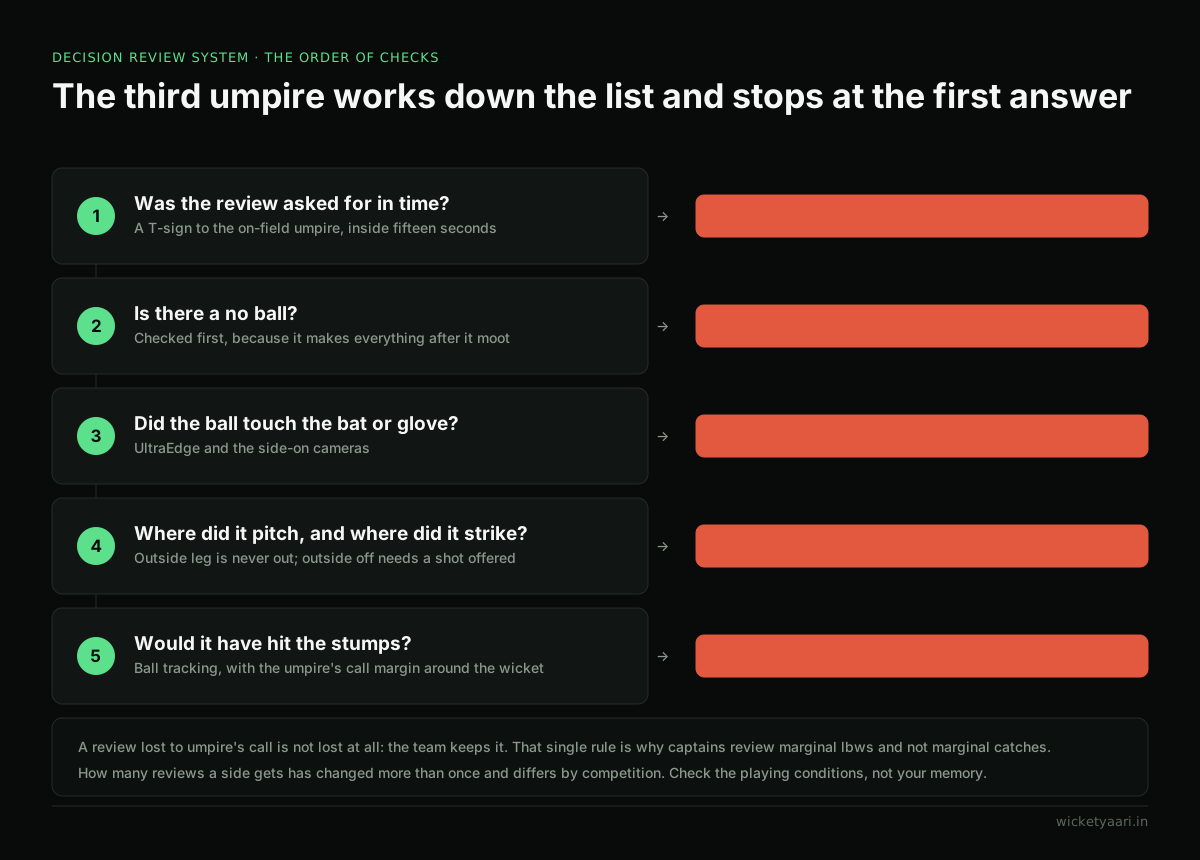
Step one: was there an edge?
Real-time snickometer, sometimes with an infrared layer. An edge onto the pad ends an lbw review immediately, because a ball that hit the bat first cannot be lbw. An edge to the keeper on a caught-behind review ends it the other way.
Step two: where did it pitch, and where did it strike?
These are measurements, not predictions. The system can see where the ball bounced and where it hit the pad, and it says so with confidence. Pitching outside leg is an immediate not out; impact outside the line is not out unless no shot was offered.
Step three: would it have hit the stumps?
This is the only predicted element. The system extrapolates the ball's path from where it struck to where the stumps are, and the further the ball travelled before impact, the more confident that prediction is.
A review shows the ball clipping the very top of leg stump. The on-field decision was not out. What happens?
Clipping is inside the margin, so the original decision stands. The same delivery given out on the field would have stayed out. That asymmetry is the whole point of umpire's call.
Why umpire's call is not a fudge
The tracking prediction has a margin of error, and that margin is published rather than hidden. Inside it, the technology is not confident enough to say the umpire was clearly wrong, so the umpire's decision survives.
The result is the thing people find unfair: two identical deliveries, opposite outcomes, decided by what the on-field umpire said first.
That is exactly what the system is designed to do. It was built to remove howlers, not to replace the umpire with a computer. If margins were removed, the umpire would become a formality and every marginal call would be settled by a prediction that is not certain enough to carry it.
Who owns a review, and who loses it
Teams get a fixed number of unsuccessful reviews per innings. The count varies by format and has changed over the years, and it is topped up in Tests after a set number of overs.
The rules that matter in practice:
| Situation | Review lost? |
|---|---|
| Decision overturned | no |
| Decision stands on umpire's call | no |
| Decision stands, clearly correct | yes |
| Review taken after the time limit | not permitted at all |
The umpire's call exception is why captains take marginal lbw reviews far more freely than marginal caught-behind ones. A tracking review can fail without costing anything; an edge review cannot.
The fifteen second rule
A review must be signalled within about fifteen seconds of the decision. It exists to stop teams looking at the big screen or taking instructions from the dressing room.
It is also the source of most of the drama, because the batter and the non-striker have to agree in that window without discussing the ball's line, and one of them was watching from side-on and the other from twenty-two yards away.
- Clear umpiring errors
- Edges nobody heard
- Balls pitching well outside leg
- Decisions the whole ground could see were wrong
- Replace the umpire
- Settle every marginal call
- Produce a single objective truth
- Remove judgement from the game
The three technologies, and what each is actually doing
The word "DRS" covers three separate systems that answer three separate questions, and treating them as one box is where most arguments start.
Ball tracking takes six or more high-frame-rate cameras, finds the ball in each frame, fits a trajectory to the frames before the impact, and extrapolates forward. The part before the pad is measurement. The part after is prediction, and the further the impact from the stumps, the longer the extrapolation and the larger the honest error bar.
Edge detection is a directional microphone in the stumps synchronised to the frame the ball passes the bat. It is looking for a spike at exactly the right moment. It cannot tell you what made the spike — bat on pad, bat on ground and shirt on bat all produce one — which is why the third umpire also watches the picture rather than trusting the trace.
Thermal imaging, where a competition uses it, shows friction as heat. It is slower to read, does not work equally well in every climate, and is not universally adopted, which is why you see it in some series and not others.
None of the three is present in every competition. A domestic tournament with one broadcast camera at each end has no ball tracking at all, and its reviews are edge-and-replay only.
What it changed about how cricket is played
The obvious change is that howlers get corrected. The interesting changes are the ones nobody was aiming at.
Umpires give more lbws now. Before reviews, the convention was that a batter on the front foot to a spinner was rarely out, because the umpire could not be sure about the bounce and the benefit of the doubt went to the batter. Tracking made that doubt measurable, and a decision that used to be unmakeable became routine.
Batters sweep differently. Padding away a ball outside off is a much worse idea when the impact point is going to be measured to the millimetre, and the sweep that used to be a safe percentage shot against turn now carries a real lbw risk.
And captains hold reviews like a resource, because they are one. A side with two reviews left in the last session of a Test bats differently from a side with none, and bowlers know it.
What the technology cannot see
Ball tracking predicts from a limited number of frames after impact. It is better with more distance between pitch and pad, which is why a ball that hits the pad very full, right after pitching, produces the least confident predictions and the most umpire's calls.
Edge detection struggles when bat and pad are close together, because the sound of one masks the other. This is the situation that produces the reviews commentators describe as inconclusive, and it is a real limit rather than a failure of will.
- A review challenges a decision; it does not ask for a new one
- Edge first, then measured impact, then predicted tracking
- Umpire's call means the prediction was not confident enough to overrule a human
- Marginal lbw reviews are cheap; marginal edge reviews are not
The Law it is most often applied to is lbw, and the full list of dismissals it can be used on is here.