How lbw actually works in cricket, decision by decision
Leg before wicket is four questions asked in a fixed order, and most arguments about it are really arguments about which question the umpire stopped at.
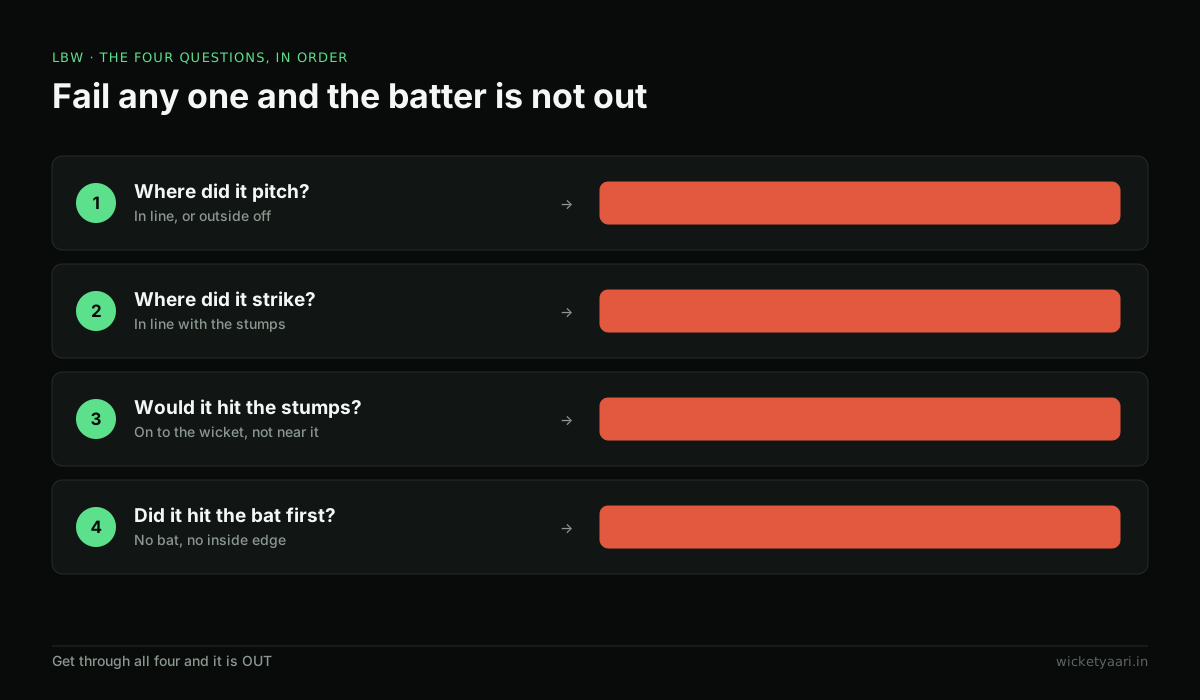
Leg before wicket is the Law people argue about most and understand least. It is not a judgement call. It is four questions, asked in a fixed order, and the answer to any one of them can end the appeal.
- Four questions, in order: pitching, impact, would it hit, and did the bat touch it
- Fail any one and the batter is not out, regardless of the others
- Pitching outside leg stump is not out, always, no matter how plumb it looks
- Most arguments are about which question the umpire stopped at, not the answer
The four questions
One: did it pitch in line, or outside off?
If the ball pitched outside leg stump, it is not out. Full stop. It does not matter how straight it then went or how dead it would have hit middle. This is the rule that produces the loudest wrong appeals in the game.
Two: where did it hit the batter?
Impact must be in line with the stumps. There is one exception: if the batter made no genuine attempt to play a shot, impact outside off stump still counts. That exception exists to stop batters simply padding away anything wide.
Three: would it have hit the stumps?
The projected path must be going on to hit the wicket. Not near it, on to it.
Four: did it hit the bat first?
An inside edge onto the pad is not out. Nothing else in the Law matters if the ball touched the bat first.
A ball pitches outside leg stump, strikes the pad in front of middle, and would have hit off stump. What is the decision?
Pitching outside leg is an absolute bar. It does not matter where it hit or where it was going. This is the single most common misunderstanding in the Law.
Where umpire's call comes from
The Decision Review System does not overturn an umpire on a coin flip. It draws a distinction between what the technology is confident about and what it is merely estimating.
For each of the three ball-tracking questions there is a margin. If the answer falls inside that margin, the original decision stands — that is umpire's call.
| Element | Overturned when | Umpire's call when |
|---|---|---|
| Pitching | clearly outside leg | never, this is measured not predicted |
| Impact | clearly outside line | the ball is marginally in line |
| Wickets | more than half the ball hits the stumps | any part clips them |
The consequence that annoys people is that two identical-looking deliveries can produce opposite results depending on what the on-field umpire said first. That is not a bug. It is the system saying: when the prediction is this close, the human who was standing there gets the benefit.
Why it is harder for spinners
An off-spinner turning the ball into a right-hander has to worry about question one constantly, because the natural line that beats the bat pitches on or outside leg.
This is why so many spinners bowl a fuller, straighter line to left-handers and why the arm ball, which does not turn, wins so many lbw decisions. The delivery that looks least dangerous is often the one that gets the finger up.
Fast bowlers have the opposite problem. Pitching in line is easy; the bounce is what defeats them, because a ball hitting high on the pad has usually already climbed over the stumps.
The height question nobody mentions
The fourth constraint is vertical and it is invisible on television without tracking. A ball striking the pad above roughly the top of the stumps is going over, and the taller the batter the more often this saves them.
It is why bowling to a very tall batter from close to the stumps produces appeals that look plumb and are not, and why bowlers with a lower release point win more lbws than their pace suggests they should.
Where the four questions came from
The lbw Law is not original to cricket in its current form. It has been rewritten repeatedly, and each rewrite closed a loophole batters had found.
The earliest versions had no lbw at all. It was added in 1774 because batters had begun deliberately blocking the stumps with their legs, which was legal and tedious. For over a century after that, a ball had to pitch in line with the stumps for an lbw to be given, which meant a bowler moving the ball in from outside off could not get one however plumb it looked.
That changed in 1935, when the Law was extended to allow lbw for a ball pitching outside off stump. The effect on the game was immediate and negative: off-spin and inswing became far more valuable, and the game got slower and more defensive for a generation.
The 1937 addition — impact outside off counts only when no shot is offered — was the correction that made it workable, and the modern Law has been essentially stable since. The one thing that has never changed at any point is the bar on pitching outside leg, which is the oldest surviving clause in the whole Law.
The batter's defences, in order of usefulness
Knowing the four questions is also knowing what to do about them.
Get forward. The further down the pitch the impact, the longer the projection and the more likely the ball is shown to be missing. It is the single most effective defence available and it is why front-foot play against spin survived the arrival of ball tracking.
Play with the bat in front of the pad. An inside edge ends the appeal outright, and a bat close to the pad makes an edge much more likely to be detected.
Use the height. A tall batter struck high on the front pad is frequently saved by the projection going over the stumps, which is why bowlers target the front pad of a short batter and the gloves of a tall one.
Do not play across the line. Almost every lbw dismissal in first-class cricket follows a bat coming down at an angle to the ball's path. Straight bat, straight line, and question four answers itself.
The bit that is genuinely subjective
Only one thing in the whole Law is a judgement rather than a measurement: whether the batter made a genuine attempt to play a shot.
That decision changes whether impact outside off counts, and it is made by a human watching whether a bat swung with intent or was hidden behind a pad. Two umpires can watch the same footage and disagree, and neither is wrong.
Everything else is either measured or predicted with a stated margin.
- Whether it was going to hit
- Where it pitched
- Where it hit the pad
- How high it struck
- Whether the batter played a shot
- Nothing else
Reading an lbw shout live
Watch in the same order the umpire does and most decisions stop being surprising.
- Where did it pitch? Outside leg ends it.
- Where did it strike? Outside off ends it, unless no shot was offered.
- How high did it strike? High on the pad usually means over the top.
- Was there an inside edge? Listen before you look.
Get through all four and it is out.
- Pitching outside leg is an absolute bar, whatever happened next
- Impact outside off only counts when no shot was offered
- Umpire's call means the prediction was too close to overrule a human
- The only genuinely subjective part is whether a shot was played
The Decision Review System is a separate piece. If you want the numbers behind the players who won the most of these, the player list has every cricketer in our dataset.