Javed Miandad by the numbers, and the last-ball six
8,832 Test runs at 52.57, appearances in six World Cups across twenty-one years, and the single most replayed delivery in Pakistan-India cricket.
Javed Miandad averaged 52.57 in Test cricket, played in six World Cups, and hit the last ball of a one-day international for six to beat India in a way that is still replayed every time the two sides meet.
- 8,832 Test runs at 52.57, from 124 Tests
- He played in all six World Cups from 1975 to 1996
- A double century on Test debut at 19, and 271 at 25
- The last-ball six at Sharjah in 1986
The record
| Format | Matches | Runs | Average | Span |
|---|---|---|---|---|
| Tests | 124 | 8,832 | 52.57 | 1976-1993 |
| ODIs | 233 | 7,381 | 41.70 | 1975-1996 |
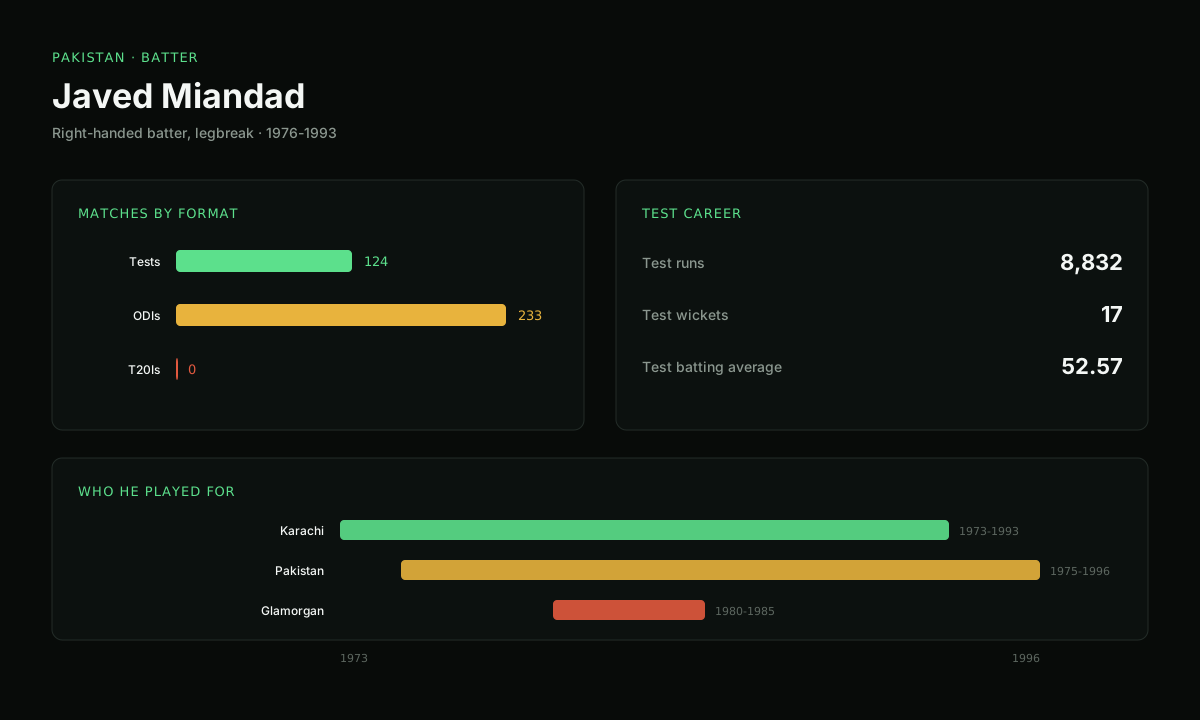
The full record is on his player page.
The debut
He made 163 on Test debut against New Zealand in October 1976, aged 19, and a double century in his third Test.
Very few players score a hundred on debut. Fewer score a double in their first series. He then averaged over fifty for seventeen years, which means the debut was not a fluke and the career that followed was the same player.
Six World Cups
He is one of a very small number of players to have appeared in six World Cups — 1975, 1979, 1983, 1987, 1992 and 1996 — which spans twenty-one years.
The 1992 tournament is the one Pakistan won, and he was the second-highest scorer in it behind Martin Crowe, with 437 runs at 62.42, batting at three in a side that almost went out in the group stage.
He also, in the final, batted with Imran Khan in the partnership that set the total England could not chase.
The Sharjah six
Australasia Cup final, April 1986. Pakistan needed four runs from the last ball against India. Miandad hit Chetan Sharma for six.
The delivery was a full toss. The shot went over midwicket. Pakistan won by one wicket.
It is the most replayed piece of footage in the history of Pakistan-India cricket, and it acquired a significance well beyond a tournament final: it is cited by players on both sides as the moment the psychological balance in that fixture shifted for a decade.
The unorthodoxy extended to where he stood. He took guard well outside leg stump against some bowlers and moved around the crease between deliveries, both of which were unusual then and are common now. The intent was to disrupt the bowler's line rather than to access a particular shot, and it worked often enough that opponents complained about it.
The style
He batted with an unorthodox, improvised method built on placement rather than power, and he was among the best players of spin of his generation.
The two features people describe are the running between the wickets — he turned ones into twos more consistently than anybody of his era — and the willingness to improvise. He played shots that did not have names, particularly against spin, and he scored heavily in areas fielders were not.
He was also, by universal agreement including his own, one of the most combative cricketers ever to play. The confrontation with Dennis Lillee at Perth in 1981, in which the two came close to a physical altercation on the field, is the most-cited incident.
The 1992 captaincy question
Imran Khan captained the 1992 World Cup side and Miandad was vice-captain, having captained Pakistan in several earlier periods.
His own captaincy record — 34 Tests, 14 wins — is better than most Pakistani captains of the era and it ended in circumstances that were, as usual for Pakistani cricket of that period, political rather than cricketing.
The two of them together are the reason Pakistan won in 1992: Imran set the direction and Miandad scored the runs.
Country and role narrow it. The span from 1976 to 1993 is the fastest route.
Javed Miandad — The last-ball six at Sharjah in 1986 that Pakistan still talks about. Full record
The one-day career, in context
7,381 runs at 41.70 from 233 matches, at a time when a one-day average above forty was outstanding.
The format was in its infancy for the first half of his career — sixty overs a side, no fielding restrictions, and a scoring rate that would now look like a Test innings. His method, built on running and placement rather than power, was well suited to it and he was among the most reliable one-day batters in the world for fifteen years.
The six World Cups are the record that survives. Playing in the first one in 1975 and the sixth in 1996 requires being good enough at 18 and still good enough at 39, and almost nobody manages both ends of that.
The Test record, plainly
52.57 across 124 Tests places him in the top handful of batters of his era, alongside Border, Gavaskar and Viv Richards.
His record at home was outstanding and his record abroad good, which is roughly the pattern for every subcontinental batter before the 2000s. The 260 at the Oval in 1987 is the innings usually named from overseas.
He scored six double centuries, which is more than any Pakistani has, and only one batter in the world had more at the time he retired.
- The last-ball six at Sharjah
- The confrontation with Lillee
- The 1992 World Cup
- Being difficult
- A Test average of 52.57 across seventeen years
- Six double centuries, the most by a Pakistani
- Appearances in all six World Cups from 1975 to 1996
- A double century on debut at 19
The 280 not out
His highest Test score is 280 not out against India at Hyderabad in 1983, in a match Pakistan won by an innings.
That series is one of the more one-sided in the fixture's history: Pakistan won 3-0, Miandad and Mudassar Nazar both scored heavily, and Imran Khan took 40 wickets at 13.95, which is among the best series returns by any bowler.
The 280 not out is also part of a specific pattern in his record. He scored six double centuries, all of them at home, and all of them in matches Pakistan were winning comfortably. A batter who converts big scores into very big ones is unusual, and it is why his average sits above his contemporaries' despite a similar number of hundreds.
What came afterwards
He coached Pakistan across three separate spells and was involved in the board in various capacities, and none of it lasted long.
Pakistani cricket administration in that period changed direction with the government, and coaches and selectors were appointed and removed on cycles that had nothing to do with results. He was appointed and removed more times than most.
His son married the daughter of Dawood Ibrahim, which became a political subject in India and had nothing to do with anything he did on a cricket field. It is mentioned here only because it is the reason his name appears in Indian coverage that is not about cricket.
Where he sits in our dataset
Difficulty tier 1 on the player list. Pakistan, batter, 1976 to 1993 has one answer, and the runs column confirms it.
- 8,832 Test runs at 52.57, from a debut double century at 19
- Six World Cups across twenty-one years, and the 1992 win
- The last-ball six at Sharjah, which is still replayed
- Six double centuries, more than any other Pakistani batter
The short version
He averaged over fifty for seventeen years, played in every World Cup for two decades, and hit the single most famous ball in the sport's most-watched rivalry. The last of those is what gets replayed and the first is what the record is.
For the captain he won the World Cup under, see Imran Khan by the numbers, and for the tournament itself, the first cricket World Cup 1975.