Why there is no money in WicketYaari, and never will be
No entry fees, no prizes, no wallet, no accounts required. The law that made it necessary, and the reasons we would have chosen it anyway.
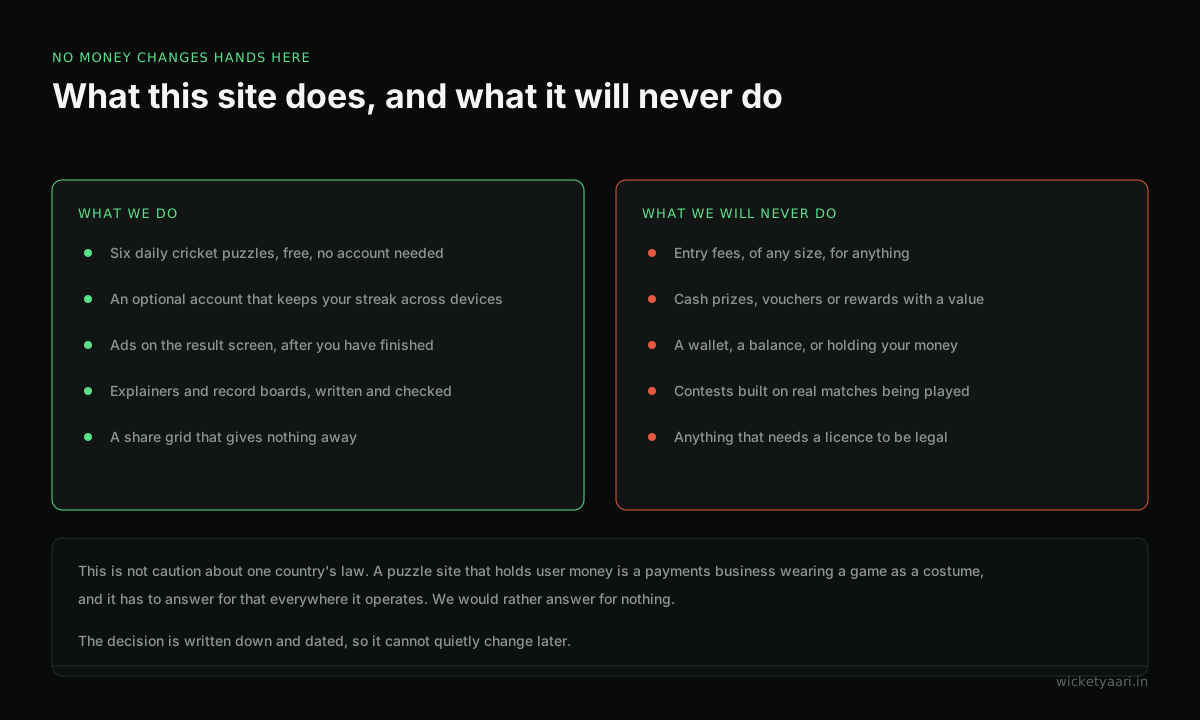
There is nothing to win here. No entry fee, no prize, no voucher, no wallet, no balance, no withdrawal. You play six cricket puzzles, you keep a streak, and that is the entire transaction.
That is a permanent position, and this is why.
The law made it necessary
India's Promotion and Regulation of Online Gaming Act 2025 has been in force with its rules since 1 May 2026. It prohibits online money games nationwide — any game where money is staked to win money — and it does so regardless of whether the game is one of skill. Fantasy sports are covered.
The effect on the industry was not subtle. Dream11 suspended all paid contests, which had accounted for roughly 95 percent of its revenue and effectively all of its profit, and moved to free-to-play with advertising. My11Circle, MPL, Howzat and the rest followed within weeks.
Challenges to the Act were transferred from the High Courts to the Supreme Court in September 2025 and remain undecided.
So a real-money cricket game was never an option for a site starting in 2026. But the legal position is only half the reason.
We would have chosen it anyway
Once a product holds money, it stops being a puzzle and becomes a financial service with a puzzle attached.
It needs a payment processor, chargeback handling, refunds, identity checks, tax treatment in every country it operates in, and a support function for everyone who cannot find their withdrawal. Every one of those is a real job, and none of them is making the puzzles better.
There is also the thing that money does to design. The moment a product's revenue depends on people spending, every decision gets a second, quieter question attached: does this make them spend more? Difficulty curves, streak mechanics and notification timing all start bending, usually so gradually that nobody involved would say they did it on purpose.
We would rather not have the question available.
What that rules out, specifically
- Entry fees, buy-ins, or any paid contest
- Cash prizes, gift cards, vouchers, merchandise prizes, or anything with a
- Wallets, balances, deposits, withdrawals, or held user funds
- Anything a reasonable regulator would read as a stake
cash equivalent
The prediction game we will eventually run during a tournament is the closest this site comes to fantasy, and it will score points and nothing else. If a sponsor wants to attach a cash prize to it, the answer is no. That is written down in the project's decision records, not just in someone's head.
So where does the money come from
Advertising, and a small affiliate line. Those are transactions between this site and an advertiser, not between this site and you.
We have also blocked the gambling, betting and real-money gaming ad categories, because it would be absurd to write this page and then run a betting banner underneath it.
To be straightforward about the scale: this is a few hundred dollars a month kind of business, not a venture-backed one. The ads sit above the board and on the result screen, never inside the game, never as an interstitial before you play, and never over the share button. If those placements ever start costing us returning players, the placements come out before the players do.
What the ban actually changed, in numbers
| Before the Act | After | |
|---|---|---|
| Dream11 paid contests | ~95% of revenue | none |
| Legal real-money fantasy in India | yes, as a game of skill | no, regardless of skill |
| Free-to-play fantasy | a side product | the entire industry |
| Prizes permitted | cash | non-cash only, and we do neither |
The row that matters for a new site is the second one. The Act removed the skill-versus-chance distinction that every Indian fantasy platform had built its legal position on. Whatever the Supreme Court eventually decides, a product designed in 2026 around a stake would be betting the whole thing on that decision.
What a puzzle site with money attached actually becomes
The reason this is a decision rather than a preference is what the alternative requires.
The moment a site holds a user's money, it is a payments business. It needs identity verification, because you cannot pay out to somebody you cannot identify. It needs anti-money-laundering procedures, because a system that takes money in and pays money out is exactly the shape of thing that gets used for that. It needs a way to handle disputes, chargebacks and refunds, in every jurisdiction its users are in. It needs licences in some of those jurisdictions and cannot legally operate in others at all.
None of that is cricket. All of it is a full-time operational burden that arrives before the first rupee of profit, and it is a burden that grows with success rather than shrinking.
| A free puzzle site needs | A site holding user money needs |
|---|---|
| Hosting and a database | All of that |
| A privacy policy | Identity verification for every user |
| Working analytics | Anti-money-laundering monitoring |
| Somebody to answer email | Dispute handling in every jurisdiction |
| Licences, where they exist, and geo-blocking where they do not |
What we do instead, in detail
Advertising on the result screen, and nothing else for now.
The result screen is the right place for it because you have finished the puzzle. Nothing is being interrupted, nothing is being gated, and no part of the game is worse because an ad loaded. If we ever cannot sell an ad there, the puzzle still works, which is the test we apply to every revenue idea that gets suggested.
There are a few things we would consider later and have not built: a paid archive for people who want to play every past puzzle, merchandise, and a sponsorship of a specific game by somebody whose brand fits. Every one of those is a transaction where somebody buys a thing from us at a known price. None of them involves holding a balance, running a contest, or paying anybody out.
Why write this down at all
Because decisions like this get quietly reversed.
A site that is not making money looks at its options every few months, and the option that always resurfaces is the one where users deposit something. It is written down, dated, and published so that the reversal cannot happen silently: if it ever changes, it changes in public, against a document that says what we said we would do.
And no account, either
You do not need to sign up to play anything. Not the daily puzzles, not the archive, not the stats, not the group leaderboards.
An email is optional and buys exactly three things: your streak follows you to another device, you get a name on a leaderboard, and you can have one reminder a day if you want one. Nothing on this site is ever locked behind it.
The reason is the same as the money one. A signup wall would raise a number on a dashboard and lower the number that actually matters, which is whether people come back tomorrow.
- No entry fees, no prizes, no vouchers, no wallet, no held funds
- Partly the law in India, mostly because money bends every design decision
- Revenue is advertising and affiliate, between us and an advertiser, not you
- No account is required for anything, and nothing is ever paywalled
The short version
No stake, no prize, no wallet, no account. Partly because the law in India says so, mostly because a puzzle that handles money stops being a puzzle.
If you want to know how the puzzles themselves are put together, that is here. If you would rather just play, today's six are up, and the archive has every one we have ever run.