

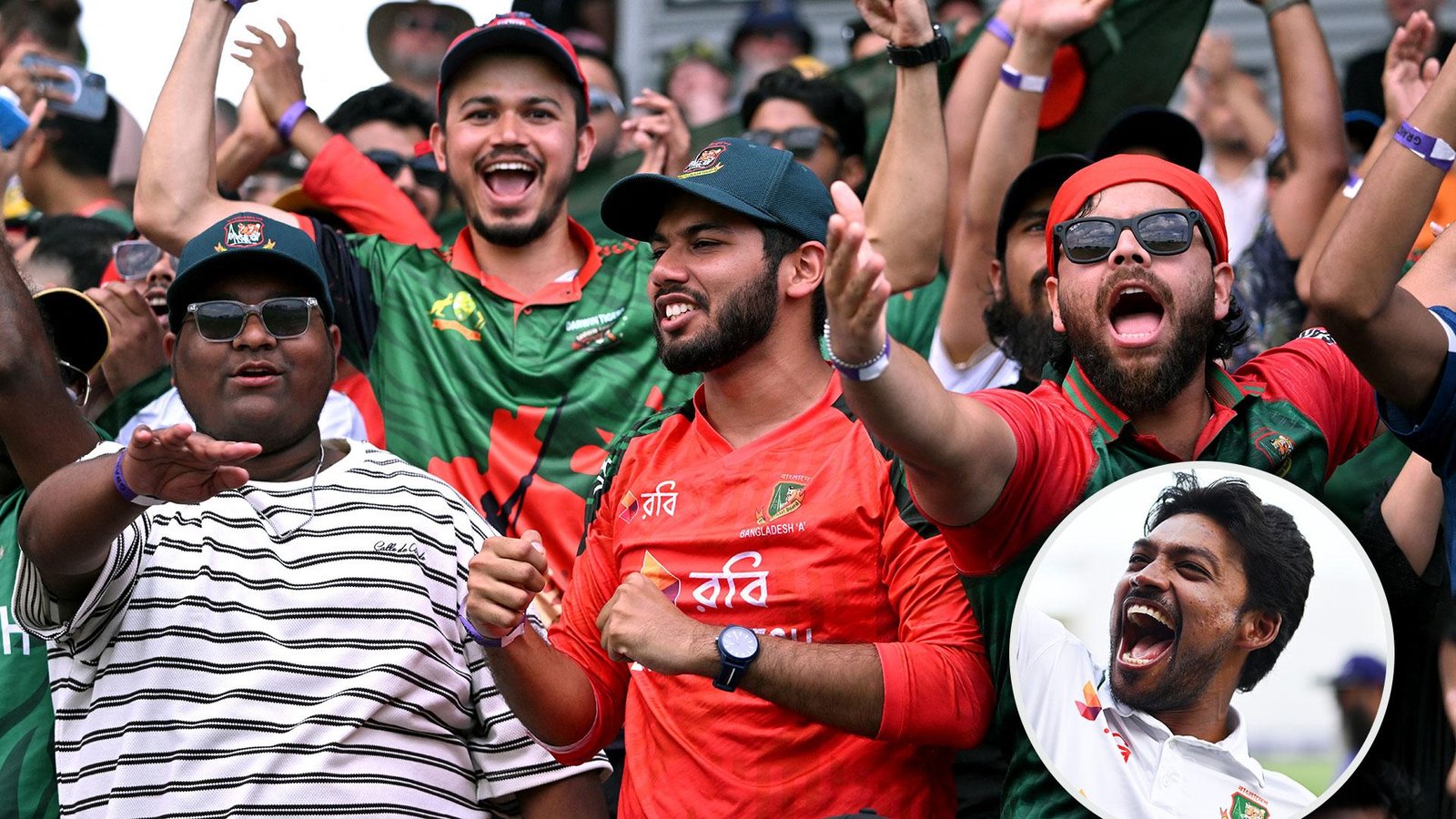
The Bangladesh team’s victory song reverberated off Marrara Stadium’s concrete pillars and into Darwin’s early-evening air long after the last of their jubilant fans had departed.
The sound of one of cricket’s unlikeliest results being heard by few outside the tight-knit Tigers group was in keeping with their muted celebrations. Mominul Haque had hours earlier hit the winning runs and hardly raised a fist.
Only a couple of the visitors breaking away from the lines of handshakes with their conquered hosts to seize souvenir stumps gave away the gravity of what they had pulled off over the preceding three-and-a-half days.
Bangladesh players assembled in front of the Maurice Rioli Stand with a phone held up by a support staffer as their country’s Prime Minister congratulated them on a video call. Najmul Shanto’s grinning charges assembled for a team photo before politely carting the white plastic chairs back to their dressing rooms.
It was not the carry-on of giddy underdogs who had lucked into unexpected success. Rather, it was the measured satisfaction of a group that has admirably coped with immense expectation.
“We all know the fans are really crazy about cricket,” said Shanto. “I really believe they are very happy … That’s the beauty of this game. In our culture, we’re pretty emotional. Sometimes when we lose, they cry.”
In the bigger picture, it is a win underwritten by a major shift in Bangladesh’s cricketing identity.
In 2017, they beat Australia on a low, turning Mirpur snake-pit tailor-made for their small-in-stature spinners. Four years later they toasted their first series win over the Aussies on an even more wicked set of surfaces at the same venue in a five-game T20I series.
Since, there has been a commitment to producing wickets that encourage their growing stable of fast bowlers and make life less of a lottery for their batters. It was on these type of wickets in June that they enjoyed a 2-1 ODI series win over an undermanned Australia.
That the two major pace threats in that campaign – Nahid Rana, who blitzed the Aussie top-order with 4-41 in the first match, and Shoriful Islam, who returned 6-48 in a tight third game – were absent injured for the Darwin Test only underlined their newfound pace foundations.
“That is the biggest change for Bangladesh in Test format,” Shanto told the host broadcaster after what he labelled his team’s biggest ever victory.
“Earlier, five years ago, pacers didn’t want to play Tests. But we’ve been playing lots of Test cricket and they are giving importance to Test format. They want to play, want to perform, want to be world-class.
“That is the mindset they now have. Seniors like Mushfiqur (Rahim) and Mominul (Haque) have encouraged them to play more Test cricket.”
Still, Bangladesh were rightly unfancied by virtually everyone for their first Test down under in 23 years.
Their two most recent red-ball games, both in the kind of conditions they were expecting in Darwin, were innings defeats. Even despite their experience on springier home pitches, they displayed a worrying vulnerability to the southern hemisphere’s extra bounce.
In their most recent Test in Harare, a four-pronged Zimbabwe seam attack knocked them over for 140 and 185 on a wicket their own seamers only managed two wickets during the hosts’ only innings of 410.
Fears that Bangladesh were to be cannon fodder for the likes for Mitchell Starc and co. grew when left-arm swing bowler Campbell Thompson, with one Sheffield Shield cap to his name, decimated the tourists with a haul of 8-25. They were skittled for 54.
“It shows our character,” Mehidy said. “After losing the practice match, we still had belief. We thought that it’s a great opportunity for us in these conditions, after a long time we came here.
“They are a very good and world-class team, they have lots of good players and if we beat them it would be great for our country and our cricket. We knew we had to believe otherwise we can’t do it.”
Shanto singled out the contributions of Taskin Ahmed and player of the match Hasan Mahmud in particular. Gifted favourable bowling conditions by Pat Cummins on Thursday morning, that pair collected eight of the Australian wickets to roll them for 198.
Mahmud had up-skilled his long-form bowling on nippy wickets with a 12-wicket, two-match stint for Kent in June. It was then little surprise he thrived in similar day-one conditions in Darwin and finished with a player-of-the-match haul of 9-111.
Among visiting bowlers, only Jasprit Bumrah has better Test match figures in Australia over the past 15 years.
There was a grit, too, about this outfit.
Not long before the 13th hole tee shots of Australian players enjoying the Darwin Golf Club landed on top of the Marrara nets, coach Phil Simmons was imploring the Bangladesh bowlers to show more fight with the bat after a couple of airy swings against net bowlers.
A couple of days on, those same tail-enders helped Mehidy Hasan add 118 for the final four wickets in their first innings. It has helped Bangladesh, remarkably, go above India on the World Test Championship standings.
Not that Shanto has wavered from his cool demeanour, setting his sights now on a 2-0 series win. “Follow the process, play session by session,” he said. “Bowlers did their job, batsmen chipped in and especially the lower middle order and lower order, the way they added (runs). Those are the things we need in Mackay.”
NRMA Insurance Bangladesh Test series
First Test: Bangladesh beat Australia by nine wickets in Darwin
Second Test: August 22-26, Great Barrier Reef Arena, Mackay, 10am (local)
Australia squad: Pat Cummins (c), Scott Boland, Alex Carey, Cameron Green, Josh Hazlewood, Travis Head, Josh Inglis, Marnus Labuschagne, Nathan Lyon, Steve Smith, Mitchell Starc, Jake Weatherald, Beau Webster
Bangladesh squad: Najmul Hossain Shanto (c), Mehidy Hasan Miraz (vc), Soumya Sarkar, Shadman Islam, Tanzid Hasan Tamim, Mominul Haque, Mushfiqur Rahim, Litton Das, Amite Hasan, Jaker Ali, Taijul Islam, Taskin Ahmed, Hasan Mahmud, Syed Khaled Ahmed, Ebadot Chowdhury, Shoriful Islam, Musfik Hasan
