

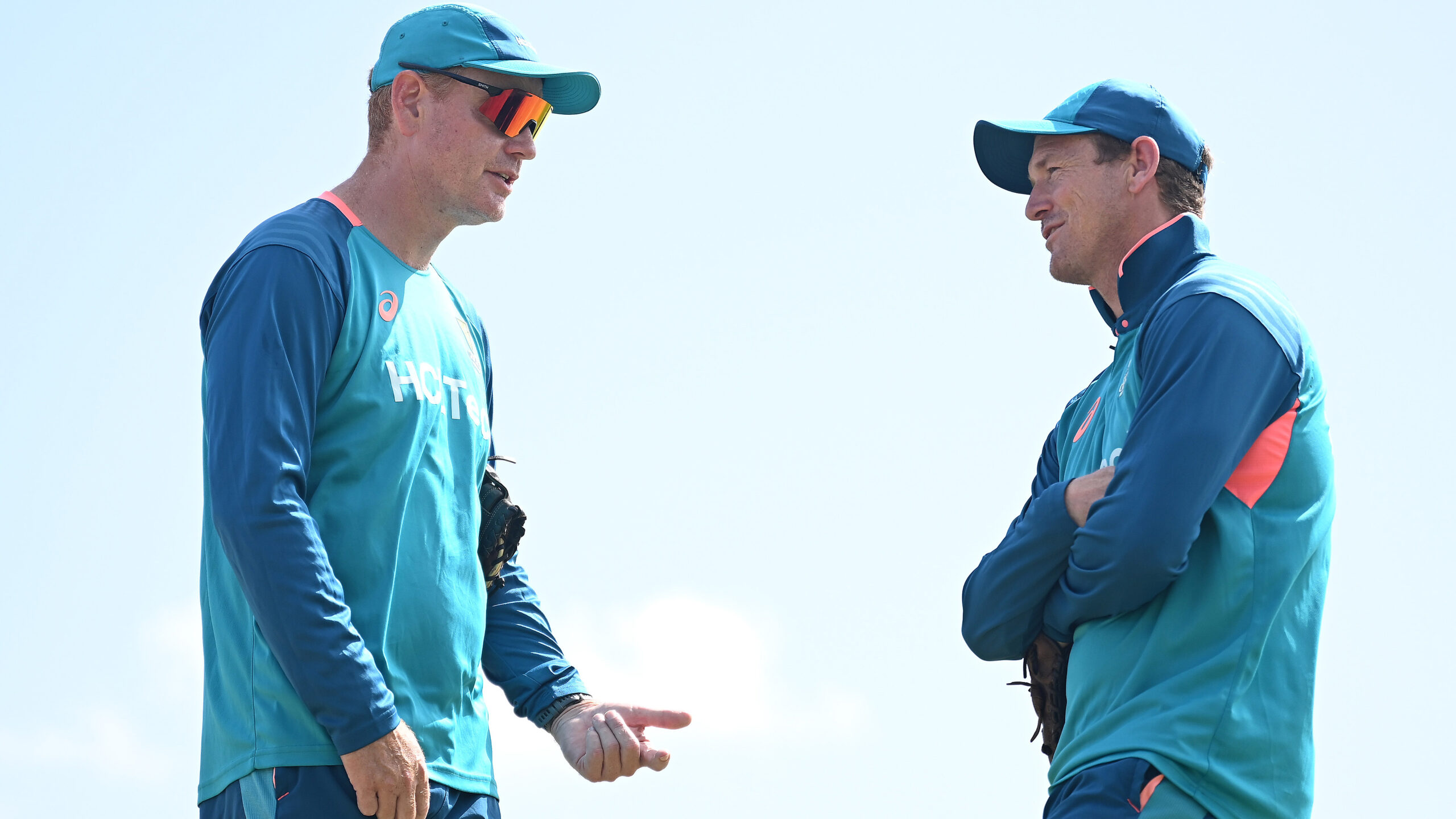
George Bailey has dismissed concerns that Australia stars could turn down national contracts but conceded franchise cricket has created “tension in the marketplace”.
It comes after the release of Australia’s winter white-ball squads to tour Pakistan and Bangladesh that have several top players missing entirely or making delayed entrances because of the game’s most lucrative T20 league.
Bailey, the former national limited-overs captain turned team selection chief, also expressed solidarity with reported discontent from top Big Bash players over outsized salaries for overseas imports.
Australia will take a total of 24 different players to Pakistan and Bangladesh to cover the absences of some of the team’s leading lights for varied reasons and durations. The overlap of the Indian Premier League playoffs with the ODI series against Pakistan was the most significant among a convoluted set of factors selectors were forced to reckon with.
Australia squad for Pakistan ODIs: Mitchell Marsh (c), Alex Carey, Nathan Ellis, Cameron Green, Josh Inglis, Matthew Kuhnemann, Marnus Labuschagne, Riley Meredith, Oliver Peake, Matthew Renshaw, Tanveer Sangha, Liam Scott, Matt Short, Billy Stanlake, Adam Zampa
Australia squad for Bangladesh ODIs: Mitchell Marsh (c), Xavier Bartlett, Alex Carey, Cooper Connolly, Ben Dwarshuis, Nathan Ellis, Cameron Green, Travis Head, Josh Inglis, Matthew Kuhnemann, Marnus Labuschagne, Matthew Renshaw, Tanveer Sangha, Liam Scott, Adam Zampa
Australia squad for Bangladesh T20Is: Mitchell Marsh (c), Xavier Bartlett, Cooper Connolly, Tim David, Joel Davies, Nathan Ellis, Cameron Green, Aaron Hardie, Travis Head, Josh Inglis, Spencer Johnson, Matthew Kuhnemann, Riley Meredith, Josh Philippe, Matthew Renshaw, Adam Zampa
Only IPL players whose teams cannot, or likely will not, make the league’s finals – including Lucknow Super Giants’ Mitch Marsh and Josh Inglis, and Kolkata Knight Riders’ Cameron Green – have been named for the ODIs beginning in Rawalpindi later this month.
Some others in the playoff mix – including Travis Head (Sunrisers Hyderabad), Tim David (Royal Challengers Bengaluru) and the Punjab Kings’ contingent of Ben Dwarshuis, Cooper Connolly and Xavier Bartlett – will link up for the ensuing ODI and T20I tour legs in Bangladesh.
But none of the Big Three pacemen, including ODI captain Pat Cummins, will play any part in either tour. All three of Cummins, Josh Hazlewood and Mitchell Starc are fit and firing in the IPL, albeit after delayed entrances having been held back by Cricket Australia medicos.
Bailey suggested the trio, all of whom have battled injuries of varying seriousness in recent times, will shift focus to the start of a hectic run of Tests beginning in August.
Cummins could return to the limited-overs fold during Australia’s ODI series in Zimbabwe and South Africa in September, countries that will co-host the 2027 ODI World Cup, along with Namibia. Hazlewood and Starc could conceivably follow a similar path. Starc is retired from T20Is.
Mainstays Glenn Maxwell and Marcus Stoinis have also been left out, as has Steve Smith despite his recent T20I recall during February’s World Cup. Bailey said the door was not shut on any of that trio playing T20Is again. All three are retired from ODIs.
That trio are also among the more than a dozen Australians who hold contracts for Major League Cricket, the USA T20 league that overlaps with next month’s T20Is in Bangladesh.
But Bailey insisted MLC, unlike the IPL, was not a consideration for selectors, who left out Matthew Short and Mitchell Owen (two more MLC players) out of the T20I squad. Other MLC players like Connolly and Bartlett were picked.
“The fact of the matter is, particularly around bilateral white ball cricket, is there’s always something going on,” said Bailey. “There’ll be a franchise opportunity somewhere around the world that normally runs concurrently.”
The head-spinning set of considerations for selectors illustrates the challenges administrators face, and comes amid CA’s stalled privatisation push for the Big Bash that, according to a News Ltd report, has led to some players holding out putting pen to paper on national contracts offered to them last month.
“I’ve seen a few reports on it and I actually think that’s pretty normal for this time of year,” Bailey told reporters on Monday.
“One of the things that’s important to understand is that we offer our contracts up at the end of April. The key reason for that is to unlock the state contracting process and allow states to go forward with certainty, knowing who they have on national contracts and then what space that allows … for their state players.
“But the actual contract doesn’t kick in until the first of July.
“So I think it’s pretty normal at this time of year that agents are out spruiking trying to get the best deal that they can for their for their clients. I don’t think that’s been any different to any other year.
“But there’s no doubt we acknowledge that it’s a changing landscape. Players do have options. It’s an exciting time to be a player and we’re constantly trying to strike that balance.”
Cricket Australia’s chief executive Todd Greenberg has admitted the rejection by multiple state associations of the proposal to test the value of BBL teams presents a marked challenge for the game.
“Players are being presented with lucrative alternative offers right now, and we’re not going to sit on our hands or try to kick some of these decisions down the road,” Greenberg told the ABC.
“Those challenges are real. We’re trying to find a model in Australian cricket that we think pays the players fairly on the revenue that we generate, but also protects the broader sport as well. And that’s a fine balancing act.”
One of the Australian team’s blessings, reiterated by Bailey, Greenberg and other CA leaders in recent times, has been players’ prioritisation of international cricket – and particularly Tests – in the face of the tempting sums on offer from the global franchise circuit.
Bailey also pointed to the Australian cricket’s high-performance network – the envy of rival nations – as a major drawcard that even well-resourced T20 franchises cannot yet compete with.
Speaking about freelancers who might snub national or state deals, Bailey said: “One of the things I’m always interested is you potentially buy yourself flexibility, but you’re probably a on a year-to-year whim, or a franchise tournament-to-tournament whim, as to whether you’re going to get selected.
“You also run the risk of giving up that consistent training base, access to the resources that you need to actually help you perform, in terms of training facilities, coaches, strength and conditioning, gym programs, physios, doctors, psychologists – all that sort of thing.
“If you look at the guys (who have done it) – and it probably depends too on the age of the player and where they’re at in their career and what they’re trying to achieve – but there’s not a huge amount (of players) that I would say made that shift and done it incredibly well.
“I think if you start to look around the world, even at some of the countries where that’s happened, we’re starting to see some players actually fold back into the into their national programs as well.”
But as Greenberg insisted, there is an open question over whether Australian cricket’s governance model will be able to keep top players involved in international cricket.
“Can we continue to attract and retain the best players playing both for Australian cricket in bilateral cricket, can we retain them there?” he said. “And can we retain them and attract them to the BBL in a market where we’re up against private capital all over the world in T20 leagues?”
CA had hoped selling stakes in BBL teams would keep the hounds at bay by bumping the salaries of its best players, only to be snagged by Australian cricket’s federated decision-making model that has allowed administrators in NSW and Queensland to halt the move towards allowing private capital into the game.
As it stands, the current contracting system that sees some of the BBL’s international imports earn more than its best men’s domestic players will roll over into next summer. This has reportedly been a major bone of contention for Australian stars.
“It’s not my area – but I can empathise with some of our best white-ball players,” said Bailey. “Not only that, but I think the guys that are probably marketed and helped grow the Big Bash to where it is, I can empathise with their position.”
Qantas Tour of Pakistan & Bangladesh 2026
May 30: First ODI, Rawalpindi Stadium, 9:30pm AEST
June 2: Second ODI, Gaddafi Stadium, Lahore, 9:30pm AEST
June 4: Third ODI, Gaddafi Stadium, Lahore, 9:30pm AEST
June 9: First ODI, Sher-e-Bangla National Stadium, Dhaka, 3pm AEST
June 11: Second ODI, Sher-e-Bangla National Stadium, Dhaka, 3pm AEST
June 14: Third ODI, Sher-e-Bangla National Stadium, Dhaka, 3pm AEST
June 17: First T20I, Bir Sreshtho Flight Lieutenant Matiur Rahman Stadium, Chattogram, 6pm AEST
June 19: Second T20I, Bir Sreshtho Flight Lieutenant Matiur Rahman Stadium, Chattogram, 6pm AEST
June 21: Third T20I, Bir Sreshtho Flight Lieutenant Matiur Rahman Stadium, Chattogram, 6pm AEST
All matches exclusive on Kayo Sports and Fox Cricket
