

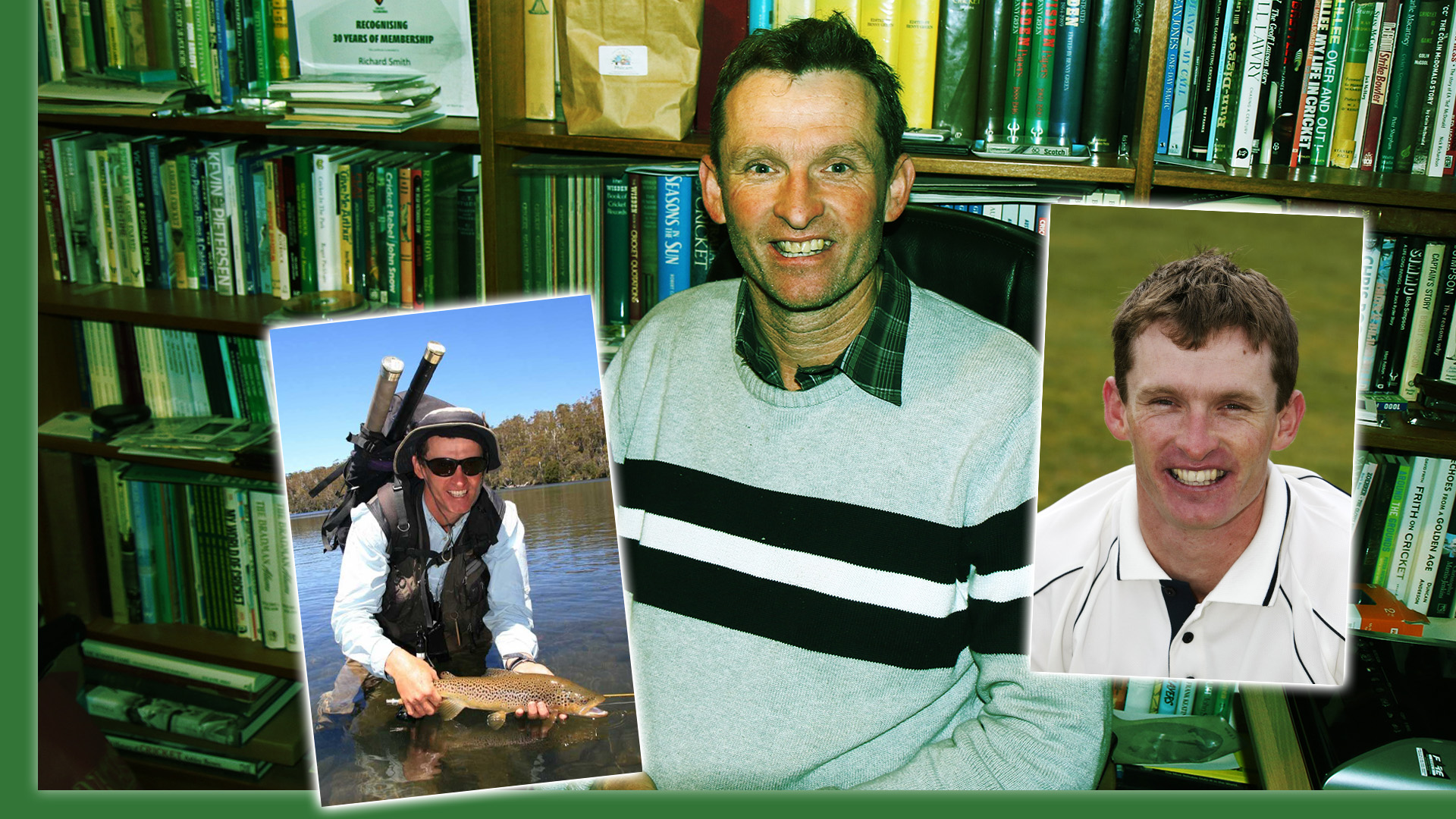
On his lush green property just a short drive north-east of Launceston, Christopher Bassano has been planting juvenile oaks.
One day, well beyond his time, these three-year-old saplings will mature into grand old trees, for future generations of his family to enjoy.
“Life changes,” Bassano tells cricket.com.au. “Initially, it’s all about you – and certainly there’s a level of selfishness that’s required to play professional sport. That doesn’t sit comfortably with me, but I understand that’s how it had to be – and that is how it was.
“But it also means that, now in my life, most things I do, I’m thinking of my children.”
Lately though, a couple of looming milestones have been dragging him back into the past.
Bassano turned 50 last September, which means it is half a lifetime ago that, across three weeks in the northern summer of 2001, a fleeting moment of cricket glory made way for a timeless grief.
“Twenty-five years, and it’s still like this,” he says, brushing a tear away. “I still haven’t got over it. I know I’ll never get over it.”
* * *
A week before Christmas, 1988, a 13-year-old Christopher Bassano and his father, Brian, touched down at Hobart Airport.
The Bassanos had left their home on the Indian Ocean in Port Elizabeth (now Gqeberha), South Africa. There, Brian – a cricket writer and historian – openly defied the policy of Apartheid by introducing junior cricket programs to a number of the city’s black townships. Another arm of his activism came in the form of the Rainbow Cricket Club, which he established with his friend and colleague Donald Woods, who wrote the books upon which the movie Cry Freedom, starring Denzel Washington, was based.
“Dad captained that team,” Bassano says. “They had police at every game because it was illegal for them to be playing (desegregated cricket).”
So inextricably bound to cricket was Brian, he felt that South Africa’s international sporting ban ultimately forced him into a life-changing move.
“That was one of the main reasons he wanted to leave South Africa – he just wanted to watch Test cricket,” Bassano says. “He couldn’t really see how (an end to the ban) was going to happen at that stage. He’d say, ‘Look, it’s not coming back – if I’m going to watch Test cricket, we’re going to have to leave’.”
With his experience as a journalist and his connections across the cricket world, he landed a job with The Examiner newspaper in Launceston.
It meant an uprooting of the family. For Christopher, a budding right-handed batter and captain of the Eastern Province Under 13s, the practical reality of that was to be jolted out of a childhood that had been nothing short of idyllic.
“We’d had nothing really to worry about as kids,” Bassano says of his life that began in East London (now KuGompo City) and then moved south along the east coast to Port Elizabeth.
“You’re young, and you don’t understand (the politics). We used to go outside, run around, play cricket all the time, go fishing … it was great.”
Bassano had two uncles on his mother’s side, each with a fishing shack in different parts of the country. He remembers most his uncle Cecil’s, situated in a little town called Eerste River over on the Western Cape. There they would spend idle time with their lines in the water.
“There was a dirt road, his shack was on one side, and there were rocks and then ocean on the other,” he says. “So we’d collect bait off the rocks, then fish right in front of the shack. Mostly for black tail, zebra fish, luderick and tailor.”
The move to Australia signalled an abrupt end to that world. So much so that Christopher, who was playing in an U13s national tournament at the time, went directly from cricket ground to airport.
“Just me and my dad,” he says. “The rest of the family – my mother, two sisters, and brother – stayed back and flew out later.”
In keeping with the traditional values of a white South African family of the period, the boys – oldest sibling Richard and third-oldest Christopher – were closer with their father, while the girls, Mary and Kate, were closer with their mother, Alison. The brothers attended Grey High School, which according to Christopher, was run with military levels of discipline.
A lot would change in Tasmania, and first stop on the road to a new life was another cricket ground: Bellerive Oval.
“Literally straight there from the airport,” Bassano tells cricket.com.au. “Tasmania were playing the West Indies.”
It was December 20. Brian’s friend, Ric Finlay – a mathematics teacher and cricket statistician – lived with his wife and two children on Warwick Street in West Hobart. The family’s two-storey federation brick house was thrown open to the arriving pair.
That night, as Christopher drifted off to sleep, Brian and Ric caught up. They pored over the day’s play and regaled each other with tales from their very different worlds. By the time they pulled up stumps, it was almost midnight.
“The next morning, I could hear young Chris coming up the stairs,” Finlay says. “He stood in our bedroom doorway and said, ‘Dad’s not very well – he thinks he’s had a heart attack’.”
Finlay put both father and son in his car, and dashed to St Helens Hospital, a private facility at the top of Macquarie Street in Hobart’s CBD. As the severity of his condition quickly became clear, Brian was transferred to nearby Royal Hobart Hospital.
On the penultimate day of the school year in Tasmania, Chris tagged along to Rose Bay High with Finlay, who was an acting senior master at the time. For long stretches of that Wednesday, the fair-haired 13-year-old sat in the staff room, his head spinning with all that had transpired.
“You’ve just arrived in a new country, you’re a bit young to fully understand all the unknowns, but more than that, your dad’s really not well,” he says. “And my relationship with my dad … we were very close.”
In the days that followed, Christopher was ferried back and forth to sit with his father, whose condition improved initially but then worsened after a relapse on Boxing Day. He remembers, too, walking the 30-minute round trip from the Finlay residence to the hospital as he became more familiar with his surrounds.
The young teen had spent Christmas morning with the Finlays, then returned to the hospital that afternoon, staying into the evening.
“I couldn’t tell you how long it was after that – maybe a week or two – that the rest of my family made it out (to Australia),” he says. “They arrived, Dad got transported up to Launceston Hospital, and then it all becomes a bit of a blur.”
As the Christmas and New Year’s window came and went, Brian’s health gradually improved. Before too long, he was back on his feet. Through it all, Christopher was by his side.
By then, the rest of the Bassanos had landed in Launceston, though settling into a new life wasn’t easy for any of them.
“It was all a bit of a shock,” Christopher smiles now. “Even being in a co-ed school (Launceston Grammar) was a shock – the only girls I’d ever spoken to were my sisters.
“In South Africa, you’d make sure your shoes were clean, your tie was done up properly. All the teachers were ‘Sir’, and when I was spoken to, I would stand up. Then I’d do those things (in Australia) and everyone’s looking at me very strangely (laughs).”
Cricket, though, was a common language. The school had a proud cricket heritage; then Test batter David Boon had graduated a decade earlier. Bassano made his way onto the grade cricket scene with Launceston, and by the early 1990s he was also in Tasmania’s pathways system, representing the state in the 1991-92 U17 National Championships in Canberra as a batter and part-time leg-spinner (he dismissed Victoria captain Brad Hodge lbw for two in that tournament).
By 1993, Bassano’s final year of school, he had also become better acquainted with Tasmania’s abundance of lakes and rivers. No longer an ocean fisherman, he had adapted happily to his environment, taking advantage of the state’s stunning wilderness to learn the art of fly fishing.
One day, during an afternoon of trout fishing with brother Richard, he had a chance meeting that would have considerable reverberations through his life.
“We ran into this random bloke who was asking us about where we’d been fishing, and I told him about this particular place up at the Lakes,” he says. “And I said, ‘Look, if you’re going up there, here’s some flies’ – and I gave him some flies to use.”
The man was himself a fishing guide, and he soon offered Bassano a job. It was work he continued through his university days and beyond, a stable foundation amid the undulations of professional cricket, which he later parlayed into other fishing avenues.
Around that time, Bassano’s parents separated. Alison chose to stay close to the heart of Launceston, where she was establishing roots. Brian bought a 30-acre parcel of land around 25 minutes north-east of the city.
“It was just bush then,” Christopher says. “Dad cleared it, and eventually moved out there.”
The property became special to Brian. The stillness of its surrounds. The uninhibited wildlife. St Patrick’s River running through it. The vista of Mount Barrow to the east. He planted trees and tended to the land.
One day, he told his sons, he would leave it to them.
He named it Newlands.
* * *
In the northern summer of 2001, Bassano made one of the most impressive arrivals ever witnessed in the County Championship.
Twenty-five at the time, he had for years been part of the Tasmania set-up without ever earning the state cap he was chasing.
The Tigers of that era boasted quite the batting line-up. At full strength, a list of Dene Hills, Jamie Cox, Michael Di Venuto, Ricky Ponting, Dan Marsh and Shane Watson (or Shaun Young) would have competed comfortably at international level.
And for a period in Bassano’s early 20s, retired Test batter Boon regularly occupied a spot, while across 2000 and 2001, mainlanders Graeme Cunningham and Michael Dighton – as well as 16-year-old Hobart product Tim Paine – were added to a Tasmania squad desperately pursuing a first Sheffield Shield title.
The promising middle-order man also found himself competing with fellow up-and-coming Launcestonians Scott Mason and Scott Kremerskothen. Having played together for both Launceston and Tasmania U17s, Bassano and Mason were firm friends. In 1999, they even attended the famous World Cup semi-final tie at Edgbaston, alongside paceman Ben Targett. Ponting had given them the tickets.
“I played a lot of cricket with Scott,” he says, “and I loved every minute of it.”
Bassano was showing himself to be a capable player. For Tasmania’s Second XI in the 2000-01 summer, he made 100 in Perth and 50 in Brisbane. Yet absent from his armoury was the sort of self-confidence possessed by so many of the best.
“That’s probably what cost me the most,” he says. “I think that comes back a little bit to your coaches understanding you, and you understanding your coaches, which I potentially didn’t.
“It was my father who taught me to bat, from when I was young all the way through to us getting to Australia. He was quite encouraging: ‘Yep, that looks good’ or ‘OK, let’s try this – that’s better’. I was used to those sorts of interactions … and the Australian way is not really like that. It’s more, ‘You’re falling over – stop falling over’.
“You sort of think: A shit sandwich would be nice (laughs), but in Australia it’s just, ‘Toughen up, mate’.
“Now those two ways are very different – I’m not saying one is right and one is wrong – but I was used to a bit more explanation around, ‘This is what’s good, and this is what we need to work on’.”
Working against Bassano at the time was the Tasmanian Cricket Association’s move to centralise its state program in Hobart. The decision ruffled feathers in Launceston, where much of the state’s best talent was produced. Yet as a consequence, they headed en masse to the capital.
Bassano though – partly out of stubbornness, partly due to his continued fishing guide work in the Great Lakes area – chose to stay in Launceston.
“It was a very interesting time for me,” he says. “I was keen to play (but I) understood that I wasn’t there; I wasn’t that good. And I got a sense that I wasn’t going to get picked from Launceston anyway, unless I was that good – like a Ricky or a ‘Boonie’, which I wasn’t.
“I just decided: Nah, well bugger you then, I’m staying.
“And at the end of the day, you’re only hurting one person, and that’s yourself. The selectors don’t care. They just pick somebody else.”
Bassano was preparing for a Second XI game against the Queensland Academy of Sport when news of his county deal was reported in Hobart’s The Mercury newspaper on February 10, 2001.
“If the deal comes off, and I do well for Derbyshire,” he said at the time, “then hopefully it will improve my chances of breaking into the Tasmanian team.”
Given he qualified for a British passport through his English mother, Bassano had played cricket in the UK intermittently since turning 18. It also meant he did not have to be signed as an overseas player; at Derbyshire he lined up alongside fellow Tasmanian Di Venuto, who he suspects put in a good word for him at the club. The year prior, Bassano had made Second XI appearances for no fewer than four counties. And his relationship with England went back further still.
“Dad was an MCC member, and I was fortunate enough to go to Lord’s with him for a Test match in 1986,” he says. “And as a kid, I was a massive Graeme Pollock fan, and he used Duncan Fearnley bats, so Dad took me to the Duncan Fearnley factory (in Worcester) and got me a Magnum – which is still the best stickered bat I’ve ever seen.”
When he flew out of Tasmania in the autumn of 2001, Bassano did so with high hopes that his cricket career was about to take its first major step.
“I remember shaking Dad’s hand as I was leaving,” he says. “Then I gave him a hug, and headed off.”
* * *
Bassano hit 95 in his first Second XI match with Derbyshire. A few days later, he was shocked to be a very late call-up to make his first-class debut. His opponent? The visiting Pakistanis.
“I wasn’t picked in the XI, but I was out on the field before the game, having a hit with the (Second XI players),” he says. “Then the coach came over and said, ‘You’re gonna play’.
“I thought he was taking the piss. I said, ‘Yeah good on ya, bullshit’.
“He said, ‘Seriously – you’re going to play’.
“My first first-class game. I was pinching myself. I got out of the nets, I’m walking along, and there’s Waqar Younis and Shoaib Akhtar warming up.
“I’m thinking: you’re f—ing kidding me. A week ago I was playing Second XI down the road.”
Bassano spent almost three hours at the crease against the Pakistanis for scores of 17 and 13, dismissed by both superstar quicks.
“My first runs were off Saqlain (Mushtaq) – I went back and punched it through cover for two,” he says. “I was extraordinarily nervous; I can’t tell you how nervous I was.”
It was his first televised game, and despite the mediocre returns, it filled him with the confidence he sought. By the time he was picked for his County Championship debut just over a month later, he was averaging 58.50 in the Second XI competition and raring for an opportunity.
Against Gloucestershire, the team that might have signed him when he was there a year earlier, Bassano went to stumps on day two unbeaten on 40. Twenty-four hours later, he was not out 186. It was the highest score by a Derbyshire batter on Championship debut.
“I could sit here and tell you about what a great innings it was,” he smiles now. “But the reality is that the pitch was relatively benign, and even though I prefer it fast and bouncy, it was one of those pitches that was more difficult to get out on. So it was nowhere near the best innings I played.
“And I’ll let you in on a little secret. I gloved one down the leg side on about 16. It was a feather of a glove, and just a half appeal. From there on in, I didn’t really ever feel troubled.”
Long after the close of play, Bassano made the same phone call he did every night. Twenty-five years on he still remembers his father’s pride, for it ties a special bond to youthful dreams, life achievements, and middle-age nostalgia.
On the final day, as the captains pushed for a result, there was time enough for yet more history; his 106 anchored what became a thrilling run chase (Derbyshire finished 9-297 in pursuit of 306), and after spending more than half the match batting, it also made him the first player in the Championship’s long history to make twin centuries on debut.
London’s Daily Telegraph called Bassano’s first-innings performance a “brilliant tour de force”, and the Sunday Telegraph followed up by labelling him “a correct and immensely calm right-hander”. From Birmingham, the Sunday Mercury declared that he had “announced himself as a batsman of genuine quality”.
Back home, there was a suggestion in the Mercury that his one-year deal at Derbyshire “seems certain to be extended” while in an interview with the newspaper’s reporter, David Stockdale, he restated his primary ambition.
“I’ll be returning to Tassie at the end of the season to see if I can break into the Tigers’ side,” he said. “But because I’m living in the North, that’s not going to be easy.”
Yet his return to Tasmania came far sooner than he had anticipated. On July 3, after Derbyshire lost a one-day match to Worcestershire at the County Ground, Bassano received a call from his brother Richard.
“He said, ‘Dad’s had a stroke’,” he recalls. “‘The doctor says he’s going to be OK, so there’s no need for you to come home; you know what Dad’s like, he’d rather you were over there playing cricket’.”
Just 48 hours later, after spending the opening day of the corresponding first-class match against Worcestershire in the field, Bassano came into the dressing room and again picked up his phone.
“And I had 63 missed calls from my brother,” he says. “I remember thinking: f—ing hell, that’s not good.
“So I rang him and he just said, ‘Look, Dad’s not well. Get home’.”
The next morning, thanks to some compassionate figures at Derbyshire, he was on a flight bound for Launceston. Bassano fights back tears as he details the rest.
“I arrived back in Tassie, went straight to the hospital,” he says. “Spent a bit of time with him over the next few days – as much as I could – but I never saw him conscious.”
Brian Bassano had suffered his stroke at Newlands. He went to hospital that day and never came out.
Much later, his sons spread some of his ashes at the property they had inherited, under a grand old oak tree whose leaves turn a spectacular golden yellow in autumn.
* * *
Cricket for Bassano changed after that.
From the outside looking in, all seemed business as usual. He returned to the UK that August and made 70no – including the winning runs – in a low-scoring clash with Durham. A year later he was back again, this time hitting a career-high 1,063 runs for the campaign, with eight fifties and a best of 152.
In that 2002 season he played at Lord’s for the first time. Sixteen years earlier, he had been there with his dad. This time around, he took him out to the middle. When I die, Brian had told his boys, I want you to scatter my ashes at Lord’s.
Bassano laughs as he recounts the story. Like Andy Dufresne through the yard at Shawshank State Prison, he ventured out onto the hallowed turf and began surreptitiously emptying his pockets.
“Dad even had a couple of spots picked out,” he smiles. “Down the hill at the Pavilion End, just on the approach to the pitch, and also on a good length.
“And fielding at extra cover, I was actually on the Test pitch. At one point I put my hand in my pocket, and as I pulled it out, I hear: ‘Christopher!’ I turn around and the ball, having gone through to the ‘keeper, has been launched towards me – but I’ve got my hand full of ashes.
“There was nothing I could do but catch the ball, and the ashes just went everywhere. Everyone knew what was going on, they’ve seen this massive puff of dust, and the whole place just went quiet.”
In the 2002-03 Australian summer, Bassano finally relented, making the move to Hobart and signing with Kingborough. At the back-end of the season, after hitting twin hundreds for Tasmania’s Second XI against WA and a century for his new grade club, he was at last picked to make his Shield debut.
Twenty-seven at the time, he played officially as an overseas player, owing to his status as a local player with Derbyshire. In late February and early March, Bassano turned out in consecutive Shield matches home and away to South Australia, winning and then losing. In three innings, he did not produce his best; a highest score of 20 and a sandshoe-crushing lbw dismissal from Shaun Tait serving as the takeaways from his time with the Tigers.
It was a two-week glimpse into the world of Australian first-class cricket, and the feeling of what might have been still rests uneasily with him today.
“I’m always going to be uncomfortable with how things unfolded there, and that’s my issue more than anybody else’s,” he says. “There were things along the way, decisions that I made, that perhaps I shouldn’t have, in hindsight.
“I wish I’d been more mature about making some of those decisions … because I know I could’ve contributed more than I did. There’s no doubt, if I had my time over, I’d do things very differently to how I did do them.”
When he headed to the UK for the 2003 northern summer, Bassano found the form of his career in the 50-over game, hitting four hundreds and averaging 50.50.
Yet throughout those eventful couple of years, he couldn’t escape the sense that for him, the game no longer held the allure it once had. He says now that his father’s death affected him more than he would have liked. Suddenly, their post-match debriefs – a perennial source of enjoyment and a driving force in his development since childhood – were no more, and the man he most wanted to make proud was no longer watching. It sapped his will more than he cared to concede at the time.
“It wasn’t a case of stopping trying; I did as well as I could every time I played,” he says. “But I didn’t have that person to talk to. Because of the relationship I had with him, that was part of the fun of the game for me – knowing subconsciously that I’d be having that discussion and debrief with Dad afterward.
“So there was something missing for me … it just never felt the same.”
There was also a health factor complicating matters. Only a couple of years before his father’s death, Bassano was diagnosed with diabetes. Between insulin and blood sugar testing, he required up to 15 injections per day. And the nature of his day job – sometimes he would be batting for hours, sometimes he would be sitting around – made self-management difficult; blood sugar ‘lows’ could result in splitting headaches that lasted hours.
He found the best prescription for his mental health (not a term used regularly at the time) was fishing.
“Wherever I could, I would get out (fishing),” he says. “I was a member of the Derbyshire Angling Club, which was really good.
“Not having those conversations with Dad anymore as well, it all sort of built up inside me. I needed a coping mechanism … and I found that the state of mind I had to be in (to relax) was a state I could find when I was fishing.”
Yet fishing as an escape from cricket entailed its own set of problems.
“It’s much easier in cricket for drinking to be your thing,” Bassano says. “A lot of cricketers relax by sitting down at the end of the day and having a quiet beer. It just calms them. I didn’t have that, because I don’t drink.
“My way of doing that was to go fishing, but the problem is that takes a long time; you can’t just pop off at the end of the day for a fish.
“I think that probably cost me as well. Some people I played with – in Australia and England – I think they felt like I loved fishing more than playing cricket, and they didn’t look very fondly on that.”
Bassano cites the example of his second – and final – Shield match in Adelaide, where he was feeling out of touch and “generally uncomfortable” ahead of the contest. To calm his nerves, he organised a day’s fishing with a friend.
“I think, in those days (the perception was), here you are playing your second Shield game and you’re going fishing,” he says. “I think in their minds it would’ve been: What the hell?
“But in my mind, it was a necessary thing to do. I don’t think anybody really understood. I think, in hindsight, a sports psych would’ve been really good for me, and enabled me to explain things to my teammates better, because there was always this thing of: Oh, he’s going fishing again.”
* * *
It wasn’t long before fishing was serving an altogether different purpose in Bassano’s life.
His final year of county cricket, 2005, started with another devastating phone call. This time it came from Tasmania allrounder Kremerskothen, who got in touch with Di Venuto as he and Bassano played a pre-season match in Kent. He told them Mason, their 28-year-old Tigers teammate and longtime friend from Launceston, had died after multiple cardiac arrests.
“Just a complete and utter tragedy,” Bassano says. “Last time I saw him we were shaking hands, hugging, and wishing each other all the best, see you soon.
“Then all of a sudden you hear that news. We were in complete shock.”
The day after Mason died, Bassano scored what would become his last hundred for a professional side. His top-level career came to a close six months later, in the weeks after his 30th birthday. He could look back at having experienced both Shield and County cricket, playing with and against the likes of Ponting and Warne.
Across the next couple of years he played lower leagues cricket in the UK, and with Launceston back in the NTCA competition. But as he moved away from the sport, he began missing the sound of spikes on concrete, as well as the team camaraderie. Above all, he missed the competitiveness that stirred his blood.
But there was a substitute awaiting him out in the Tasmanian wilderness. In time, Bassano would come to view fly fishing, until then a pastime shared at most with a friend or two, as a competitive team sport.
By the time his cricket was winding down, he had already become a renowned fly fishing guide in the state’s Central Highlands region, where the hatching mayflies provide the perfect cover for the artificial flies used to catch wild trout on the edges of the pristine lakes.
In 2006, he released a couple of DVDs on fly fishing techniques. It sold well, and a little while later, Bassano decided to try his hand at competitive fly fishing.
“I started pretty well – won a competition, and then I won the Tasmanian state title,” he says. “Then I went to the nationals, and won the national titles a number of times.”
Through that period Bassano also took on ownership of Rainbow Lodge, a dwelling in the Central Highlands based around fly-fishing experiences, and was approached by an English company that wanted to mass produce a dozen of his flies. It made him a household name in the world of fly fishing.
“I tried to keep my name out of it, but they wanted to use it for marketing purposes, so we ended up with ‘Christopher Bassano’s Black Spinner’ or ‘Christopher Bassano’s Red Tag’,” he says. “I’m very conscious of the fact that most flies … were invented by someone else – many 200 years ago – and you’ve just modified it slightly for your conditions, or to suit you.”
In February 2012, when Tasmania hosted the Commonwealth Fly Fishing Championships, Bassano comfortably claimed the individual event and was also part of the winning Australian team.
But his experiences at the pointy end of competitive fly fishing cut both ways. While it went some way to satiating a fix, the team environment fell short of what he had so loved in cricket.
“I’d been the number one ranked angler for many years, and then I retired as the number one ranked angler because I’d just sort of had enough,” he says.
“I was only going to the World Championships to win for Australia, and unfortunately, just the way it’s set up doesn’t really allow for that … really, Australia aren’t that bothered with it; they sort of want it, but they’re not really prepared to sacrifice to get it … and it’s very hard to explain to people who haven’t been brought up playing sport how good teams operate, and what’s required in terms of commitment and sacrifice if you’re going to be the best team in the world.
“In the end, it was just expending too much energy … I knew we weren’t going to compete with the best teams.”
Bassano had fished throughout Europe and North America, as well as in his own glorious backyard. Still today he finds himself wistful about those bright, cloudless January days in the Western Lakes, a World Heritage listed area right in the heart of Tasmania. And when the mood strikes, his schedule allows, and conditions are right, away he goes.
“No roads out there, no helicopters,” he says. “Just a light breeze from the north, and big brown trout in shallow, clear water.
“That’s about as good as it gets.”
* * *
Brian Bassano once told Christopher that, in Launceston, he felt he had found the perfect part of the world in which to raise a family. Over the last dozen years or so, Bassano has been experiencing that for himself.
In May 2011 he married Krystal, whom he had proposed to on the edge of one of Tasmania’s gorgeous lakes. There in the great outdoors of his adopted state, he presented her with a custom-made fly rod from the US company Sage. Along its side, he’d had inscribed: ‘Will you marry me?’
In 2012, they named their first-born daughter Sage, after that rod. A couple of years later, another baby girl followed. This one they named Sidney, in honour of Brian Sidney Bassano.
The girls were both eight-year-olds when they caught their first fish on fly rods. They have known no other home than Newlands, where Bassano moved in 2006 when his brother Richard, who had been living there since shortly after their father’s death, headed to the mainland.
“I’m very content here,” says the 50-year-old, who nowadays is more desk-bound than he would like to be in his job with the Tasmania Parks and Wildlife Service.
“I love it. I love the quiet, and I love sitting out and looking at the stars without any other lights around. I just enjoy my own peaceful time here.”
Just south of the property, across 125 square metres, he is growing a vegetable garden. There are berry patches, and chickens. Just a stone’s throw away, there is clean, fresh water in the river that snakes through his land.
Both Sage and Sidney have shown considerable promise in the swimming pool. Last December, Sage was awarded the prestigious Ariarne Titmus Scholarship from the Launceston City Council. Perhaps their father’s competitive spirit runs deep.
Bassano is a proud dad who loves his daughters madly, and he smiles when he says he would happily have a million more if it meant he could also have one son. He knows that sentiment makes him a throwback, but that doesn’t make it one he shies away from.
“I picture the great times I had with my dad and I think: Jeez, it’d be good to have a son … because you’re almost reliving your youth again,” he says. “It’s a pie-in-the-sky thing, I know, but…”
Swirl the tea leaves here and a clear picture emerges. It’s one that shows a son missing a lost father as much as a father missing a hypothetical son. Perhaps more. He is surrounded by women and jokes that he is getting a dog – a male golden retriever – to keep him company out on the property.
He talks on the phone to his mum, Alison, every day, but the cruelness of dementia means those conversations are not what they should be. Instead, when Bassano takes her out for their weekly coffee catch-up, the feeling is one of another lost connection to his childhood.
He wishes he had more photos to display of his dad around the house at Newlands. Sometimes he finds himself poring through the vast trove of cricket memorabilia he left behind. Caps from most of the Test playing nations. Notebooks with messages from the likes of Bradman and Viv. One of his sisters has a VHS tape of an old family film that he has been meaning to have digitised. He’s not sure he could sit down to watch it – he fears the emotional toll – but he likes the idea of his daughters experiencing the grandfather they never had.
For a long while Bassano was also holding onto a white cassette tape, which was given to him shortly after his father’s death. Recorded on it was a radio interview Brian gave in the wake of Christopher’s twin hundreds for Derbyshire, just a fortnight before his stroke.
“I came home at the end of that season, and I couldn’t bring myself to listen to it,” he says. “I thought: I’ll listen to it one day. But now I can’t find it. I’ve looked and looked, but I don’t know where it is, and I’ve got great regrets about that.”
Bassano struggles to watch cricket nowadays. On December 26 he finds himself yelling at the television – his three girls know to leave him be – and groaning over batting techniques and Test matches played in fast forward. He suspects he knows what his traditionalist dad – who was gone before the arrival of T20 cricket – would make of it all.
And so he takes comfort in stepping outside, onto the sacred family turf of Newlands, where the quolls fossick, the wallabies feed, and the Tassie devils scutter about at night. There he can feel his father, whose ashes he once scattered across the grass, and who never lived to see the yellow leaves of the silver birch he planted glisten in the morning sun.
One day, Bassano knows, his oaks will do the same.
“I love the idea of my children, and their children, being able to play in and around those trees in future years,” he says. “That’s the hope.”
Lead image taken by Rick Smith
