

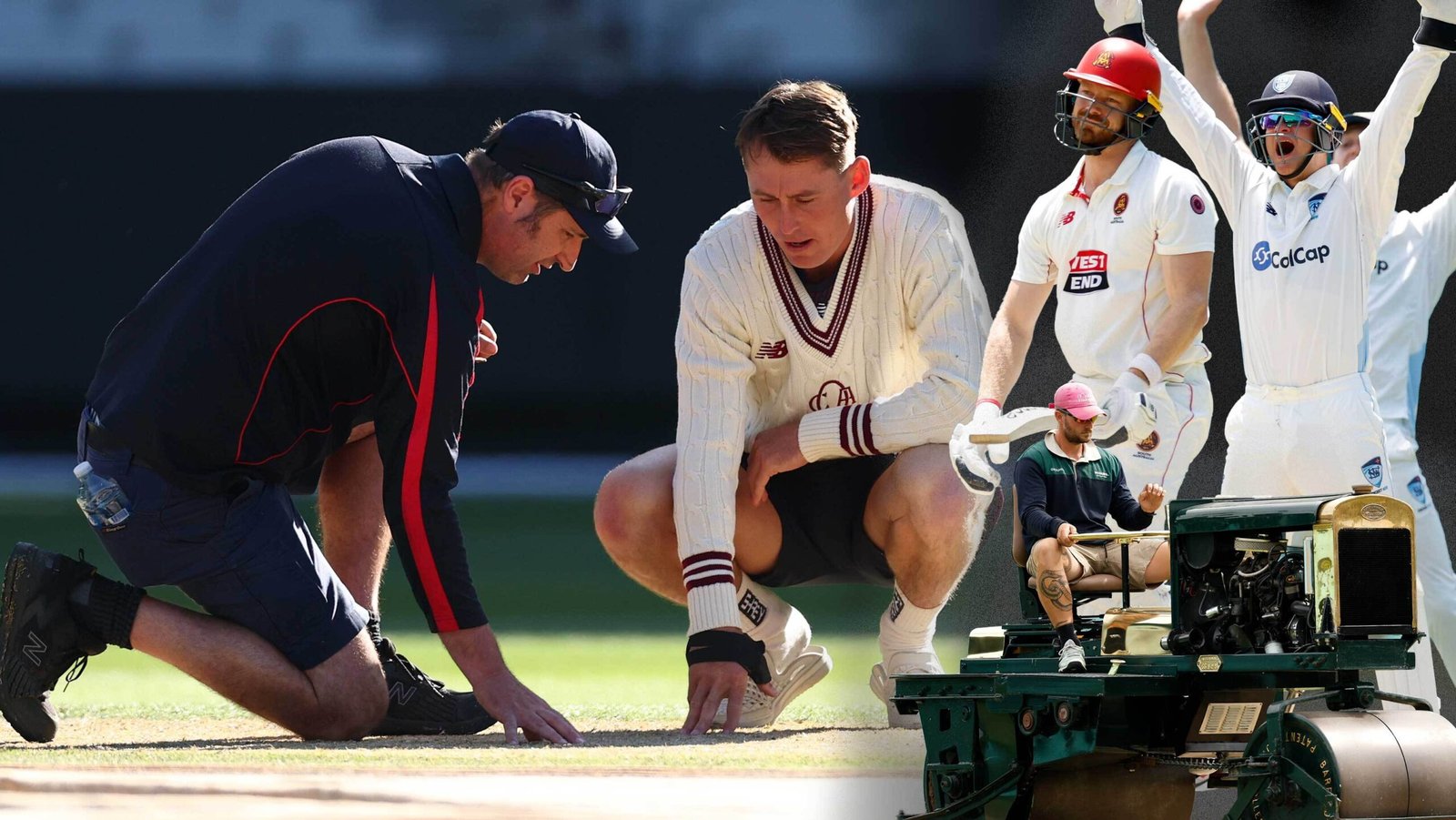
Curators have been urged to err on the side of batters this summer as Cricket Australia seeks to even the balance between bat and ball in the Sheffield Shield.
The governing body also confirmed it has tweaked session times for the country’s premier first-class competition. With a goal of reducing the length of the last session – which usually stretched to 2.5hrs to get the overs in – CA has moved time to the middle session, and will monitor if this provides any edge to the batting team or encourages fielding captains to bowl more spin overs.
Under revised playing conditions for the 2026-27 Shield season, the second and third sessions will effectively now be equal length at 2hrs and 15mins. To achieve this, the middle session has been extended by 15 minutes, with that time taken from the third session. With the half-hour extension for the daily minimum overs, which remains set at 96, the third session’s playing time will match that of the middle.
Sheffield Shield session times 2026-27
Morning: 2 hours
Lunch: 40 minutes
Afternoon: 2 hours 15 minutes
Tea: 20 minutes
Evening: 1 hour 45 minutes
* An extra 30 minutes is available to complete daily overs
Peter Roach, CA’s operations and scheduling boss, revealed the catalyst for the change had come from player and coach feedback that suggested the evening session tended to drag at 2.5hrs, especially coming after the shorter 20-minute tea break.
With the average over taking just under four minutes to bowl in Shield cricket, it’s hoped an additional three to four overs in the middle session will allow batters to capitalise against fatiguing bowlers when batting is supposedly at its best, according to Roach.
“What we don’t want to do is make it harder for batting or harder for spin bowlers to get a look into the game,” he told cricket.com.au.
“Adding time to the first session didn’t make a lot of sense because certainly on day one, with 22 teams out of 31 last season winning the toss and bowling, it makes the first session longer when the wicket is probably at its hardest for batting.
“When is the easiest time to bat? Certainly, on day one, you would think when the sun is at its highest in the middle of the day and the heat is at its hottest.
“(The extra 15 minutes) might change the way fielding captains think about the way they use their bowlers in that middle session to get through, and it could potentially lead to some more spin overs.
“The key message is we are tweaking rather than blowing things up.
“We’ve got three levers at our disposal: the ball, the pitches, which is at arm’s length because we don’t employ any curators, and the playing conditions. This is a minor tweak to the playing conditions, which we think could assist players in not having that long, laborious two-and-a half-hour last session, but also add a bit of time into the session in the middle where we think batting generally should be at its easiest.”
Interest in wicket preparation hit fever pitch following last summer’s pair of two-day Ashes Tests that cost CA almost $15 million in lost revenues and ticket refunds. Another Test finished in two days last weekend in Mackay against Bangladesh.
Batting great Ricky Ponting said on commentary during the weekend’s Mackay Test – the third in a year on Australian soil to end inside two days, and just the fifth in almost 150 years of Test cricket in this country – that he felt “wickets in Australia have to change”.
While the cause of plummeting averages is a matter of opinion, there’s no doubt that batters have recently endured two of their worst Shield seasons in the past 50 years.
Almost a third of the Shield’s 2025-26 regular season games finished inside three days (nine out of 30 matches), well up from a more fruitful 2024-25 summer for batters when there were only five three-day finishes and batters collectively averaged more than 30.
“Everything you hear coming back from the Shield players is how much more difficult it’s become to bat in Shield cricket with the way that the wickets are,” Ponting said on Channel Seven.
“I think it’s gone too far in the advantage of fast bowlers or seam bowling in Australia.
“If it goes back (towards fairer pitches), those guys that are averaging 38 maybe average 50 and all of a sudden you’ve got what we would deem as a Test-match quality batsman.”
Roach, however, suggested it’s the language around pitch preparation that requires a change of approach.
“We still want results in Shield cricket, we want to see a balance between bat and ball, and that hasn’t changed,” he continued.
“But the mantra a decade ago was probably ‘if in doubt, lean towards the bowler’. We’re now changing that language to say, ‘if in doubt, we should lean towards the batter’ because conditions are being seen as pretty difficult for batting.
“Curators have all these moments in their preparation when they say, ‘Do I do this? Do I do that?’ We want them – if in doubt wheter to thin some grass out, take another millimetre of grass off or give it another roll – to say, ‘OK, I’m going to make my decision leaning on the side of the batter more so than the bowler’.
“It’s a delicate balance and it’s not the same for every ground; we’re not averaging the same number of runs at every ground and we’re not averaging the same number of overs of spin at each ground, and we don’t want to. We want our grounds to be a bit different.
“Across the board, we want results, but we want them to be deep on that last day.
“We want to see teams win the toss and bat a bit more.
“They’re the outcomes, but in the curators’ minds, we’re trying to use the language that we still want a balance, we still want to see fast bowlers have their turn, but we want to see batters have their turn and want to see spinners – that’s a great game for us.
“We want to see pace and bounce; we want to see it spin in Sydney. We’re just making that minor tweak to our language to say, ‘If in doubt, I think we need to lean towards the batter a little bit more in the preparation of pitches’.”
Injury substitue trial extended
Meanwhile, Roach also confirmed CA’s injury substitution trial – which allows teams to replace an injured or ill player up until stumps on day two – would continue for this summer barring any change of stance from the International Cricket Council.
The next update from the ICC is expected in October, after the start of the Shield season, with global administrations weighing up whether to introduce a version of the rule into Test cricket for the next World Test Championship cycle.
“We think the substitution trial we had last season worked exceedingly well and we’re really happy with it,” Roach said.
“We heard really great feedback from our teams that there were times when they tried to take advantage of it and couldn’t find a way to, which is exactly what we want. We want that team that has the injury to be not massively disadvantaged by the injury, hence the ability to replace. But we don’t want them to get an advantage over the other team either.”
Roach said the first-innings bonus-point system, which some believe encourages states to produce livelier pitches in search of banking easier bowling bonus points, was not among the changes considered for this season.
“We don’t think that’s influencing the way teams play as much as maybe the perception is,” he said.
“We think the Shield competition is in good shape. The right teams are winning it. The majority of games are played in a really good manner and we think anything we do should be minor.
“Changing the point structure is probably a bit more major, and we just don’t think we’re in that space where we need to.”
