

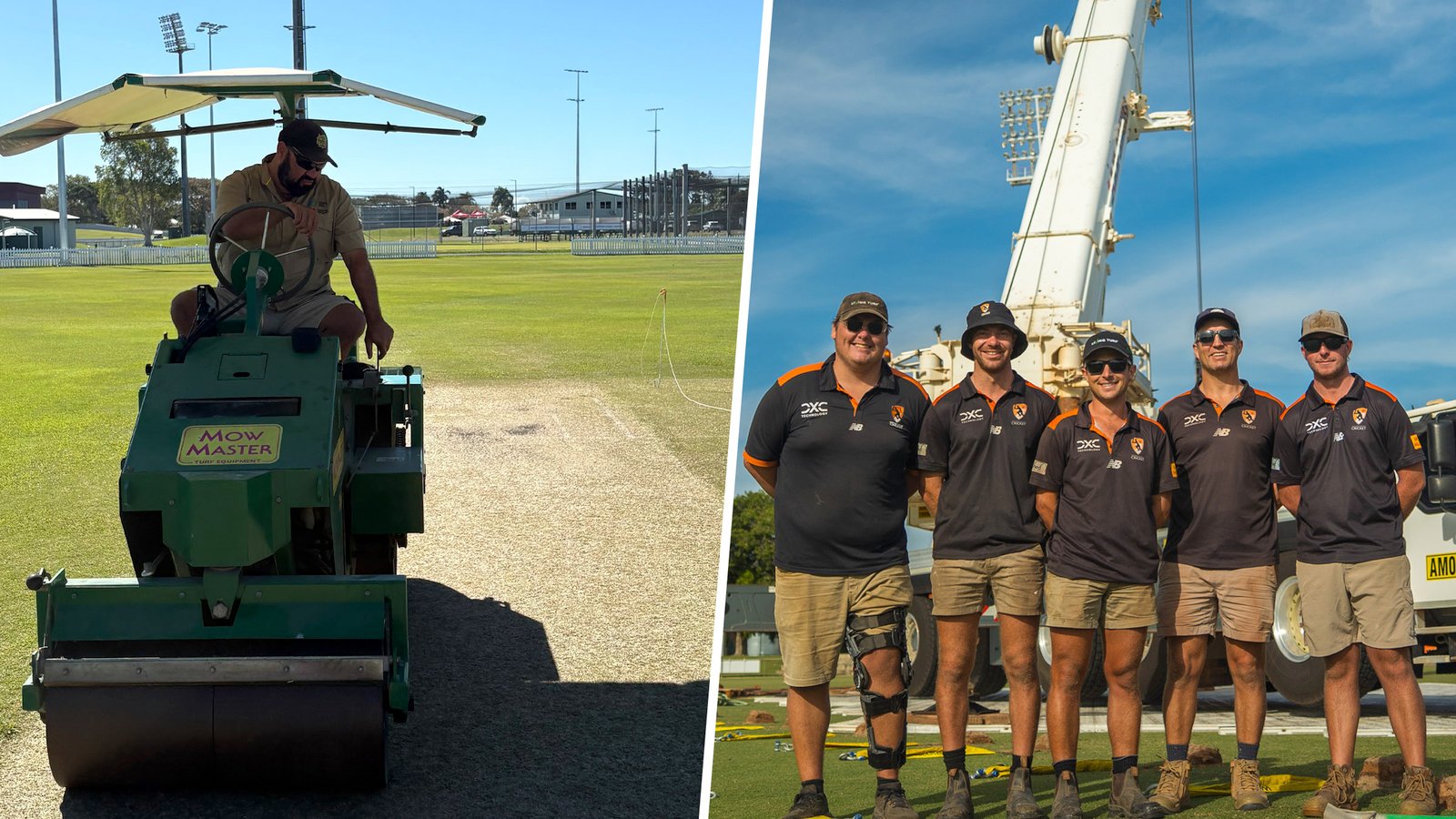
Given Jake Pavlich and Peter Kazakoff call home to a region where vicious weather and man-eating reptiles are daily considerations, it is little surprise neither of these northern curators are particularly anxious about their roles in making Test cricket’s return to Australia’s rugged tropics a success.
For the first time since the mid-2000s, Australia will play host to the country’s favoured format outside of its traditional summer window when Pat Cummins’ men face Bangladesh in Darwin and Mackay in a two-Test series.
For the Northern Territory capital, it marks an incursion into an Australian rules football-mad town that will nonetheless display its cricket pedigree when Darwin’s first homegrown Test cricketer, Jake Weatherald, likely wears the Baggy Green at Marrara Oval.
In Mackay, there will be a sense of a mission accomplished after the transformation of the Harrup Park precinct achieved an ambition to make it a hub for elite cricket. It will become just the 12th Australian ground to host a men’s Test.
And in making these off-the-beaten-track venues Test-ready, Pavlich and Kazakoff have faced challenges rarely encountered by their southern counterparts.
Cricket on the rise in Darwin
The duties of Pavlich – who laughs that he was “too short, fat and slow” to follow the career path of his cousin, the former Fremantle AFL star Matthew Pavlich – are surely among the most varied in world sport.
As Northern Territory Cricket’s head of facilities, the turf expert is also responsible for the wickets at Traeger Park in the arid desert town of Alice Springs, around 1,500 kilometres south of Darwin.
Compared to the relatively sedate climate of Adelaide, where Pavlich cut his teeth working for the South Australian Cricket Association at Karen Rolton Oval, Darwin’s distinct ‘wet’ (from November-April) and ‘dry’ (May-October) seasons necessitate a vastly different approach.
“One thing is that it just never stops growing,” Pavlich says of the grass at the flagship 12,000-capacity Marrara venue set to welcome back Test cricket for the first time since Sri Lanka’s 2004 visit.
“And then dealing with enormous amounts of rain. You’re always planning and always trying to control the growth.
“You’ve got weeds, and you don’t really want to spray too many herbicides because it obviously affects the grass that you want to grow on cricket wickets. So it is very different (to Adelaide). Same principles, obviously but just different challenges.”
On average, Darwin receives double the rain in its three wettest months – January, February and March – than Adelaide does in an entire year, forcing cricket to be played into the drier ‘winter’ while football codes sweat through the steamy summer.
The extreme weather patterns might be enough to send even the most expert of turf stewards into an early bout of Mango Madness, an affliction associated with the intense humidity that precedes the rainy months.
Pavlich is not so easily unsettled.
One of his major challenges since arriving in the remote NT outpost in 2024 has been successfully migrating and embedding a drop-in wicket into place in the middle of the main stadium in two separate pieces.
Darwin had in fact been the first venue in Australia to pull off the ‘split pitch’ method when it hosted Test cricket for the first time in 2003 for a match against Bangladesh. It is a cost-effective solution that’s been used on the Gold Coast, in Launceston and at Docklands in Melbourne.
But Pavlich concedes the halving of his pride and joy, which sits in metal trays in a compound outside the main stadium for 10 months of the year, is not necessarily best practice.
“It is a pain in the arse,” he says, laughing again. “The infrastructure underneath the pitches is quite old. It’s just a slab of concrete with some sand on it, very similar to the initial MCG setup with the drop-ins. It’s a bit tricky each year. Sometimes it goes in really well, sometimes it’s a bit difficult and you’ve got to work around it.”
If Pavlich and his team are diligent in tending to the ‘join’, no-one will notice. Last year they produced two belting surfaces for Australia’s men’s T20 Internationals against South Africa. “People didn’t realise last year it was a split wicket,” says Pavlich, “so that’s the aim.”
There have also been glowing reports from participants in the Top End T20, which has attracted BBL academy teams as well as sides from Chicago, Nepal, Pakistan and Bangladesh in recent years, on Darwin’s suitability for cricket while the south of Australia shivers through the cold.
Mackay’s transformation from ‘country cricket ground’
Even though the Great Barrier Reef Arena will be witnessing Test cricket for the first time later this month, Mackay has a curator who could hardly have served a more valuable apprenticeship.
Kazakoff was still a student at Brisbane State High School when he started manning the rain sheets a short (but sweaty) walk up Vulture Street to the Gabba, where the doyen of curators, Kevin Mitchell Junior, ran the show.
Mitchell had a knack of knowing what was on the horizon. He typically had the rain covers on the Gabba wicket before the umpires had even called for them. In offering Kazakoff a job out of school, the master groundsman’s foresight again proved sage.
“Seventeen years later, I was still there,” says Kazakoff, who only departed his dream gig when he was lured up the Bruce Highway to take charge at Harrup Park in 2021.
“You couldn’t get a better bloke to learn off. He was one of the best in the world. To see hands on how he did his craft and how he held himself under pressure made a mark on myself, that’s for sure.
“There’s always stuff you’ve got to do off the cuff, and he handled it really well. His results speak for itself.”
India’s famous triumph at Australia’s fortress months before Kazakoff took the Mackay job marked the first time he had seen the home team lose a Test at his workplace. “I nearly had a clean sheet,” says Kazakoff, who had watched Australia go undefeated through 16 previous Tests.
It was hardly a sour note to end on considering the knowledge he had accumulated across close to two decades preparing a Gabba pitch that was often declared (and not solely by one-eyed locals) the best in the world.
Still, the scope of the task he took almost 1,000 kilometres north of Woolloongabba was sizeable even by the pioneering standards of a town that was established by the sugarcane industry.
When the Juliet Street land in Mackay South was purchased in 1939, the site that is now Harrup Park was literally a cow paddock. Cattle roamed the property which featured a large watering hole and overbearing Moreton Bay fig trees.
It was swiftly developed to capitalise on the town’s interest in cricket, borne out when a crowd of around 6,000 (more than half of Mackay’s population at the time) turned out to see Donald Bradman score a century on a concrete wicket on an exhibition tour of northern Queensland in April 1931.
Harrup Park had sufficiently modernised to be awarded an ODI World Cup game in 1992, though the imprudence of fixturing an India-Sri Lanka clash at the tail-end of the wet season was highlighted when locals eager to see a young Sachin Tendulkar at the crease instead saw only two balls bowled and the match abandoned.
But a $25m redevelopment that added a 2,000-seat grandstand as well as modern changerooms and media facilities has fast-tracked its ambitions to become a hub for elite cricket.
“The icing on the cake was that they needed a curator with experience at that sort of level,” said Kazakoff.
After hosting women’s internationals in 2021, Ray Mitchell Oval has seen men’s A, Sheffield Shield and One-Day Cup games through 2023 and 2024 before two day-night ODIs against South Africa in August last year.
Kazakoff was proud and a little shocked when it was announced that Mackay and Darwin had won out over Townsville and Cairns to kick-start Australia’s run of up to 21 Tests in 12 months. Harrup Park has also been flagged as a cricket host for the 2032 Olympic Games.
“We’ve hit the big time this year,” he said. “It was a country cricket ground and we’ve transformed ourselves into an ICC Test venue, which is pretty remarkable.”
Northern obstacles
While Darwin and Mackay are hosting their major fixtures during their cooler dry seasons when rain poses little threat, that has itself posed challenges to Pavlich and Kazakoff.
That the temperature in central Queensland can drop to single-digits during the winter – “you do still have to wear jumpers,” says Kazakoff, “albeit only in the mornings” – means grass growth can be curtailed.
In Darwin, as saltwater crocodiles typically take fewer victims during the dry season, so too do the cooler months allow groundstaff to take a deep exhale. But while the NT’s tropical heart is warmer overall than Mackay through the winter, Pavlich faces similar obstacles to Kazakoff.
“From mid-July to mid-August, it’s beautiful days, 32 degrees, it’s not humid this time of year – you think it’d be perfect growing conditions,” says Pavlich.
But he admits the use of growth mats – mesh blankets used to heat soil – was a tactic reserved for the type of colder climate he left behind.
“We can really tell the difference once it drops below 20 (degrees) – the grass just stops,” he says. “It sounds amazing, but we notice a lot of improvements through using them.
“We use them flat out in Adelaide. Up here I thought we’d never have to use them, but there’s a good three-month period that we’re in at the moment that we notice gets a lot of results.”
Both curators know that the difference between preparing suitable wickets for high-level white-ball cricket last year and a high-quality surface that will last five days this year is considerable.
Even the best can get it wrong, as Matthew Page demonstrated with an overly juicy MCG Ashes pitch on Boxing Day last summer.
“There definitely is some pressure,” says Pavlich, while Kazakoff conceded it was “daunting” to be in charge of the strip for Queensland’s only Test this season.
They are not the only ones hoping the return of Test cricket to a sometimes-forgotten part of the country is a success.
“When the umpires walk on the ground on day one, we’ll close the gate,” says Kazakoff, “and I can sit back and just hopefully enjoy a great Test match.”
NRMA Insurance Bangladesh Test series
First Test: August 13-17, Marrara Stadium, Darwin, 10am (local)
Second Test: August 22-26, Great Barrier Reef Arena, Mackay, 10am (local)
Australia squad: Pat Cummins (c), Scott Boland, Alex Carey, Cameron Green, Josh Hazlewood, Travis Head, Josh Inglis, Marnus Labuschagne, Nathan Lyon, Steve Smith, Mitchell Starc, Jake Weatherald, Beau Webster
Bangladesh squad (first Test): Najmul Hossain Shanto (c), Mehidy Hasan Miraz (vc), Soumya Sarkar, Shadman Islam, Tanzid Hasan Tamim, Mominul Haque, Mushfiqur Rahim, Litton Das, Amite Hasan, Jaker Ali, Taijul Islam, Taskin Ahmed, Hasan Mahmud, Syed Khaled Ahmed, Ebadot Hossain Chowdhury, Musfik Hasan
