

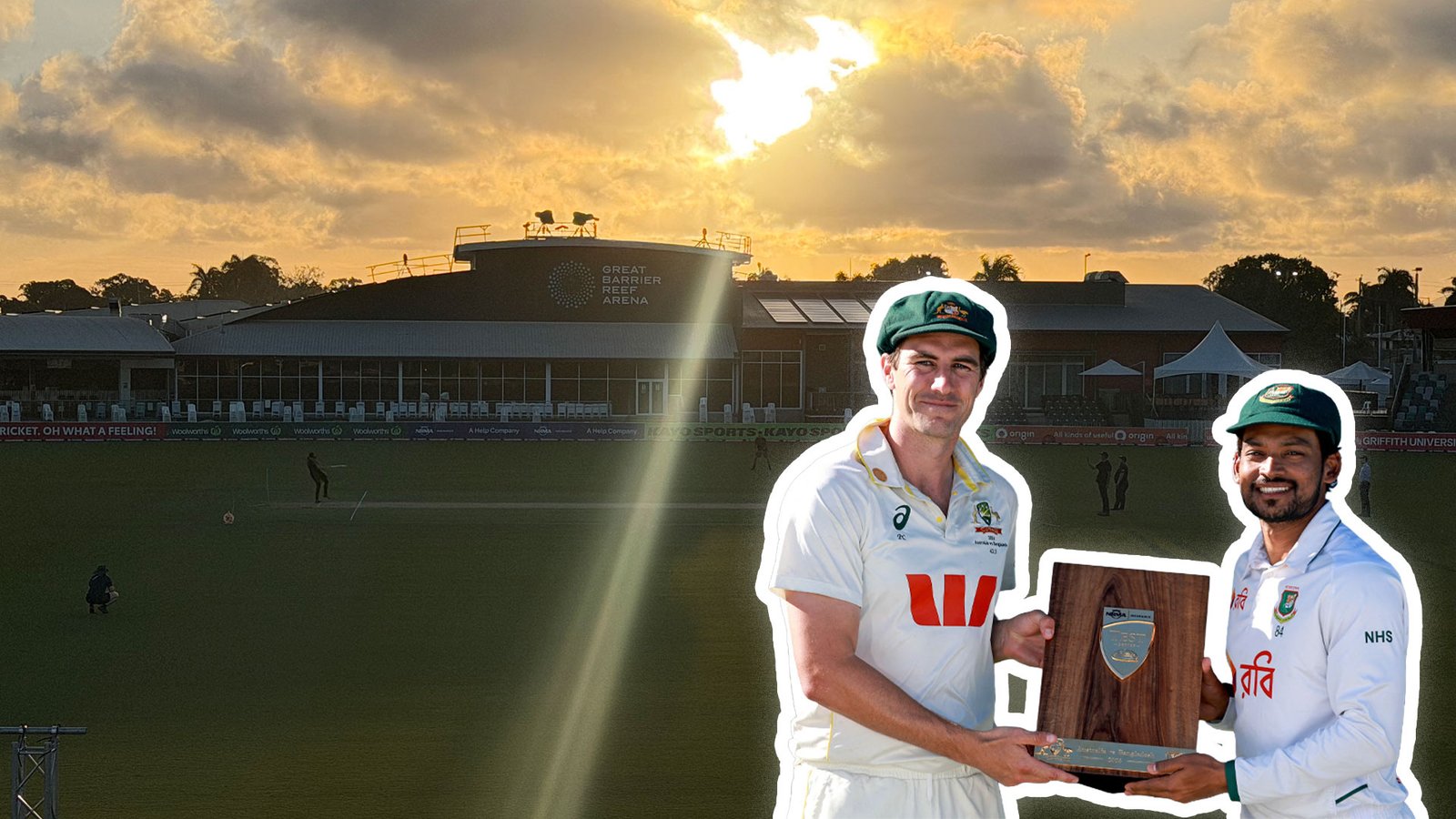
As fans packed up picnic rugs and made their way onto the sun-kissed Great Barrier Reef Arena to capture autographs and take selfies with players, a loud cry of ‘Free burgers!’ rang out from one of the food trucks stationed behind the eastern hill.
Barring ageing bowlers, short Tests are bad for almost everyone. The cost of forsaken gate receipts and uneaten hot dogs will be nowhere near the $15 million lost to last summer’s pair of two-day Ashes Tests. But in the trend towards accelerated Test cricket, third and fourth day tickets are becoming about as speculative an investment as cryptocurrency.
More than 12,000 spectators enjoyed their weekend at the idyllic country cricket ground; several thousand more will not be afforded the same treat on Monday and Tuesday.
In the first 145 years of men’s Tests hosted by this country, just once did one end inside two days. In the last four-and-a-half years there have been four, three coming in Australia’s last seven outings. Globally, more than a quarter of the 50 shortest Tests ever (by balls bowled) have come in the past four years.
For Bangladesh, it was a brutal reality check after their unimaginable high in Darwin. “When you look at how Australia played in Mackay, you realise exactly what type of team we defeated in Darwin,” their captain Shanto told reporters.
His counterpart was none the wiser as to the precise causes of the rapid finish.
“I can’t quite put my finger on it,” Pat Cummins said after captaining Australia to an innings-and-51-run trouncing. “In my first season or two, (Tests) felt very attritional, and I think in my first Ashes series every single game went five days. I’m biased – I much prefer it when it’s a bit shorter than that – but maybe somewhere in between.”
During the second day of a match in “fast-forward”, on the fall of the Test’s penultimate wicket Travis Head turned to the crowd to sign autographs rather than join his teammates in celebration.
Even as Australian players hung around later to pose for more post-Test photos when patrons were invited onto the field, there was a feeling that the improved Mackay venue (earmarked for more upgrades before the 2032 Olympics) deserved better than the fourth shortest match (by balls) in Test history. In the end, its weekend start proved a godsend.
Ultimately Bangladesh’s lack of exposure to classic bouncy Australian conditions was the biggest factor in the fast finish. Australia’s own batting woes and the brilliance of their seam attack did not help either. “It seemed to happen in fast-forward,” said Cummins. “Pitch was pretty good – didn’t really feel like a 30-wickets-in-five-sessions kind of Test match.
“But it seems to be the way a few of these Test matches are going. Some really good bowling in there at times. Some little bit below-average batting – myself included – so that’s probably why it’s a bit accelerated.”
The visitors do have a valid excuse. This marked their first invitation to play Tests in Australia since 2003. Their inability to cope with Queensland’s elevated spring, particularly compared to the more placcid Darwin drop-in wicket, stems from a lack of exposure.
It was little surprise Shoriful Islam and off-spinner Mehidy Hasan made beelines to their respective Australian counterparts, Mitchell Starc and Nathan Lyon, at the conclusion of the Test. “We’re here after 23 years,” said Shanto.
“It’s not easy to compete in this conditions against this quality of team. So if we are able to come consistently, then the players have their idea, players have their experience and they can be able to adjust these kinds of conditions and play good cricket. My request is we want to play here, we want to play similar kinds of conditions consistently, not after 23 years.”
Peter Kazakoff’s two decades of experience working at the Gabba reflected in his first Test pitch. A challenging first day, featuring seam movement and tennis-ball bounce, gave way to faster, flatter conditions, but by which time 18 wickets had already fallen.
Mackay’s entry to the two-day Test club felt more analogous to the 2022-23 Brisbane contest with South Africa, which incidentally was also completed inside a single weekend. There, Australia stumbled to their fourth-innings target of 34 after as many wickets fell in the game’s 144.3 overs.
There were also similarities to last summer’s Ashes opener in Perth, when Travis Head’s final-day ton derailed England’s tour. But at no stage did it feel as if batters had elevated their batting aggression to almost kamikaze levels like both Australia and England did at the MCG last summer, such was the seam-friendly nature of the explosive surface.
“I don’t think it’s all on conditions,” said Cummins. “I definitely think some of the Test matches – say the MCG, that was quite extreme – but Perth Stadium or this one wasn’t extreme enough for a two dayer. I think the trend is there probably seems to be a few more wickets on day one in a lot of these Test matches.”
Ten minutes before what should have been stumps on day two, Harrup Park’s chief executive Adrian Young, instead of Steve Smith or Najmul Shanto, was batting on the Test strip. The Mackay sun set behind the group of hospitality staff rightfully enjoying the chance to test out the bouncy wicket, the last of the fans having long hit the road.
Kazakoff has expected to flood his wicket table as soon as this Test finished ahead of the ground hosting local Australian rules finals next weekend. There is now plenty of time for him to soften the grass.
NRMA Insurance Bangladesh Test series
First Test: Bangladesh won by nine wickets in Darwin
Second Test: Australia won by an innings and 51 runs in Mackay
Australia squad: Pat Cummins (c), Scott Boland, Alex Carey, Cameron Green, Josh Hazlewood, Travis Head, Josh Inglis, Marnus Labuschagne, Nathan Lyon, Steve Smith, Mitchell Starc, Jake Weatherald, Beau Webster
Bangladesh squad: Najmul Hossain Shanto (c), Mehidy Hasan Miraz (vc), Soumya Sarkar, Shadman Islam, Tanzid Hasan Tamim, Mominul Haque, Mushfiqur Rahim, Litton Das, Amite Hasan, Jaker Ali, Taijul Islam, Taskin Ahmed, Hasan Mahmud, Syed Khaled Ahmed, Ebadot Chowdhury, Shoriful Islam, Musfik Hasan
