

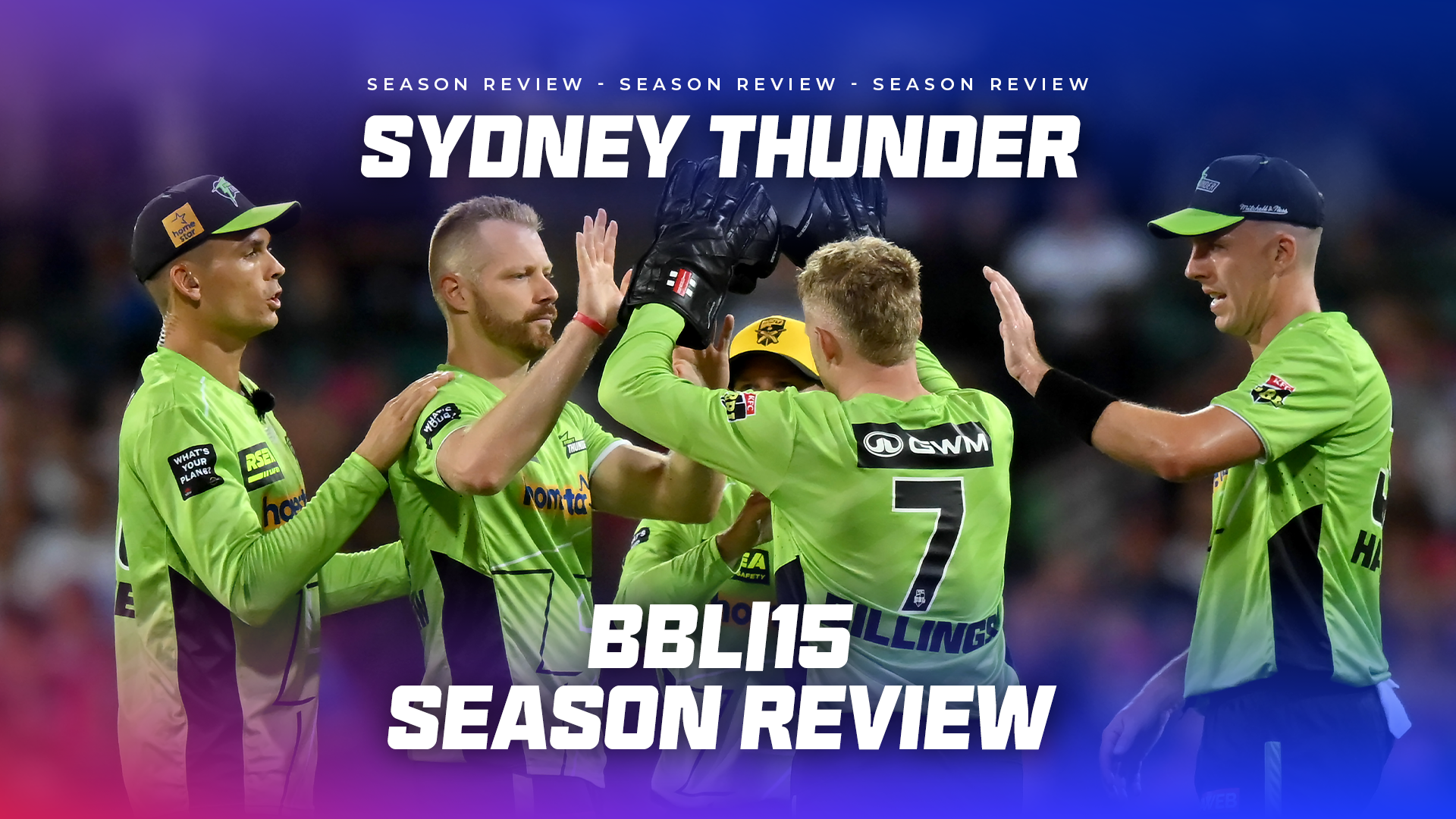
Sydney Thunder entered KFC BBL|15 eyeing a second men’s Big Bash title but, despite making the final in the season prior, what followed was a two-win campaign leaving more questions than answers.
For the second time in three seasons, the club finished on the bottom of the BBL standings, and while there were a number of impressive individual performances, general manager Trent Copeland knows the team failed to put together consistent, high-quality cricket.
“I think it was just never that full performance,” said Copeland.
“I think early in the season, it was the bowling performances that were not up to scratch. When we got the bowling right, in Adelaide for example, and we had a low run chase and had the game won two or three times over, the middle-order batting just couldn’t quite get it across the line.
“T20, the BBL, it’s a bus that comes at you, and if you’re not with the bus and on the journey, it can roll over you at different stages, and it certainly did.”
It’s a season that has left the club’s GM examining all parts of the business, including his own processes and practices as a leader in the organisation.
“From my point of view, the things that I need to look at internally, including my own draft strategy and list management practices, I thought we were off the pace in quite a few games,” said Copeland.
“There were some games we were in, but quite frankly, we weren’t good enough in lots of matches. (We were) getting beaten by 30-plus runs, or teams chased our totals down in 15 overs way too often.
“Last place on the table, and that type of tone as my takeaways, means that we’ve got work to do. Me included.”
In this first BBL|15 season review on cricket.com.au, Copeland helps us breakdown the Sydney Thunder’s campaign through the key talking points that defined their season.
Sydney Thunder: BBL|15 snapshot
BBL|15 result: Last (2 wins, 8 losses)
Most runs: David Warner (433 at 86.60)
Best strike rate (min. 100 runs): Matthew Gilkes (155.70)
Most wickets: Daniel Sams (12 at 26.16)
Best economy (min. 10 overs): Chris Green (7.77)
Contracted for BBL|15: Cameron Bancroft (BBL|17), Sam Billings (BBL|16), Matt Gilkes (BBL|17), Chris Green (BBL|16), Ryan Hadley (BBL|17), Sam Konstas (BBL|18), Aidan O’Connor (BBL|16), Daniel Sams (BBL|17), Tanveer Sangha (BBL|17), David Warner (BBL|16)
Out: Liam Hatcher (Stars), Ollie Davies (Sixers)
Eligible free agents: Wes Agar, Charlie Anderson, Tom Andrews, Pat Cummins, Nic Maddinson, Nathan McAndrew, Blake Nikitaras
Uncontracted: Shadab Khan (Pakistan), Reece Topley (England), David Willey (England), Ravichandran Ashwin (India), Lockie Ferguson (New Zealand)
ENGIE Stadium wicket
After losing just one match at ENGIE Stadium in BBL|14, Sydney Thunder struggled to make Western Sydney a fortress in BBL|15, with their one and only win at the venue coming during their last home game against Melbourne Renegades on January 12.
Previously known for being a spin-friendly pitch that was relatively difficult to bat on, the script was flipped last season, and as Copeland explains, the Thunder were slow to adjust to a much-improved wicket.
“We didn’t adapt well at our home venue, it was a much better surface,” said Copeland.
“It wasn’t the low, slow turning surface that it was the year prior, and I thought opposition teams adapted better to that when they came to our ground than we did, particularly in those (Power) Surge and death moments.”
The average first innings total at ENGIE Stadium in BBL|15 was 193, which was 40 runs more than the previous season. While the Thunder were after a wicket that could produce more runs, Copeland admitted he didn’t expect the surface to be as true as it was throughout the competition.
“The wicket was exceptional,” said Copeland.
“We were building (our squad) off sort of known quantities, but also a genuine aspiration to have our wicket not be a 130 (runs wicket). 165 to 185 was the ambition, but credit to the ground staff.
“Even with our list build, we still had options and ways to adapt our game style, but I don’t think we did it well enough.
“Game one, our (Sydney) Smash at home looked like an incredible cricket field, so I couldn’t be more pleased with that.
“I like our characteristics being that slower balls stop in the surface, that batters have to check their swing, and that spin is in the game.
“I don’t want it to be, and this is no criticism of other venues, but win the bat flip, you bat second and you win the game is kind of this unfashionable, in my opinion, trend of the BBL sometimes.”
Warner’s greatest season
Sydney Thunder skipper David Warner ended the BBL|15 regular season with the most runs of any player in the competition, earning him the BKT Golden Bat award for scoring 433 runs at an average of 86.60.
Despite missing two matches, Warner’s phenomenal season resulted in the 39-year-old being awarded captaincy honours in the BBL|15 Team of the Tournament.
Having scored the first ever Big Bash hundred way back on December 17, 2011 at the MCG in BBL|01, Warner added two more in BBL|15 to become just the seventh player to hit multiple hundreds in the same BBL season, with unbeaten triple-figure scores against Hobart Hurricanes (130* off 65 balls) and Sydney Sixers (110* off 65).
“It’s pretty cool for the fans to be able to see, because at his best he is just phenomenal,” said Copeland.
“If you were to ask me the top three fittest players in our squad, he’s still probably one of those guys at the age of 39.
“We didn’t anticipate him missing game one, so that little back spasm just prior to the tournament wasn’t ideal… but I think he did a fantastic job.”
Ashwin’s withdrawal and losing Lockie
After signing with Sydney Thunder in September before committing to the full BBL|15 season in October, former Indian international Ravichandran Ashwin was ruled out of the competition during November in a savage blow for the Western Sydney side.
Set to become the first Indian national men’s representative to feature in the BBL, Ashwin’s knee injury left the right-arm off-spinner “gutted” and the Thunder devastated ahead of a new men’s Big Bash campaign.
“What Ashwin would have done for that group and that genuine connection to our heartland is still firmly on my mind,” said Copeland.
“Not only being the first Indian icon of the game to come out and potentially play in the BBL, but it was also his quality and his competitiveness that he would have brought.”
Unfortunately for the Thunder, the champion Indian player wasn’t the only international signing the club missed through injury last season.
After making his Big Bash debut in the summer of 2024-2025, New Zealand speedster Lockie Ferguson did not play a match in BBL|15 after injuring his calf in the ILT20 tournament.
The 34-year-old was the Thunder’s first selection in the BBL|15 Draft, after taking eight wickets at a measly economy of 7.16 in an impressive first season in Australia’s premier domestic T20 competition.
Combined with the loss of Ashwin, Copeland explained the impact of losing two marquee internationals for the duration of the tournament, but refused to use their withdrawals as an excuse for poor performances.
“Lockie’s Powerplay starts to games for us the year prior, but then also as the game goes on, that key experience and top-end pace to break partnerships and get rid of set batters, I think those were two key elements that we lacked in the crunch during matches,” said Copeland.
“No excuses. At the end of the day, we’ve got to be good enough to aim up.”
Shadab Khan’s impact
While the Thunder had no luck with Ashwin or Ferguson, Shadab Khan proved to be a significant recruit for the team in lime green.
Playing for his fourth Big Bash season for as many BBL clubs, Shadab’s first BBL campaign since BBL|12 saw the Pakistan international play six games, the most games he’s played in a single season.
The allrounder took seven wickets with the ball and made a handy 182 runs with the bat, but it wasn’t just his on-field performance that impressed the general manager.
“Just genuinely one of the nicest human beings I’ve ever met,” said Copeland.
“He was awesome and his batting actually far exceeded where I thought it would go this year. He had shoulder surgery in the off-season, with a six-month build up to playing in our tournament, which was his bowling shoulder. Not many people know about that.
“There was a time there where he was not coming. We didn’t know whether it was going to happen… so all of that said, what he delivered for us was exceptional.”
The curious case of Konstas
The 20-year-old Sam Konstas returned to Sydney Thunder having experienced a whirlwind 12 months in Australian cricket.
In his first Big Bash season, Konstas scored a half-century on Thunder debut, before making his way to the Australia side for the Boxing Day Test in a dream summer for the then teen phenomenon.
Fast forward to BBL|15 and January 10, 2026, a day where the opening batter was not only no longer in the Australian Test squad, but he was also dropped for Sydney Thunder’s away fixture against Brisbane Heat.
At the conclusion of the season, Konstas finished BBL|15 having played nine matches resulting in 151 runs, with an average of 16.77 and a high score of 63.
Despite the rollercoaster journey the young man has been on, Copeland has “zero doubt” the kid is going to be a special player not only for his club, but also for the national team in every format of the sport.
“We’ve signed him to a four-year extension, and I firmly believe that he’s going to be an all-format player for Australia,” said Copeland.
“I think what we saw from Sam this year was, excuse the French, but the ‘holy s**t’ moment,” said Copeland. “‘Teams are coming at me with plans. They know what my go-to’s are’ … and also a bit more entrenched in what weaknesses are and where places to exploit are.
“He’s gonna be fine. He is a kid, and there’s certainly zero doubt on my side.”
Making their mark in Western Sydney
Maintaining a strong presence in Western Sydney remains a key priority for Sydney Thunder, and in contrast to their on-field performance, Copeland said the club was flying when it comes to matters beyond the boundary.
“If you separate those two things right now, on-field performance not being up to standard, but also looking at off-field, we couldn’t be going better in that regard,” said Copeland.
“The appetite to come to our matches, the events that we put on at our home ground, those types of things, are in a really healthy spot.
“Ticket purchaser retention is as good as we’ve seen in a long time, so all of those things in our core multicultural market in Western Sydney, it’s just booming.”
As an organisation with strong links to the South Asian community located in the city, and specifically in Western Sydney, Copeland opened up on the lengths the club has gone to in order to connect with fans and showcase their care for all diaspora in the region, including those with ties to Nepal.
“Without getting the cart before the horse, we’ve had discussions with the Nepalese national team about coming and playing BBL practice matches for us in the window just before the tournament,” said Copeland.
“Having the Nepalese community in Western Sydney be able to come and watch that match… that to me is ways we can do things authentically.
“The way we’re thinking about South Asian engagement generally, whether it’s the Nepalese national team or whether it’s the Indian diaspora, is don’t do things because it seems like a great idea right now, it’s thinking about who we are to our core.
“If someone in Western Sydney was to talk about as a club, what would they say?
“It’s the things like showing up regularly at community events that are run by other places… for no return on our side, but just because we care.”
Squad moves with an eye on BBL|16
The Thunder have locked in ten players ahead of BBL|16 but 25-year-old Ollie Davies is not one of them.
Earlier this month cross-town rivals the Sydney Sixers secured the batter on a multi-year deal with the 49-game Thunder player to join his younger brother, Joel Davies at the team in magenta.
Despite caring for his now former player, Copeland said the move was nearly a “necessity” for the domestic talent.
“I’d almost call it a necessity for his career if I was being honest,” said Copeland.
“I care about Ollie and I played with him, so this has not been necessarily easy from a management standpoint.
“He can be that guy that can score, Tim David-style in the middle order against spin. He could also open the batting. He does it in club cricket, but the tough pill to swallow, I think, is that we haven’t just seen it yet.
“I think he’s got stuff he needs to work on, his work ethic and the stuff that comes with being a professional cricketer… but I’ve got no doubt he’ll find that again.
“Sometimes you sit back as GM and think, you know what, this is actually best for that player. So I certainly wish him all the best.”
English wicketkeeper Sam Billings has one more season left on his contract signed in 2024, that made him the first men’s player to sign under the league’s multi-year contract option for overseas players.
Matthew Gilkes, Ryan Hadley and captain David Warner all re-signed prior to the nine-day Player Movement Window that saw Davies depart to the Sixers.
With the focus now turned to improving on-field performance next season, Copeland revealed his thoughts on the club’s squad list and what the Thunder need to make their way back to to the top-of-the-table.
“I’m firmly looking at a three-to-five-year window on who we are,” said Copeland.
“We have a responsibility to be trying to win every tournament we’re in. That’s the primary focus.
“Despite the performances this year, when I sit back and think from that standpoint, around top-end pace, world class leg-spinner, dynamic top order batters that have explosivity as one of their key characteristics, we’re pretty well placed, but have some work to do.
“It’s a holistic, genuine look internally, including our whole high performance structure.
“I think the plain and obvious standout was explosiveness in our middle order with the bat and then top-end pace domestically.”
As for what’s next for the Thunder, the message is simple.
“Everything’s being looked at because we’ve got to be better,” said Copeland.
“We’ve had a key group of, say, 14 to 15 players that have been here for over three years.
“I (need to) get that revitalised energy around our group, youthfulness, and hunger for what’s next in the modern game.”
