

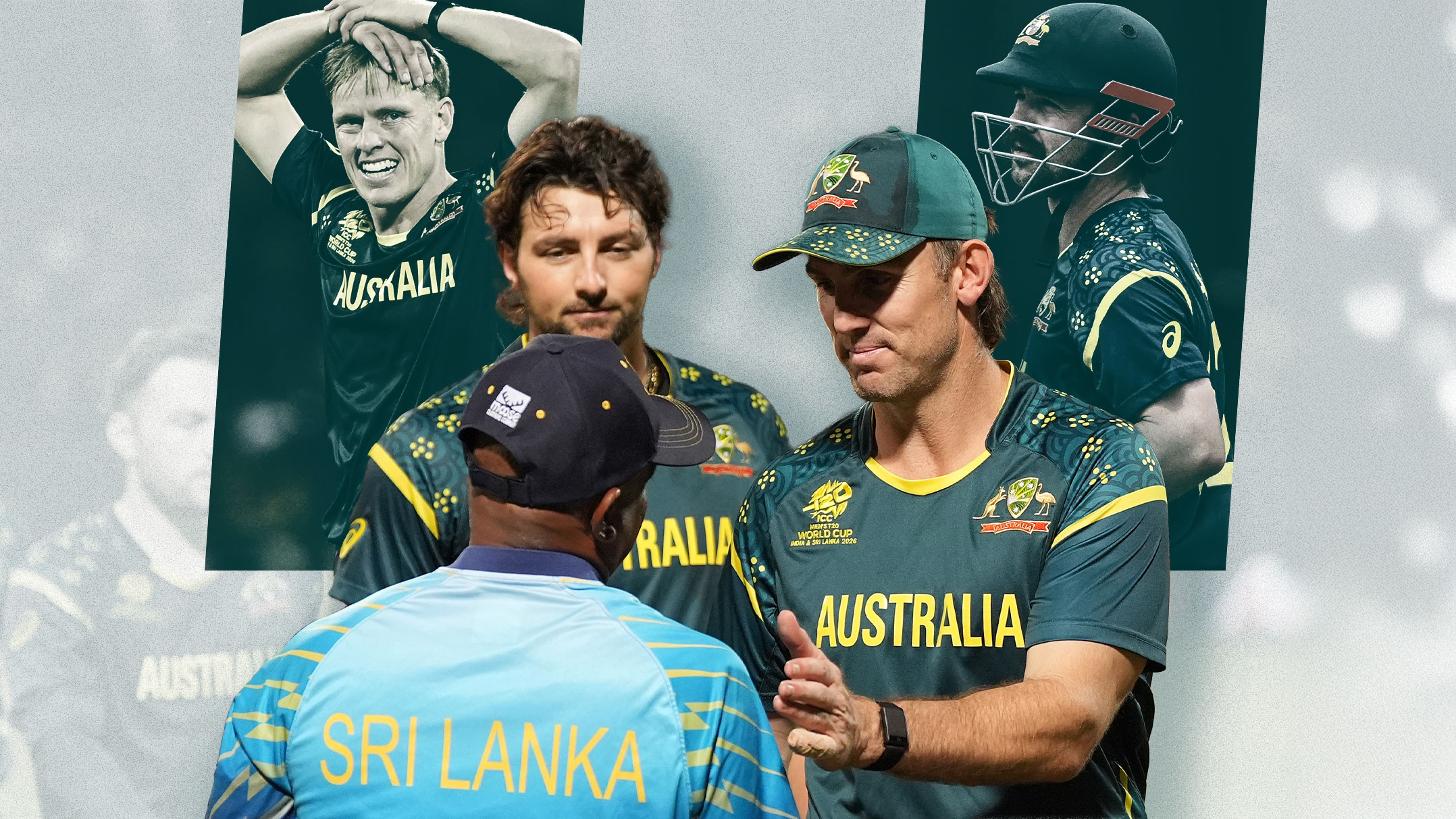
Australia are heading home early from a tournament coach Andrew McDonald said they “truly believed” they could challenge for a title in, eliminated following a “rare” collective loss of form.
Consecutive losses to Zimbabwe and Sri Lanka were terminal to Australia’s hopes, with the African side’s washout with Ireland on Tuesday confirming the 2021 champions would exit at the tournament’s group stage for the first time in almost 17 years.
Zimbabwe finished top of Group B after also accounting for co-hosts Sri Lanka on Thursday.
Against Zimbabwe, McDonald’s side were beaten in the Powerplay of each innings, slipping to 4-29 in the fifth over chasing 170 after opposition openers Brian Bennett and Tadiwanashe Maruman put on 61 having been sent in by Australia.
Then, facing Sri Lanka three days later, Australia lost their last eight wickets for 65 runs in the second half of their innings, including a collapse of 6-21, and were bowled out for 181. That allowed Sri Lanka back into the match, who accelerated their scoring throughout their innings with Pathum Nissanka’s 52-ball unbeaten century guiding them home two down with two overs to spare.
Australia took just two wickets in each of those matches – three to Marcus Stoinis and one to fellow allrounder Cameron Green.
But McDonald said it would be “unfair” to put both defeats at the feet of Australia’s bowling attack, highlighting their Powerplay against Zimbabwe and their collapse against Sri Lanka as moments where their batters couldn’t take advantage.
“Across all three phases of the game we’ve had some areas for improvement and to single out the bowling, I think it’s easy to do that when you don’t have the impact that we have had,” he said.
“But if we had put some more runs on the board against Zimbabwe – 4-29 in the Powerplay – there’s some mitigating circumstances there to the reason why we’re not where we should be in the tournament.
“We’ve got a room full of players that are incredibly disappointed knowing that they were good enough to progress, and we’ve just got to own the fact that we haven’t.
“In all three facets of the game … you can find margins and small margins that would have got us over the line.
“The group as a whole has made some really good decisions across a period of time, and we feel like we were making the right decisions and asking ourselves the right questions.
“Unfortunately, we weren’t able to get the performances that we wanted, so those people are entitled to critique that and we’re incredibly disappointed with where we’re at.
“I think the critiquing from people back home and people weighing into selection is around disappointment that they thought this group could have gone further in the tournament – we truly believe that as well.”
Across three matches in this year’s tournament prior to their final group game against Oman, Australia struggled in two areas they’d been dominant in over the 18 months from the previous men’s T20 World Cup in 2024.
In their defeats by Zimbabwe and Sri Lanka, opposition batters neutralised Australia’s bowlers early in the innings, helping them put those bowlers under pressure as the innings progressed. By contrast, Mitch Marsh’s side never fully got going through the middle of their innings with the bat.
Between July 2024 and the end of 2025, Australia had been the fastest scoring team in the world in the middle overs (7-15) of men’s T20 internationals, striking at a collective rate of 162 runs on average per 100 balls faced.
But in this year’s World Cup, that strike rate dropped by 25 runs to 137 – ranked ninth among the 20 competing teams prior to their final match against Oman, at which point Australia had already been knocked out.
Australia were missing opening batter Marsh to a testicular injury for their first two games, and conditions in Sri Lanka where they’ve played their World Cup matches have undoubtedly been different to those they encountered in the UK, Caribbean, New Zealand and at home where they have played prior to the World Cup.
But with their captain back for the must-win clash with the co-hosts at Kandy’s Pallekele Stadium, Australia’s powerful batting line-up couldn’t execute on Sri Lanka’s highest scoring men’s T20I venue after openers Marsh and Travis Head had put on 104 in 8.2 overs – their highest partnership as an opening pair.
After Head was dismissed for 56 in the ninth over, Australia lost three wickets for 12 runs in the space of 13 balls to lose all momentum from an excellent opening stand.
McDonald said Australia’s batting approach had “nuance to it” and pushed back on suggestions they’d invested too heavily on power-hitting in their line-up.
“The easy answer is it has been exposed because of the performances that were put out,” he said.
“I think it’s unfair to say that we’ve put all our eggs in the basket of power when you talk about some of the quality players we’ve got in there – Cameron Green, Travis Head, Josh Inglis and Mitch Marsh. I name those players because they’ve played Test cricket.
“If you’re playing Test cricket, you do have the skills to combat most conditions.
“I think people will easily say that we invested in power, but we felt like we had the balance across that batting unit to get the job done in these conditions.
“Probably the only significant shift that we’ve made in terms of promoting power, if you want to call it that, was Tim David at No.4. He had his challenges coming into this tournament on the back of (a hamstring) injury and unfortunately couldn’t get going in his two opportunities.
“That’s really the tale of the tape – we’ve had a lot of players not performing at once, which for this group has been rare.
“Across the journey, we’ve always had two key contributors with the bat that have been able to give us the totals.”
Where Australia’s batters failed to capitalise, they’ve also let their opponents’ top orders get away. Zimbabwe had partnerships of 61, 70 and 38 unbroken for the first, second and third wickets respectively, while Sri Lanka’s Nissanka and Kusal Mendis added 97 after losing an early wicket before Nissanka and Pavan Rathnayake guided them home with an unbeaten 79-run third-wicket stand.
In the two-year cycle leading into this year’s T20 World Cup, Australia’s bowlers had been among the best during the Powerplay.
Since the end of the previous T20 showpiece in 2024, no team at this year’s event has struck more frequently in the first six overs of men’s T20 internationals than Australia’s once every 17.31 balls on average.
The most consistent in that period had been Josh Hazlewood, who was ruled out of the T20 World Cup though injury, but Xavier Bartlett and his replacement Ben Dwarshuis had also enjoyed Powerplay success in bilateral matches.
Spencer Johnson was also unavailable for the World Cup with a back injury but has been mentioned as a left-arm replacement for Mitchell Starc, who retired from T20 internationals last year. In Johnson’s three appearances against Pakistan in late 2024, he took three of his eight wickets in Powerplay striking on average once every 12 balls in the first six overs.
Nathan Ellis, while sparsely used in the first six overs, has also been effective with his 12 Powerplay wickets – which includes three against Ireland in their T20 World Cup opener in Colombo – and leads the Aussie pack alongside Bartlett (12 from 20 matches, including two against Oman), and ahead of Hazlewood (9 from 9) and Dwarshuis (7 from 12).
But that form has eluded Australia in T20 World Cup tournaments.
It did in the previous edition in the Caribbean as well where they took nine Powerplay wickets in seven games at a strike rate of 28, while at the tournament they hosted in Australia in 2022, they had the worst economy (7.62) of the Super 12 teams in the first six overs.
In this year’s tournament they took five Powerplay wickets in the three T20 World Cup matches before they were eliminated, with four of those coming in the first match against Ireland as spinner Matthew Kuhnemann got the initial breakthrough before Ellis took 3-5 in his first two overs.
While Sri Lankan conditions haven’t necessarily suited new-ball bowling, especially at Colombo’s Premadasa Stadium where they played their first two matches, Ireland managed to reduce the Aussies to 4-88 before Matthew Renshaw and Stoinis led the recovery, while Zimbabwe also had them in early trouble when they lost four wickets in the Powerplay.
Despite their superior strike rate in the Powerplay since the last T20 World Cup, Australia’s economy rate (8.6) and dot ball percentage (45.2) has been among the highest in that six-over period – ranked fifth worst of teams competing at this year’s tournament. With teams generally adopting a slightly refined approach to their batting in global tournaments compared to more aggression in bilateral matches, Australia’s ability to take wickets in the opening six overs has been stifled.
“On the bowling front, it’s easy to look at what you haven’t got here,” McDonald said.
“That does destabilise you to some degree, but the guys that have had the opportunity here are good enough.
“That’s probably where we leave this tournament is with the knowledge that we were good enough and we’re incredibly disappointed that we weren’t able to take those opportunities and get ourselves to the next phase of the tournament.”
Australia’s men won 17 of 19 completed T20 matches from the end of the last T20 World Cup to the start of their home series against No.1 ranked India last year. McDonald isn’t anticipating too much change in personnel prior to the next edition, which the country will co-host with New Zealand in 2028, just four months after cricket returns to the Olympics through the T20 format.
“The build into this tournament and our style of cricket; the balance of our batting unit and our bowling attack, we felt really confident coming into this tournament,” McDonald said.
“The time to start to look back over what happened will be when we exit the shores here and that’s when you can probably get a little bit more clarity … remove the emotion, get to playing and then we can start to really unpick what the future looks like.
“I think it’s unfair to say that a lot of these players wouldn’t be in that next phase.
“The easy option is to say, ‘well, that didn’t work there’. These players are incredibly talented, they’re very good T20 players and are some of the best we’ve seen.
“Unfortunately, we all had fail moments all too often together and that’s rare for this group.
“It’s not an excuse but we have to own that.”
2026 ICC Men’s T20 World Cup
Australia squad: Mitch Marsh (c), Xavier Bartlett, Cooper Connolly, Tim David, Ben Dwarshuis, Cameron Green, Nathan Ellis, Travis Head, Josh Inglis, Matthew Kuhnemann, Glenn Maxwell, Matthew Renshaw, Steve Smith, Marcus Stoinis, Adam Zampa. Travelling reserve: Sean Abbott
Australia’s Group Stage fixtures
February 11: beat Ireland by 67 runs
February 13: lost to Zimbabwe by 23 runs
February 16: lost to Sri Lanka by eight wickets
February 20: beat Oman by nine wickets
Click here for the full tournament schedule
All matches will be broadcast on Amazon’s Prime Video
