

Travis Head rolled into the first Ashes Test with a fresh haircut and some newly discovered rhythm. Typically a light trainer, he had gone the other way since arriving in Perth ahead of the series opener, putting in the hard yards for four consecutive days as he steeled himself for England’s pace battery.
Like Shane Warne in 2005 and Steve Smith in 2019, the left-hander felt some extra hours in the nets before the first Test might help him find his magic touch. He joked at the time that it was an “unheard of” amount of preparation, but he wanted to leave no stone unturned ahead of such a significant series.
“I’m never going to doubt my own ability,” he said later. “But I think when you have a big gap in Test cricket and you’re lying in bed a couple of nights before, you’re like: Can I do it? Can you still produce it? Can you, as a cricketer each year, keep rolling out good scores in big moments?”
Perhaps recent form had been playing tricks with his mind. Leading into the Ashes, Head had a top score of 31 from his past eight white-ball innings stretching back to the beginning of October. It prompted him to play a Sheffield Shield match he hadn’t initially planned for, though his returns of nine and 15 on a tricky wicket in Hobart weren’t exactly reassuring.
It was actually during this though – and even within that Shield match – that he began upping the ante, focusing on some Ashes-specific work with South Australia batting coach Stephen Stubbings. There were times too when he hit with SACA pathways coach Mark Cosgrove, and his old Tea Tree Gully teammate Joe Gatting, who works as a batting coach.
In Hobart, Head was hitting with Stubbings twice a day in the indoor nets as he looked to consolidate his switch from white ball to red.
“Trav was very clear on what he wanted to do,” the batting coach tells cricket.com.au. “He looked really organised … he was determined to play really straight and move really well, front and back foot.
“But don’t get me wrong, after 10-15 minutes he was smacking everything (laughs).”
Theorising that England would target him with a short-ball plan, as they had done quite successfully on their home turf in 2023, Head looked at ways he could counterpunch. He built up his short-ball volume with repeated sessions against indoor cricket balls which, Stubbings explains, can be fired out of the ‘wanger’ device at a much quicker pace.
“Obviously once the ball gets a little bit older and Trav is in and playing well, the method to turn to – and it seems to be for most players in international cricket now – is a fair bit of short stuff,” he says.
“So having a really sound method (to deal with that) is important. If there’s no short leg, you can stand and ride the ball a little bit. And depending on where the men are, you’re either going to take the pull shot on, or not.
“With Trav, the way he moves around the crease, he finds ways to throw punches back. If someone misses slightly, they’re going to go. It’s brilliant how he finds ways to put pressure back on (the opposition).”
On his social media pages, Gatting posted a fascinating clip from one of Head’s net sessions, where he talks through the dimensions of each of the five Ashes venues and decides where and how he is best placed to clear the ropes between square leg and fine leg, by getting inside the line of the ball and hooking, pulling and flicking.
“If the field’s up, take it (the short ball) on,” Head said. “Get all them (close-in fielders) back. In Perth, you’ve got to hit it behind (square), but in Adelaide you’ve got to hit it in front. MCG, you’ve gotta go that way, Gabba you’ve gotta go … you know what I mean? It’s all different.”
For a man nowadays defined by his knockabout, she’ll-be-right-mate persona, Head had done his homework. His preparation looked meticulous.
And while around the cricketing traps, there persisted a mild undercurrent of concern around his form, those who knew him best seemed unfazed. Even Head’s restless nights had little to do with a lack of white-ball runs. Moreover, they were caused by a nagging doubt as to whether he could continue to pull off what had become his greatest strength; since bursting back into Test cricket with a match-winning 152 in the first Test of the 2021-22 Ashes, he had established himself as Australia’s man for the big occasion.
“It’s not going to get much bigger than this,” he added in Perth. “I think your mind just takes you to: am I good enough to still do it against the absolute best?”
* * *
Let’s go back once again, this time to April 23, 2021. As difficult as it is to believe now, Head was dumped from Cricket Australia’s central contract list. No-one comes close to his 6,051 runs for Australia across the three formats since.
In 2024, he credited Pat Cummins, who took the leadership reins ahead of the 2021-22 Ashes, for instilling him with some much-needed confidence. Cummins urged him to blaze away, to be the destructive player he had seen dominate domestic attacks. The result was spectacular: in his first 19 Tests, Head had struck at 49.65; and in 46 Tests after the Cummins rev-up, that figure is 80.84.
Perhaps Head’s turnaround even inspired a revolution. Just a few months later, we saw the beginnings of Bazball, and a year on, ahead of the 2023 Ashes, England captain Ben Stokes pointed to the license and backing Head had been given as critical to his success.
“Him being allowed to go out and play the way that he has is why he has been so successful,” Stokes said. “He was so hard to bowl to in Australia.”
In an older, mature Australian group, where a relaxed team environment seems predicated on a you-do-you philosophy, Head has been comfortable to not only do things his way, but to have a voice.
It was why, after the retirement of David Warner, he floated the idea of opening the batting in the Test side. Having already made the switch successfully in limited-overs cricket, he felt such a move could potentially improve the team. And why not? On home soil particularly, Warner’s aggressive approach was devastating for a decade.
According to Head, the option remained “on the table” for Australia even leading into this summer’s Ashes, even if his success at number five on some testing home decks had hitherto prevented it from happening (though he had done it, with some success, in India and Sri Lanka).
A couple of months earlier, with conjecture over Australia’s top three dominating pre-Ashes conversations, Ricky Ponting had landed on a similar idea.
“They could move (Head) up to No.3,” Ponting said. “The way England play their cricket, to have someone like Travis Head coming in at No.3 and putting some pressure back on the likes of Jofra Archer and Mark Wood and these guys, that’s another way they could look at it if they really want to get on the front foot and try and dominate England through this Ashes summer.”
As it happened, it was the fortunes of Usman Khawaja – himself a “big believer in fate” – that resulted in the issue being forced, and the direction of the series taking a decisive turn.
* * *
In the same vein as “You just dropped the World Cup”, it was a throwaway line that may or may not have even been stated, but might now enter the realm of Australian cricket lore.
Having volunteered to open the batting in what loomed as a difficult fourth-innings run chase of 205 at the end of that frantic first Test, Head’s confidence not only rubbed off on his teammates, but overflowed into utter cheek.
As legend already has it, as he headed out to bat, he turned to his teammates and said: “Book us a table at the Cottesloe Hotel for lunch tomorrow – we’ll get this done tonight.”
A little more than two hours later, Head had scored the equal sixth fastest Test century of all time (from 69 balls), led Australia to their target inside 30 overs, and delivered what might well have been a knockout blow for England.
“We’re a little bit shellshocked,” Stokes said afterward. “That innings from Travis Head was pretty phenomenal. It’s knocked the wind out of us.”
Speaking after his mind-bending, series-defining 123 from 83 balls, Head offered some insights as to the method behind the madness. After pointing out how much he benefited from his experience opening in limited-overs cricket, he zeroed in on the initial phase of his innings.
“I was just really conscious about how I was going to start my innings,” he said. “I thought that my first 30 balls was really sound.”
It became a recurring theme through the series. Head’s attitude towards those first few minutes at the crease was reminiscent of a one-day philosophy: give yourself a chance to see the ball, to understand what the bowler is trying to do, to assess the pitch. Then, and only then, do you begin to play some shots.
In historical terms, it could be viewed as an electroshocked version of the approach to first-class cricket that Matthew Hayden termed “swimming between the flags”, which essentially amounted to safety-first batting in the first two sessions of the day. Thereafter, with the ball old and the bowlers tired, it was a chance to dine out, or as Hayden called it: “butter and jam time”.
Head, it seems, is in more of a hurry. Yet his process worked. In his five biggest contributions through the series – 123, 33, 170, 46, 163 – he faced at least 10 balls before cutting loose for his first boundary. On average, it was 17.8 deliveries. Beyond that, all bets were off.
Travis Head’s strike-rate in his top five Ashes 2025-26 innings
Before first boundary: 27.38 (23 runs from 84 balls)
From first boundary: 103.64 (512 runs from 494 balls)
In Perth, for example, he was three from 14, before his next 120 runs came from 69 balls. Given the way the match was unfolding – no team had reached 175 – as well as the confusion around Khawaja’s injury, it was an extraordinary performance. Not for the first time, Head’s ability to stay composed amid the chaos came to the fore.
“I was very calm in the situation,” he said. “Obviously, I was pretty keen to (open), so my mind was sort of switched on. It was all a bit scrambled until we got to tea… but my mindset was pretty sound about going out, I was pretty calm, relaxed about things.
“I was really pleased with my first 30-40 balls, and then we’ve seen the bouncer plan.”
A happy accident in Head’s move to opener was what it meant for England’s gameplan against him. Given they were brandishing a new ball, they were understandably reluctant to immediately adopt a short-ball strategy. A reliable line and length seemed the order of the day, particularly at the sort of speeds Jofra Archer and Mark Wood could generate.
But on day two in Perth, in stark contrast to their clinical day-one effort that routed Australia for 132, there was almost no high pace, and alarming inaccuracy. Head capitalised, and by the time he had faced those “30-40 balls”, he had flown past fifty.
Around the same time, as Stokes began to churn through “three or four different plans”, a poorly executed short-ball attack only fed the Australian’s strengths. Just as he had practised, he stepped inside one leg-side bouncer from Wood and helped it on its way for six. The next ball was short again, this time well outside off stump, and Head hammered it through backward point for four.
“Once I probably got to 70 or 80,” he said later, “I thought it was time to put the foot right down and maybe take a little bit more risk.”
Which was evident by the way Head shifted his approach towards Archer at that point. He was 73no from 55 balls by then and as England’s spearhead returned, he went after him for really the only time in the series, carting a 136kph half-tracker through midwicket for four and, from the next ball, slapping an incredible straight pull shot over mid-on for six.
It is instructive that across the three Tests he played in the Ashes, Archer bowled 92 deliveries to Head, and they were the only two boundaries he conceded. While Australia’s new opener would rightly receive lavish praise for his gung-ho approach throughout the series, his campaign was also a masterclass in selective restraint.
* * *
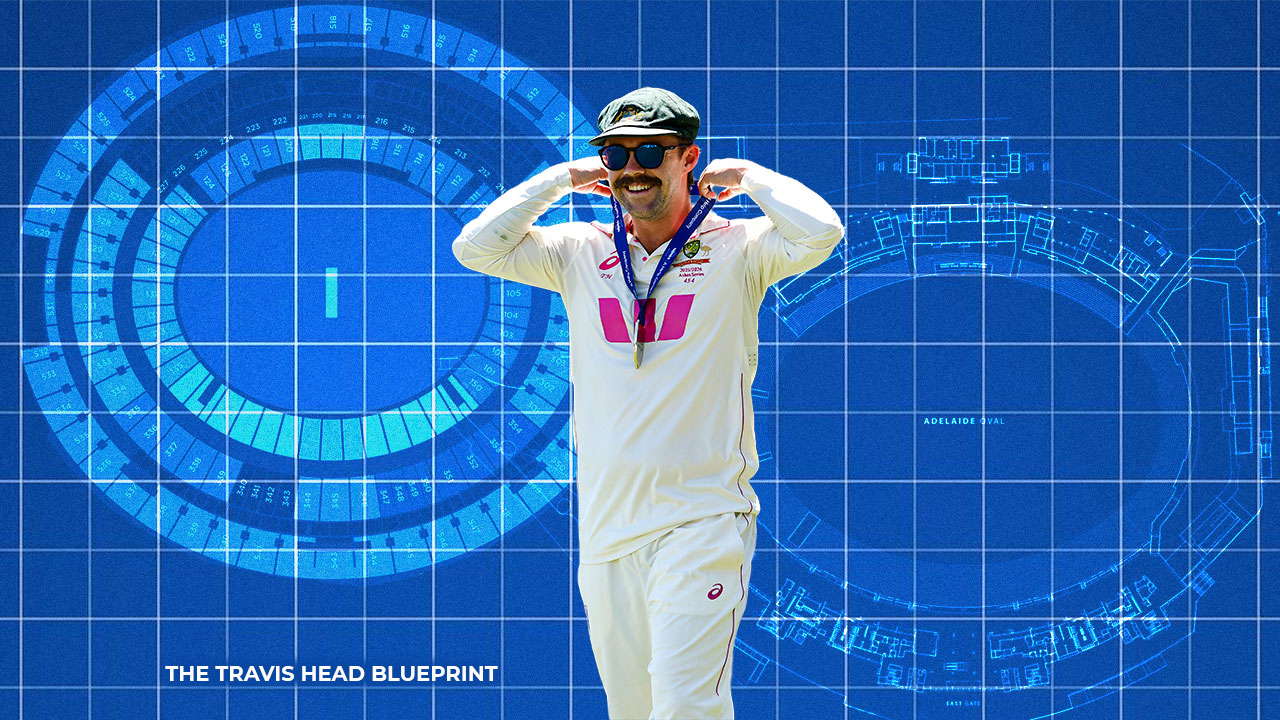
“I felt the way I went through my gears and went through the innings, it was a great blueprint for me moving forward.”
While others questioned the uniqueness of the circumstances in Perth, Head knew better. No-one had ridden the vacillations of that remarkable innings more closely than him, and he sensed he had nailed his approach to opening the batting.
“It’s pretty intuitive with him, the way his innings’ evolve,” Stubbings said. “The greatest strength I see in Trav is just his ability to not get too drawn into the mental side of things.
“He’s just watching the ball and reacting. I see someone who is at the top of their game, and when it feels right to pull the trigger, he’ll do it.”
The two-day Test had also given Head some clear air. He retreated from the excitement and headed home to Adelaide, lapping up some bonus family time. Shortly after touching down in Brisbane, he was back at it, cracking up the press contingent with a Happy Gilmore reference when asked about facing the pink ball.
With England shellshocked and the left-hander riding a wave of confidence, he lightly topped up his volume of pink-ball practice under lights in the Gabba nets, and with Australia batting coach Michael Di Venuto close at hand.
Head came to the middle with Jake Weatherald early on day two of the second Test, and took strike first. He faced four wayward deliveries from Archer, before the Englishman warmed to the contest. Two maidens to Head were followed by a quicker third over, in which he beat the bat with a 144kph off-cutter. From his next over, Archer hit him on the gloves and thigh pad with consecutive deliveries.
Though Weatherald had found his groove against Gus Atkinson from the other end – clattering him for five fours from four overs – Head couldn’t get away from Archer. He was three from 24 deliveries and in the thick of a proper battle when he edged another off-cutter through to wicketkeeper Jamie Smith, who had never played a pink-ball match and promptly dropped a regulation chance.
Stokes then made a double bowling change, bringing himself and Brydon Carse into the attack, and Australia flayed 41 from the next four overs before Head skied one to mid-on to be out for 33.
In runs alone, Smith’s dropped catch hadn’t proven too costly, but it had afforded Head the chance to dramatically change the momentum of the innings. Instead of having to come in against an on-song Archer, Marnus Labuschagne settled against Stokes and Carse, and by the time that pair had bowled England to the end of the session (plus one over from Will Jacks), an opening partnership of 77 in 13.1 overs had been built upon by an unbroken second-wicket stand of 53 from 47 balls. Put differently: Australia were flying, and Head had more reassurance that his opening blueprint was sound.
* * *
As a swarm of patrons made their way around from the Village Green to the concourse at Adelaide Oval to watch Head streakily make his way from 99 to his second hundred of the Ashes summer, a tall, familiar figure could be picked out among them.
From his vantage point, Stubbings peered over a horde of onlookers to witness the milestone moment as Head, having been dropped on 99, lofted a Joe Root off-break over long-off for four to complete his fourth century in as many Tests on his home patch.
Head’s second-innings 170 came at a crucial time in that third Test, burying England under a mountain of runs. Again he stuck solid to his blueprint, moving cautiously to 10 off 21 balls before lashing a square cut from Josh Tongue through backward point for his first boundary.
As it transpired, England likely made a misstep in not selecting Tongue earlier. The right-armer replaced Gus Atkinson in Adelaide and was far more consistent with his line and length. Outside of Archer, he was the only bowler who went close to containing Head; across Tests three to five, his figures against him read 2-67 from 109 deliveries, with only seven fours.
In that second innings in Adelaide though, there was another factor at play. While a 10th-wicket stand between Archer and Stokes on the third morning had kept their side within touching distance of the Australians, it evidently exhausted England’s two best bowlers to that point of the series.
Which meant Head had to face all of nine deliveries from Archer (scoring four runs) before he could make merry. When Tongue replaced him, Head found his aforementioned first boundary from the third ball he faced from the first-change bowler. And as Stokes turned to off-spinner Will Jacks and the part-time offies of Root, Head moved into cruise control, taking the tweakers for a combined 75 runs from 87 balls.
When Archer finally returned, Head was 90. In a five-over spell, he bowled six deliveries to him, and had him dropped on 99 from what became his third-last ball on day three.
Stokes meanwhile, was “knackered”. Head didn’t have to face him until the following day, when he was 142, by which time Australia’s lead had passed 360. Not that the England skipper seemed to be troubling him; by the end of the third Test, with Australia having wrapped up the Ashes in 11 days, he had hit him for 59 runs from 44 balls faced.
* * *
Joe Root was rightly receiving widespread praise for his magnificent 160 in the Sydney Test, but England’s greatest run-scorer was quick to dispense some of his own in the direction of Head after play on day two, with the Australian having raced to 91 from 87 balls by stumps.
Leading into the series, Australia skipper Pat Cummins had quietly implemented a personal policy of keeping his lips sealed when asked about England’s players, politely declining any opportunity to talk up his opponents.
Having watched Head streak past 550 runs for the series, Root had no such hesitation when asked in his press conference what made the new opening bat so difficult to shut down.
“The way that he can score off the top of the stumps, both sides of the wicket,” he said. “He makes your margins very small, and he’s got such incredible hand-eye coordination.
“He’s very good at putting bowlers under pressure at the right time, and making it very difficult to build a sustained period of pressure. He’s always looking to throw punches back in his own way, and he’s got a very clear method of how he wants to do it, and trusts it.”
Stubbings expresses a similar sentiment.
“He destroys lengths off the back foot that a lot of other players would feel they have to commit to on the front foot,” he says. “He can cut you to ribbons from a ball that is basically stump high, which is a hell of a skill.
“And when you go full, you get smacked back past you.”
Matthew Potts found all of this out the hard way. Asked in Sydney to share the new ball with Carse, he began around the wicket and conceded just two from his first over to Head, who once more stuck solid to his blueprint of being watchful early. He moved to three from 10 balls but then crunched 14 from his next five, all from Potts, whose short and wide offerings were gleefully received.
Head raced to 34 from 38, briefly curbed his aggression with the wicket of Weatherald (even facing a maiden from Stokes) and then carved up some shoddy England bowling across the rest of the day three session.
The following morning, after reaching another hundred, he chanced his arm more readily, though England failed to hold a number of catches, allowing him to add his final 64 runs from just 62 balls. His 163 made it four Tests out of five in which had posted the highest individual score.
And by the end of the match, with Australia savouring a 4-1 Ashes triumph, there were more startling numbers. Head’s 629 runs were the most by an Australian opener in a Test series in more than 30 years. He was also the first Test opener to score 600 runs in a series at an 80-plus strike-rate.
“I’ve enjoyed it,” he said, somewhat understatedly, of his move to opener after century number three for the series. “Nice to have been able to contribute the way I have in a series like this.”
2025-26 NRMA Insurance Men’s Ashes
First Test: Australia won by eight wickets
Second Test: Australia won by eight wickets
Third Test: Australia won by 82 runs
Fourth Test: England won by four wickets
Fifth Test: Australia won by five wickets
Australia squad (fifth Test): Steve Smith (c), Scott Boland, Alex Carey, Brendan Doggett, Cameron Green, Travis Head, Josh Inglis, Usman Khawaja, Marnus Labuschagne, Todd Murphy, Michael Neser, Jhye Richardson, Mitchell Starc, Jake Weatherald, Beau Webster
England squad: Ben Stokes (c), Harry Brook (vc), Shoaib Bashir, Jacob Bethell, Brydon Carse, Zak Crawley, Ben Duckett, Matthew Fisher, Will Jacks, Ollie Pope, Matthew Potts, Joe Root, Jamie Smith (wk), Josh Tongue
