

ICC WOMEN’S WORLD CUP, 2025

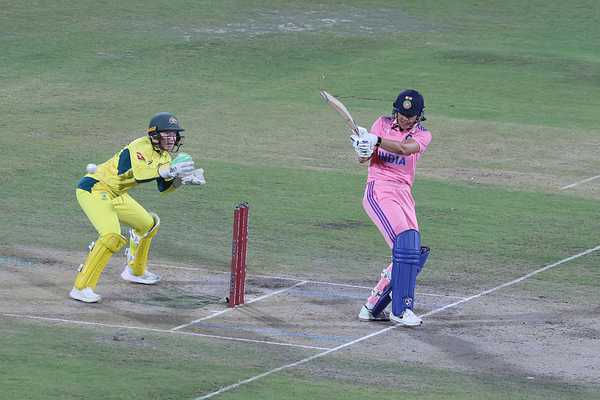
The series decider in Delhi could have foreshadowed what’s to come. ©Getty
If the 2017 World Cup put the women’s game on the global cricket map, the 2025 edition in India promises to be a game-changer. As the first ICC event to be hosted in India in almost a decade, its influence will be seismic. Australia and England have traditionally traded the silverware in the 21st century, but co-hosts India enter the tournament brimming with confidence. They’re one of just three teams with a positive win-loss record in the current cycle, alongside the traditional powerhouses, as the trio currently sit atop the ICC rankings. The women’s game has seen remarkable growth in the past three years, spurred on by the introduction of the WPL in India, a factor that will undoubtedly have an influence the outcome of this eight-team showdown.
Note: All the stats in the piece is considered for ODIs involving the eight participating teams in World Cup 2025 and West Indies, unless specifically mentioned. A World Cup cycle includes ODIs played from the end of a World Cup until the finals of the subsequent edition.
A high scoring tournament on the cards
The recent series decider between India and Australia in Delhi could well have foreshadowed of what’s to come. In that ODI, a staggering 781 runs were scored, more than 100 runs in excess of previous women’s ODI record. This high-scoring trend is a hallmark of the current World Cup cycle. In fact, 16 of the top 21 ODIs with the highest match aggregates have occurred during this cycle, with 11 of those taking place since December 2024.
The year 2025 has seen a tectonic shift in women’s ODI batting, with scoring rates and averages reaching unprecedented heights. Already, 30 individual centuries have been scored, putting the year on track to break the record for the most runs in a calendar year. The power-hitting explosion is even more striking: 203 sixes have been hit in just 53 ODIs this year, putting the record of 208 in 2017 (from 70 matches) within touching grasp. The frequency of a six has nearly doubled, dropping from one every 279 balls in the 2013-17 cycle to one every 148 balls now.
Women’s ODIs across WC cycles in 21st century
Period Mat RR Avg 300+ totals 2022-25 166 5.05 29.66 34 2017-22 185 4.55 27.23 19 2013-17 186 4.13 25.52 10 2009-13 156 4.09 24.17 4 2005-09 165 3.95 24.95 3 2000-05 166 3.59 22.6 2
For the first time in a World Cup cycle, the average scoring rate in women’s ODIs has gone north of five an over, currently sitting at 5.05 runs per over. This represents a cycle-to-cycle jump of over 11%, the biggest across two successive World Cup cycles in the 21st century. Four teams now score above the world average, and three are scoring well in excess of 5.50 runs per over, a feat only achieved by Australia in the last cycle.
There have been 34 totals of 300 or more in the current cycle, nearly double the 19 instances from the 2017-22 cycle. Co-hosts India and Sri Lanka are among the highest-scoring teams, with run rates well above five per over. Both teams have seen more than a 20 percentage increase in their scoring rates in the cycle, a clear testament to the favorable batting conditions at home.
Teams in 2022-25 vs 2017-22 cycle
Team Mat Avg (2022-25) RR (2022-25) RR (2017-22) RR % increase AUS Women 31 37.63 5.86 5.52 6.2% ENG Women 39 33.23 5.75 4.94 16.4% India Women 38 35.86 5.64 4.66 21.0% SA Women 37 33.62 5.19 4.49 15.6% NZ Women 29 29.18 4.87 5.04 -3.4% SL Women 31 25.77 4.69 3.74 25.4% WI Women 35 21.49 4.59 3.95 16.2% PAK Women 32 27.39 4.49 4.00 12.3% BAN Women 28 23.74 3.99 3.45 15.7%
What conditions do India and Sri Lanka offer?
The pitches in India and Sri Lanka are set to produce a high-scoring tournament. India has hosted 18 ODIs since the last World Cup, with a remarkable scoring rate of 5.66, the highest among all host countries. Nine of the 17 totals of 300 or more scored in India across all Women’s ODIs have come during this period, a time-frame that has coincided post the inception of WPL. Sri Lanka has hosted a similar number of games, with a scoring rate of 5.17 per over and five 300+ totals. This is a significant increase, as only one such total had been recorded in all previous women’s ODIs held in the country before the current cycle.
A key feature of this World Cup will be the prevalence of day-night matches, with all but one of the 31 fixtures scheduled under lights. This is a dramatic increase from a combined total of only 21 day-night fixtures across all previous editions. The teams are well-prepared for this change, as seven of the eight participating sides have played a higher share of day-night games in the current cycle than the leader, England, did in the 2017-22 cycle (34.1%), with Sri Lanka being the sole exception (12.9%).
Batting stats by host countries in 2022-25 cycle
Team Mat Avg RR 300+ totals in India 18 33.63 5.66 9 in England 24 30.51 5.46 8 in Sri Lanka 18 30.30 5.17 5 in South Africa 12 35.44 5.06 3 in Australia 15 24.24 4.97 3 in Pakistan 30 28.35 4.82 2 in New Zealand 14 28.66 4.76 1 in West Indies 15 24.47 4.63 2 in Bangladesh 12 20.76 3.79 0
The venues in India present an element of the unknown. Three of the four host stadiums – Guwahati, Indore, and Navi Mumbai – have never hosted a women’s ODI before. Vizag has hosted five matches, but not since 2014. While these venues have held domestic List A 50-over games, many have been low-scoring due to the strength of the competing teams. For instance, the average first-innings total in domestic games over the last four seasons was 140 in Indore, 142 in Navi Mumbai, and 169 in Vizag, while Guwahati’s most recent 50-over domestic match was a decade ago.
In Sri Lanka, the R. Premadasa Stadium in Colombo will host 11 games, all under lights. This is particularly notable as the venue had only ever hosted one day-night women’s ODI prior to the current cycle, way back in March 1999. If recent men’s ODIs are any indication, the pitches here are likely to be low and slow, with batting becoming more challenging as the match progresses. Of the 16 completed men’s ODIs at this venue since 2023, the chasing side has won only four times, with two of those wins coming in pursuit of sub-100 targets. The data also suggests significant turn for spinners in the second innings, with an average of 18.13 and a wicket every 24.1 balls, compared to 32.48 and 42.2 in the first innings.

Sri Lanka have recorded the highest jump in scoring rate in this World Cup cycle. ©Getty
Improved batting depth
Batting averages have significantly improved down the order, with the highest increases seen at positions #6, #7, and #8 across the last two World Cup cycles. This newfound depth is evident in the individual hundreds. While the 2017-22 cycle saw no centuries from batters below number five, this cycle has already produced two. Ash Gardner’s run-a-ball 102 rescued Australia from 59/4 to a commanding 308/8 against England, and Annerie Derecksen’s 84-ball 104 helped South Africa reach 315/9 after they were 85/5 against Sri Lanka. This shift in scoring responsibility is clear: the percentage of centuries scored by the top three batters has dropped from 87.1% in the previous cycle to 73.5% in the current one.
Position Ave (2022-25) SR (2022-25) 100s (2022-25) Ave (2017-22) SR (2017-22) 100s (2017-22) Opening 36.14 81.02 54 34.75 74.84 40 3 32.75 74.14 7 31.17 68.52 14 4 35.52 80.22 14 33.35 69.65 7 5 28.46 81.84 6 27.17 71.82 1 6 29.77 82.39 1 23.84 72.76 0 7 21.45 81.27 1 18.32 73.97 0 8 16.02 73.00 0 13.32 68.25 0 9 11.15 74.26 0 11.13 62.53 0 10 7.80 55.25 0 6.94 52.79 0 11 6.66 44.22 0 6.89 51.10 0
This improved batting depth is also reflected in the scoring rates across phases within an innings. While batting averages in the first 20 overs have remained consistent, they have seen a step up in each of the subsequent 10-over phases. Even with the five-over batting Powerplay being scrapped in 2021, scoring rates have surged. Batting teams now often start accelerating earlier, with run rates crossing five per over from the 31-40 over block.
Australia were the undisputed leaders in the death overs (41-50) in the 2017-22 cycle, scoring at a blistering 7.73 runs per over, well ahead of second-place England’s 6.42. During the 2022 World Cup, Australia took their game to the next level, scoring at an exceptional 9.03 runs per over at the death with clinical efficiency as attested by a batting average of 37.50. In their two games against runners up England, they smashed 100 runs in the final 10 overs of the group match and 120 in the final, propelling their totals well above par. While Australia remain the top team, others have narrowed the gap, with five teams now scoring north of seven in the death overs. India have shown the most improvement, with their scoring rate jumping by 26.8% – from 6.01 to 7.62 – followed by South Africa with a 17.1% rise.
Teams batting in death overs (41-50)
Team RR (2022-25) RR (2017-22) Increase % India Women 7.62 6.01 26.8% South Africa Women 7.32 6.25 17.1% West Indies Women 6.06 5.32 13.9% New Zealand Women 7.13 6.32 12.8% England Women 7.19 6.42 12.0% Bangladesh Women 5.61 5.19 8.1% Sri Lanka Women 4.98 4.63 7.6% Pakistan Women 5.70 5.45 4.6% Australia Women 7.95 7.73 2.8%
Will spin be the secret sauce to success?
The role of spin has steadily grown in women’s cricket throughout the 21st century. The share of overs bowled by spinners has risen from 39% in the first cycle post the turn of the century (2000-05) to 56.6% post 2022. 10 bowlers have picked up 40 or more wickets in this cycle, of which eight are spinners, including each of the top seven (it was an even 5-5 split among top ten wickets takers in 2017-22). Spinners have consistently outperformed their seam-bowling counterparts on both Indian and Sri Lankan pitches during the current cycle. Six of the eight participating teams have increased their reliance on spin, with Australia showing only a marginal decrease. The one team that has been averse to the trend is India, with the spin share going down from 64.1% in the 2017-22 cycle to 58.2% currently, though they have recently shown a penchant for playing just one frontline seamer.
Team Spin % (2022-25) Spin % (2017-22) Australia Women 46.6 47.4 Bangladesh Women 78.7 63.5 England Women 46.9 36.1 India Women 58.2 63.1 New Zealand Women 43.1 41.2 Pakistan Women 69.2 68.6 South Africa Women 36.9 32.5 Sri Lanka Women 74.3 69.2 West Indies Women 63.3 55.0 OVERALL 56.6 50.0
England have been a notable mover towards spin among non-Asian sides with the share moving up to 46.9% from 36.1% in 2017-22. They have picked four specialist spinners in their squad at the expense of experienced seamer Kate Cross. They added Sarah Glenn and Linsey Smith alongside the #1 ranked Sophie Ecclestone and Charlie Dean, the second highest wicket taker in the current cycle.

Sophie Ecclestone is the No.1 ranked bowler ©Getty
While spinners have been generally effective, the type of spinner that succeeds varies significantly between India and Sri Lanka. Conditions in India have been exceptionally flat, offering little assistance from the pitch. As a result, the mystery of wrist spin has been more effective. While wrist spinners have been more expensive than finger spinners, they have proven to be a superior attacking option with a significantly better average and strike rate.
In Sri Lanka, the more conducive pitches have allowed finger spinners to thrive. They have outperformed wrist spinners in both wicket-taking and in controlling the run rate. The fact that Sri Lanka hasve only played day games has also benefited finger spinners. This difference in conditions is reflected in the bowling statistics, with wrist spinners accounting for only 7.2% of the spin overs in Sri Lanka compared to 21.2% in India.
Spin vs seam in India & Sri Lanka in 2022-25
Host Type Wkts Ave ER SR 4w 5w Sri Lanka Pace 69 36.78 5.27 41.8 3 0 Sri Lanka Spin 157 30.64 5.01 36.6 3 5 India Pace 116 39.73 5.75 41.3 1 1 India Spin 133 33.46 5.43 36.9 3 3
© Cricbuzz
