

BANGLADESH NEWS

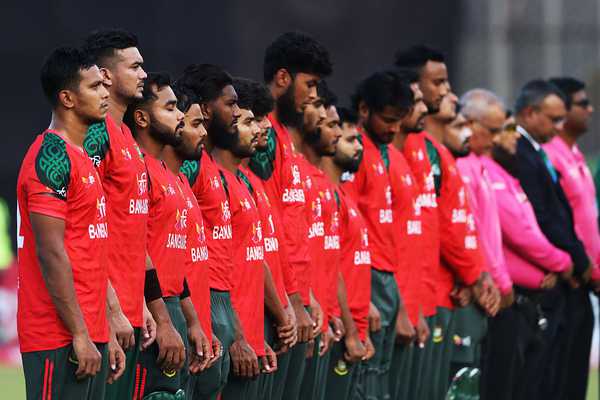
The skills-training will now be held in Sylhet. © Getty
Bangladesh national team’s preparation camp ahead of the Netherlands T20I series will be shifted to Sylhet after initially beginning in Dhaka, said Bangladesh Cricket Board officials on Sunday (August 3). Bangladesh is planning to host Netherlands for a three-match T20I series ahead of the Asia Cup as part of their preparation for the continental tournament.
According to draft itinerary, Netherlands are expected to arrive on August 14 to play the series at the Sylhet International Cricket Stadium.
Bangladesh are set to begin their camp on August 6 at the Sher-e-Bangla National Cricket Stadium in Dhaka under the supervision of trainer Nathan Keily, but in a slight tweak to plans, the skills part of the camp will now be held in Sylhet.
“The camp will begin in Dhaka on 6th August. Everyone will arrive and it will start with fitness training,” BCB cricket operation chairman Nazmul Abedin told reporters at the Sher-e-Bangla National Stadium. “However, before the start of the skills training part, the camp will move to Sylhet.
“The coaches will begin to arrive around the 11th, 12th, or 13th. Once the coaches are here, skill-training will begin but that camp will then shift from here (Dhaka),” he said.
“We are hoping to move the camp to Sylhet. The team will train there for a few days. Then, we will play the series against the Netherlands there,” he added.
Bangladesh will be hoping to sort out their batting problems as much as possible ahead of the series, considering it has hurt them the most in recent past.
Bangladesh Tigers’ head coach Sohel Islam, who is guiding the national cricketers in different venues of Bangladesh when others are busy fulfilling their national duties, insisted that the team has shortcomings as a batting unit due to cultural reasons.
“I think our culture plays a big role (for batters) especially in how we rate players. If you look at India, their domestic cricket is highly competitive. There, a hundred or even a double hundred is not treated as something extraordinary. But here, if someone scores a fifty, everyone from players, coaches, even the media – feels mentally satisfied,” said Sohel.
“When a young player plays domestic cricket hoping to make it to the national team, his average becomes crucial. He has to perform consistently. But here, we tend to judge a player based on just one or two performances. There’s also inconsistency in our domestic setup. If domestic cricket becomes more competitive and the challenges increase, players will naturally improve. Scoring big runs and making back-to-back big scores – these are habits. It’s not like if you score two centuries in one Test, you won’t be able to score in the next one,” he added.
Sohel, who is considered as mentor of leading Bangladeshi batter Najmul Hossain Shanto, said that he had recently spoken with the southpaw on why he failed to score big in the Colombo Test and the ODI series against Sri Lanka after hitting back-to-back Test centuries in Galle.
“I was recently discussing this with Shanto. When a player scores a hundred in both innings of a Test, ideally, he should aim to score in the next Test too. But in our country, we don’t have any such examples. India does. We are now trying to break out of that old mindset and train our players differently – especially mentally,” he said.
“The runs you’ve already made – they’re history. What matters is how you approach your next innings. You need to bat with the same focus, determination, and commitment as you had on the first day. That consistency is essential. A player who scores big in one or two innings must also reflect on his technical flaws and ask himself where he wants to be in the long run. These are the important questions,” he said.
“We didn’t have this culture before, but we have to start somewhere. We’re now trying to train players in that direction – to instill that hunger in them. Let’s say you’ve scored some runs in red-ball cricket – if your average is 50, then that’s acceptable. That’s a batter’s job. If you play two Tests on batting-friendly wickets, your average should be around 80. This is the kind of thinking we’re trying to push the boys towards – and they are responding. We’re trying to set a standard,” he added.
© Cricbuzz
