

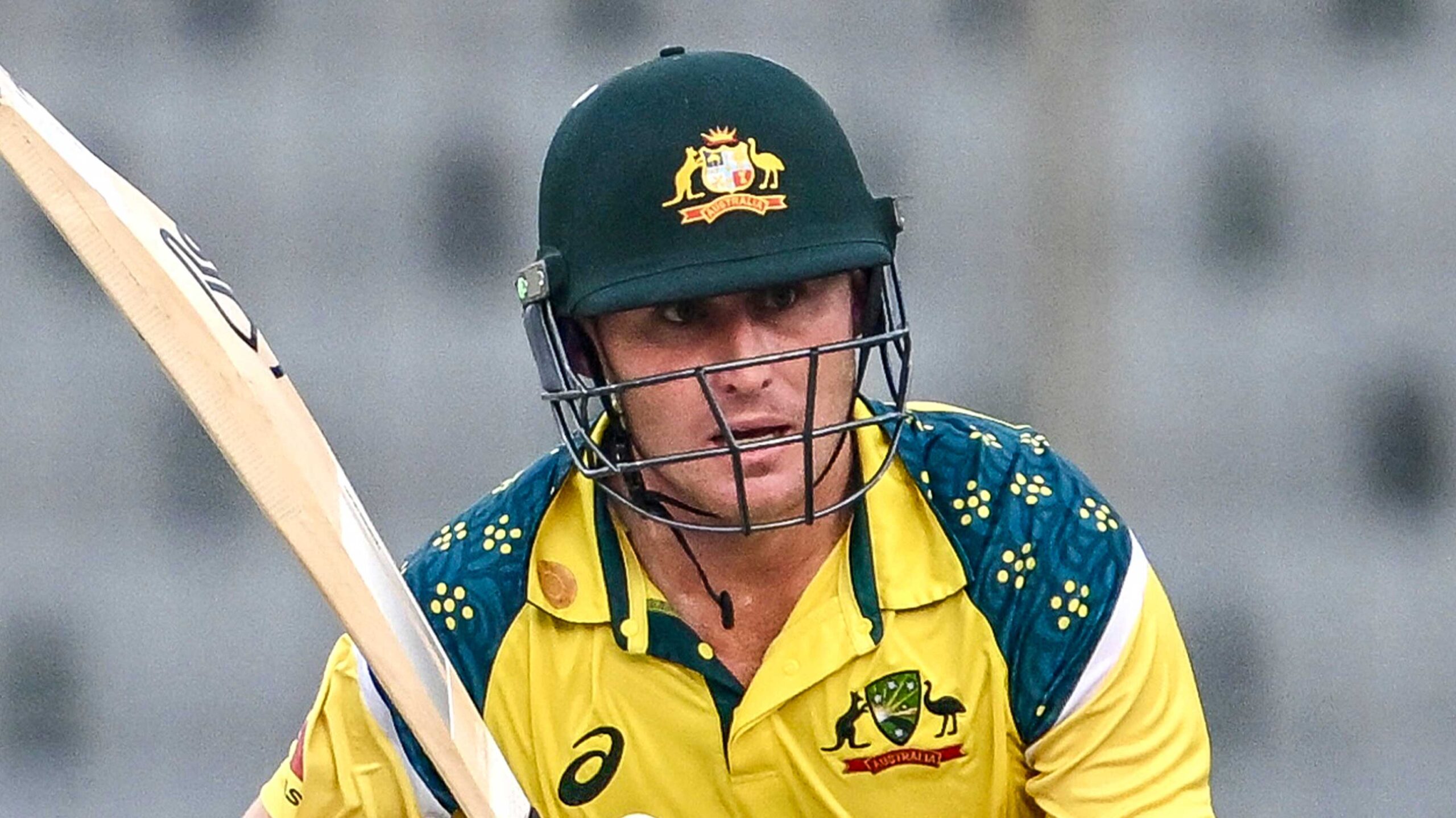
Andrew McDonald suggested Marnus Labuschagne’s recent ODI demotion to No.7 was a gambit designed to spark the misfiring batter back into form and made in the hope he can be a factor at next year’s World Cup.
But Australia’s coach insisted Labuschagne’s sub-par 50-over performances – the right-hander is averaging in the low-20s since his match-winning World Cup final stand against India in November 2023 – will have little bearing on his Test standing.
Labuschagne remains an unsolved riddle for the defending ODI champions, posting 0, 5 and 19 in ODIs against Pakistan, succumbing to left-arm spin twice before running himself out in the final match, and then started the ensuing Bangladesh series by falling for one to Mustafizur Rahman’s left-arm in-swing.
Shifted down to seven for the second ODI in Dhaka, he scored a gritty unbeaten 55 after coming in at 5-68 in the 18th over. McDonald said there were more promising signs from the 32-year-old in the 45-ball 29 he made in the final one-dayer too before he was caught-behind attempting to work another left-arm seamer, Shoriful Islam, to third.
As was the case with his Test form dip that saw him lose his spot briefly last year, Labuschagne’s passive scoring is under the microscope in ODI cricket.
His strike-rate in the format, which peaked in low-90s in June 2022 after his first 17 innings and remained in the mid-80s through the ’23 World Cup, stands at 74.94 from 18 innings since Australia lifted the trophy in Ahmedabad two-and-a-half years ago. That figure is close to 10 runs per 100 balls slower than the next lowest Aussie over the same period (Cameron Green’s 83.44).
“The conversations are still the same,” McDonald, referencing the very public messaging from selectors urging Labuschagne to be more proactive at the crease going into last summer’s Test campaign against England, told cricket.com.au.
“We dropped him down to seven (in Bangladesh). We got somewhat of a response there. Do we like having to put him down that low in that team? No – we’d like to think that one of our more experienced players would be sort of bolted on near the top there and navigating through the challenges of the top order.
“But it wasn’t to be, and we made the decision to drop him down, change his role to hopefully get a little bit of a response. We got that. Then in the final innings (in the third ODI against Bangladesh) he was looking good again before he went to lay one off.”
Labuschagne’s ODI spot was in similar jeopardy leading into that ’23 World Cup, only to earn a last-minute call-up and then hold his place through the tournament due to some solid performances and some good fortune.
A devout Christian, Labuschagne himself conceded divine intervention must have played a part in seeing him picked for the decider against India in which he played a pressure-filled role in the match-sealing partnership with Travis Head.
It forms no small part of the reason why Australia have persisted with him in the 50-over arena. That his two ODI hundreds have both come in his native South Africa, co-hosts of next year’s World Cup in October-November, is another factor in his favour.
“He hasn’t got the runs he’d like,” continued McDonald. “He needs to deliver more. It’s one of those ones where you don’t want to be having those types of conversations around your more experienced players on tour. It was unfortunate.
“I still think he’s a good player. My view on ‘Marn’ is, at his best, he’s a player that you want in your team. The energy he brings, especially in a world where you need overs and that fielding dynamic is fundamentally important.
“He’s a player that we want to see performing and get to a World Cup. But there’s no doubt there’ll be question marks. Our job is to get the best out of him, and the shift down to seven was to see whether we could get some runs under his belt, put a bit of confidence back into him, and then push him back up the order.
“Was that the right thing to do? Time will tell.”
But McDonald was firm in his belief the crossover in one-day and five-day form is limited.
Labuschagne had a so-so Ashes after his recall on the back of dominant domestic form for Queensland following his axing for the preceding Tests in the Caribbean.
He made half-centuries in the first two Ashes Tests in Perth and Brisbane before scoring 48 and 37 in Sydney (the latter marking Australia’s top score in a nervy run chase on a worn SCG pitch) for a series average of 28.77.
He looks certain to start at No.3 against Bangladesh for the two Top End Tests in August that kick-start a busy run of up to 21 Tests in 12 months.
“Totally different formats,” said McDonald. “Would it be nicer if he was making runs in one-day cricket going into a Test series? Yeah – there’s that old adage that ‘runs are runs’.
“But when it would come to a conversation around (Test) selection, it would be pretty much ring fenced to red-ball cricket and Test cricket.
“We saw him finish off last summer the way that we wanted him to, in Sydney and the way he started that Ashes series in Perth. So if you look at the bookends of last summer for Marnus, in terms of Test cricket, it was excellent, and you look at the front-end of the summer domestically in red-ball cricket, it was more of what we’d like to see.
“So there’s a very good player in amongst all of that. Our job is to work with him to bring out the best in his game, and we still think it’s there.”
Qantas Tour of Pakistan & Bangladesh 2026
Australia ODI squad v Pakistan: Josh Inglis (c), Alex Carey, Cooper Connolly, Nathan Ellis, Cameron Green, Matthew Kuhnemann, Marnus Labuschagne, Riley Meredith, Oliver Peake, Matthew Renshaw, Tanveer Sangha, Liam Scott, Matt Short, Billy Stanlake, Adam Zampa
May 30: First ODI, Pakistan won by five wickets
June 2: Second ODI, Australia won by 41 runs
June 4: Third ODI, Pakistan won by four wickets
Australia ODI squad v Bangladesh: Mitchell Marsh (c), Xavier Bartlett, Alex Carey, Cooper Connolly, Ben Dwarshuis, Nathan Ellis, Cameron Green, Travis Head, Josh Inglis, Matthew Kuhnemann, Marnus Labuschagne, Matthew Renshaw, Tanveer Sangha, Liam Scott, Adam Zampa
June 9: First ODI: Bangladesh won by 86 runs (DLS Method)
June 11: Second ODI: Bangladesh won by five wickets (DLS Method)
June 14: Third ODI: Australia won by one wicket
Australia T20I squad: Mitchell Marsh (c), Xavier Bartlett, Nikhil Chaudhary, Cooper Connolly, Tim David, Joel Davies, Nathan Ellis, Aaron Hardie, Travis Head, Josh Inglis, Spencer Johnson, Matthew Kuhnemann, Riley Meredith, Josh Philippe, Matthew Renshaw, Adam Zampa
June 17: First T20I: Australia won by four wickets
June 19: Second T20I: Australia won by seven runs
June 21: Third T20I: Australia won by seven wickets
