

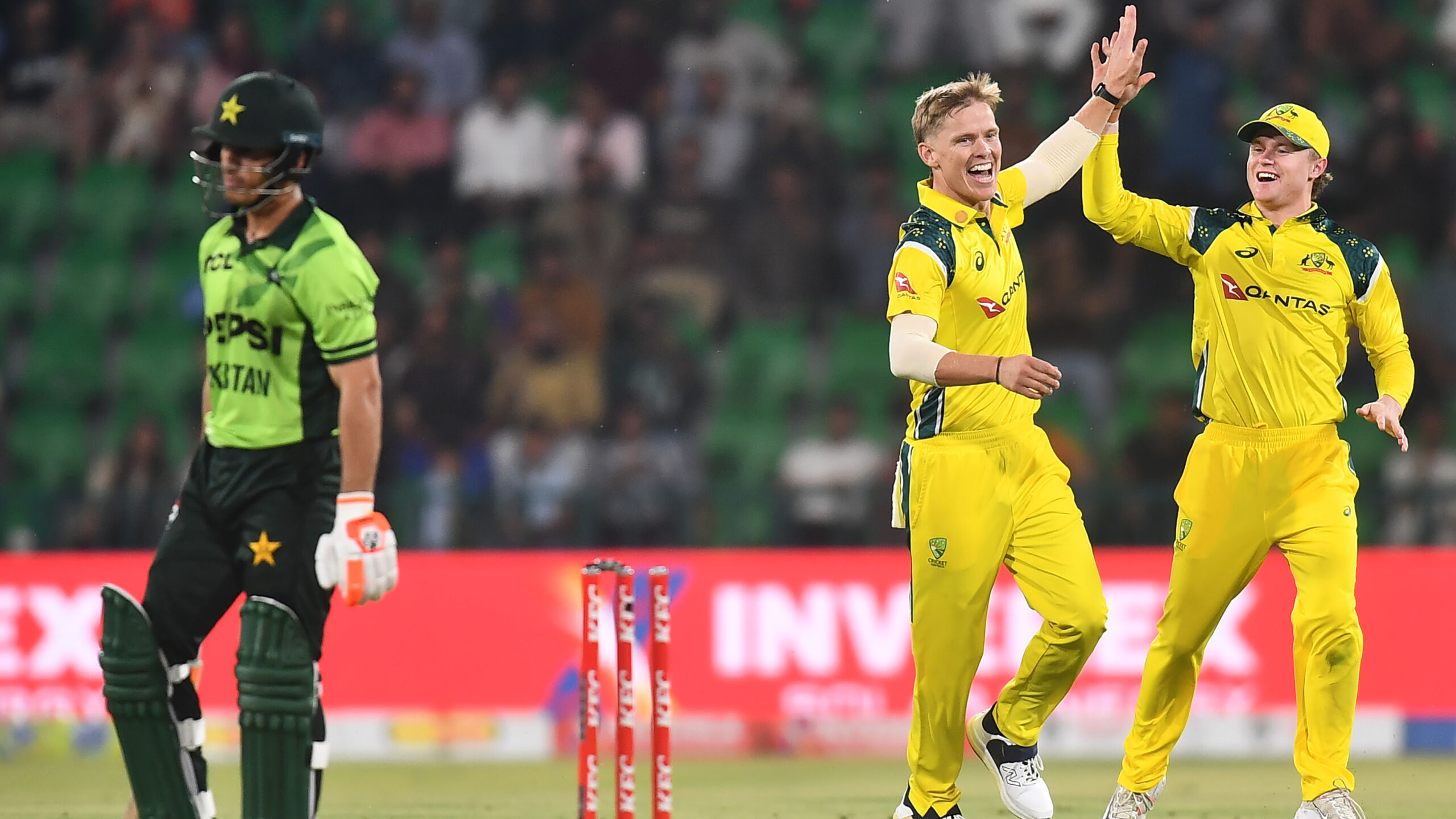
Australia’s first two ODIs against Pakistan have been worlds away from the Indian Premier League run-gluts their white-ball stars are fresh off. Even some in the host nation have queried the merits of Rawalpindi and Lahore’s raging turners given next year’s World Cup will be held in the southern African spring.
But as Pakistan’s coach insists that tournament will not be purely about ball speed and big sixes, so too might the defending 50-over champions see the value of navigating an old-school low-scoring ODI.
Those waking up in the southern hemisphere on Wednesday to see an undermanned Australian outfit posted 9-231 from their 50 overs batting first at the Gaddafi Stadium overnight could have presumed they had severely misfired.
Indeed, the last time Australia played in Lahore, during last year’s ODI Champions Trophy, they chased down 351 with 15 balls to spare against England.
But, in truth, the grinding half-centuries from Josh Inglis and Cameron Green, along with several telling late blows from second-gamer Ollie Peake, had taken the visitors well beyond par even by Pakistan’s own reckoning.
The home side would have lost by more if not for their misuse of the DRS. It sets the stage nicely for Thursday’s decider, again in Lahore, after Pakistan chased down Australia’s 200 in the series opener.
“It looks a little bit different to the traditional one-day cricket we’re seeing around the world at the moment, but I do think there’s a place for it too,” observed Nathan Ellis, whose skiddy stump-seekers and deceptive change-ups bagged him 4-33.
That ‘place’ could well be South Africa, along with Zimbabwe and Namibia, the co-hosts of the 2027 ODI World Cup, according to the “significant research” undertaken by Pakistan’s well-travelled Kiwi mentor Mike Hesson.
“I’ve been hearing a bit of chatter about the pitches here in Pakistan not being the ideal preparation for the World Cup in South Africa,” Hesson, who coached his native New Zealand to the 2015 World Cup final, wrote on X leading into his side’s 41-run defeat.
“Firstly the World Cup is jointly hosted (by) South Africa, Zimbabwe and Namibia. Zimbabwe and Namibia have venues where spin is a big factor and we will be playing matches in those countries.
“The myth of all pitches in South Africa being quick and bouncy are just not true, there are definitely some which are but they also vary throughout the country.”
I’ve been hearing a bit of chatter about the pitches here in Pakistan not being the ideal preparation for the World Cup in South Africa. It’s actually a topic I talked about on the latest #PCB podcast.
Firstly the World Cup is jointly hosted in South Africa, Zimbabwe and…
— Mike Hesson (@CoachHesson) June 1, 2026
Decent practice or not, the challenge of batting on last night’s surface became apparent one ball into the game.
Offered a wide loosener from Shaheen Afridi, Alex Carey threw his hands at a regulation square-cut only to be well through his shot by the time the delivery reached him. He was helpless as the ball slowly trickled onto his stumps.
That the game’s other left-handed opener, Maaz Sadaqat, suffered exactly the same fate a few hours later against Ellis, also from the first ball he faced, underlined the difficulties presented by the dry surface.
Where Pakistan slumped to 7-137 against Ellis and his four-pronged army of spin sidekicks, Australia recovered to a passable score thanks to Inglis and Green, two batters fresh off the crash and bash of the IPL but now adapting to a much different setting.
It was a significant hand in particular for Green, who showed he had swiftly learnt the lessons of his third-ball duck a few days earlier in similar conditions.
On Sunday in Rawalpindi, the towering allrounder was bowled playing back to left-arm spinner Arafat Minhas having just watched Marnus Labuschagne get pinned lbw, also deep in his crease to a full ball, the over before.
Here, Green instead covered his stumps against the dangerous Minhas; he played and missed three times against him in an over, smartly keeping his bat still to ensure he would not edge the sharp-turning deliveries.
The efforts of Renshaw (43 off as many balls) and Peake (31 off 32, including an eye-catching baseball-batted six over extra cover off speedster Haris Rauf) showed yet more adaptability from Australia’s less-experienced batters.
Captain Inglis admitted Australia reviewed their batting after their poor showing in the first ODI when they only limped to 200.
“I know guys had some good conversations around training yesterday, just about individual method and how they were going to go about it,” Inglis told the host broadcaster.
“It was obviously dependent on the wicket, and it looked very similar to the other day. I thought the guys played it really well today.
“We thought anything over 200, we were right in the game.”
Ellis lauded Green and Inglis for “the patience they showed in a world where taking the game on and being positive is at the forefront, especially coming from where they’ve come from (in the IPL)”.
“The maturity and the patience they showed was brilliant,” he continued. “It was probably match-winning. Then you add on top of that the youngster, Ollie Peake, his little cameo at the back end was brilliant and only just the start of the journey he’s been put on.”
Hesson all but conceded Lahore’s sweltering heat would ensure another tough batting wicket for the third one-dayer, while similar conditions could await Australia in Dhaka for three more ODIs against Bangladesh next week.
If there are slow, low wickets anywhere between Windhoek and the Wanderers next year, the Aussies should be well drilled in how to tackle them.
Qantas Tour of Pakistan & Bangladesh 2026
Australia squad for Pakistan ODIs: Josh Inglis (c), Alex Carey, Cooper Connolly, Nathan Ellis, Cameron Green, Matthew Kuhnemann, Marnus Labuschagne, Riley Meredith, Oliver Peake, Matthew Renshaw, Tanveer Sangha, Liam Scott, Matt Short, Billy Stanlake, Adam Zampa
Pakistan squad: Shaheen Shah Afridi (c), Salman Ali Agha (vc), Abdul Samad, Abrar Ahmed, Ahmed Daniyal, Arafat Minhas, Babar Azam, Haris Rauf, Maaz Sadaqat, Muhammad Ghazi Ghori, Naseem Shah, Rohail Nazir, Sahibzada Farhan, Shadab Khan, Shamyl Hussain, Sufiyan Muqeem
May 30: First ODI, Pakistan won by five wickets
June 2: Second ODI, Australia won by 41 runs
June 4: Third ODI, Gaddafi Stadium, Lahore, 9:30pm AEST
Australia squad for Bangladesh ODIs: Mitchell Marsh (c), Xavier Bartlett, Alex Carey, Cooper Connolly, Ben Dwarshuis, Nathan Ellis, Cameron Green, Travis Head, Josh Inglis, Matthew Kuhnemann, Marnus Labuschagne, Matthew Renshaw, Tanveer Sangha, Liam Scott, Adam Zampa
June 9: First ODI, Sher-e-Bangla National Stadium, Dhaka, 3pm AEST
June 11: Second ODI, Sher-e-Bangla National Stadium, Dhaka, 3pm AEST
June 14: Third ODI, Sher-e-Bangla National Stadium, Dhaka, 3pm AEST
Australia squad for Bangladesh T20Is: Mitchell Marsh (c), Xavier Bartlett, Cooper Connolly, Tim David, Joel Davies, Nathan Ellis, Cameron Green, Aaron Hardie, Travis Head, Josh Inglis, Spencer Johnson, Matthew Kuhnemann, Riley Meredith, Josh Philippe, Matthew Renshaw, Adam Zampa
June 17: First T20I, Bir Sreshtho Flight Lieutenant Matiur Rahman Stadium, Chattogram, 6pm AEST
June 19: Second T20I, Bir Sreshtho Flight Lieutenant Matiur Rahman Stadium, Chattogram, 6pm AEST
June 21: Third T20I, Bir Sreshtho Flight Lieutenant Matiur Rahman Stadium, Chattogram, 6pm AEST
All matches exclusive on Kayo Sports and Fox Cricket
