

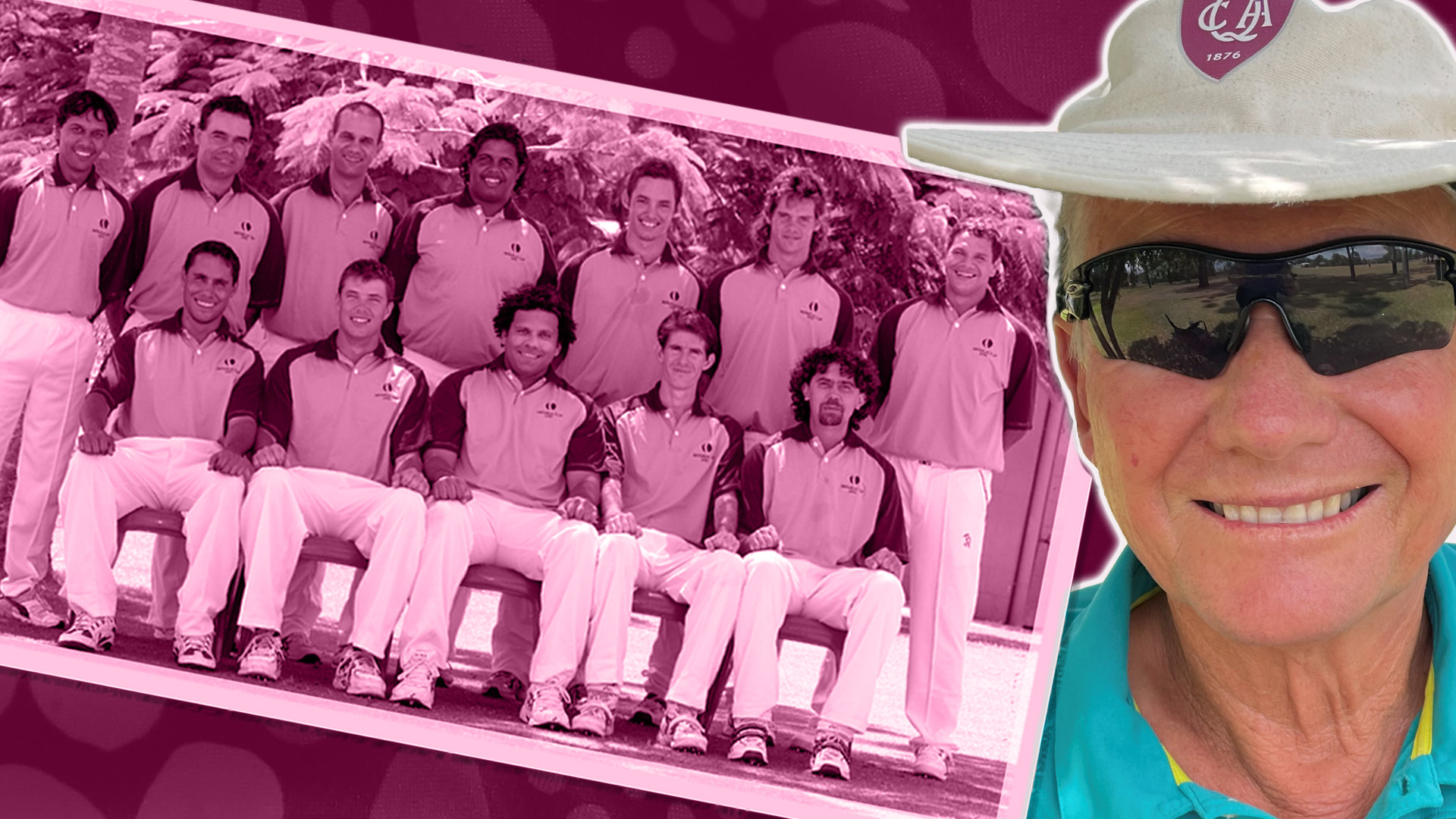
Around seven o’clock last Sunday morning, Nev Paulsen climbed into his maroon SUV and pointed it roughly north from Ipswich.
Paulsen, who turned 75 on the last day of last year, drove steadily across the day, stopping every couple of hours to fuel either himself or his vehicle. Through Nanango and Goomeri, then turning off at Ban Ban Springs, he made his way through Queensland heartland – all scrub and long stretches of nothingness – just as he has done countless times before.
“Then across to Gin Gin, up through Miriam Vale, and I stopped off that night at Rockhampton,” he says. “Next morning, I had breakfast at a little service station on the side of the road – don’t know where it was – but had coffee and a bacon-and-egg burger.”
Past Clairview and before Sarina, the A1 Highway wound right onto the coastline, offering Paulsen a picturesque snapshot of his native state, before he pulled up in Mackay – his destination for the week.
Relatively speaking, the trip he had embarked on was short. Though more than 1,000 kilometres beyond the New South Wales border, the regional centre of Mackay isn’t halfway up Queensland’s east coast. Drive west and you’ll cover another 1,700km before you hit the Northern Territory border. This is a state roughly equivalent in size to France, Spain, Germany and Italy – combined.
Paulsen knows all this – the landscapes, the distances – intimately. He has ventured to the state’s most remote corners. Has become acquainted with communities most white men don’t know exist.
But this April, the only place that matters is Mackay: ground zero for the 2026 National Indigenous Cricket Championships (NICC).
Twenty-two years ago, Paulsen went to Alice Springs as Queensland’s co-coach for their first involvement in the competition known then as the Imparja Cup. That year, and in the two that followed – 2004-06 – he oversaw a historic period for Queensland, as their untouchable men’s side stormed to three straight titles.
“I don’t think we would’ve ever even sent teams away to the Imparja Cup in the first place if it wasn’t for Nev,” says 2006 title-winning captain Kieren Gibbs. “All the groundwork that was done before that – that was him.”
Paulsen made the pilgrimage to the annual event many times, though this is his first time since 2012. And for a while there, when the cancer returned, he could have reasonably believed he had seen his last.
In the years between then and now, he has contented himself heading along every Saturday to Graceville Memorial Park, home of his beloved Western Suburbs, to watch the action of the club’s Firsts or Seconds unfold.
It’s a family affair for the Paulsens at Wests, where Nev’s son Steve – a 17-time Queensland Bulls and Brisbane Heat player – and grandson Ollie both while away their weekends. If there’s shade on offer, Paulsen’s preferred vantage point is right beside the southern sightscreen, behind the bowler’s arm.
Right now though, he is watching Wests’ Darcy Graham bat for Queensland at Mackay’s Great Barrier Reef Arena. And with this year’s NICC taking place in his vast backyard for just the second time, Paulsen’s presence feels like both a homecoming and a full-circle moment from wheels he put in motion almost three decades ago.
“He’ll be very welcomed there,” smiles his longtime friend Barry Weare. “He’s like the godfather of Indigenous cricket in Queensland.”
* * *
Back in 1994, the first Imparja Cup was played as a formalised – but still very casual – version of a friendly rivalry between teams from Tennant Creek and Alice Springs. From there it evolved across the years, first into something Northern Territory-wide and then, when Cricket Australia got involved in 2001, an annual national Indigenous tournament.
It wasn’t until 2004 that Queensland sent its first official squad. By then, remembers Paulsen, years of groundwork had left them well placed for immediate success.
“It all started in 1997, when (founding commissioner of the Criminal Justice Commission in Queensland) Sir Max Bingham came to us at Queensland Cricket (QC) about doing some cricket out in the Aboriginal communities,” he says. “He’d discovered that when they were playing sport, everyone was happy, there was no crime … so he came to us about that, and we set up the Eddie Gilbert Program.”
The new program, named in honour of Queensland’s greatest Indigenous cricketer and targeted at rural and remote First Nations communities, was both audacious and popularly received.
“It was launched initially in 1998 at Woorabinda (in Central Queensland), with the State Government and Queensland Cricket,” Paulsen recalls. “We had a day up there where we ran some coaching courses and activities for the kids at the school. Sam Trimble and Matthew Hayden came up … there were a whole heap of ministers, and the police commissioner. It was a big day up there.”
Once the circus left town, however, the onus was on Paulsen to deliver the program. He had been with QC since 1991, looking after an Emerging Players program through which the likes of Martin Love, Jimmy Maher and Andrew Symonds had risen.
Yet this was an altogether different challenge. With a $25k annual budget, away he went, crisscrossing Far North Queensland from Palm Island to Doomadgee, onto Mornington Island and all the way up to Bamaga, within an hour’s drive of Cape York.
Once there, Paulsen and whoever he could convince to join him (often including the pilot of the small plane he had chartered) would run basic cricket skills courses with kids at the schools. They also ran coaching courses for eager adults, with the hope the sessions would continue in some capacity beyond their brief stay.
“They weren’t very salubrious trips, I can tell you,” he smiles. “Over 12 months, the budget didn’t stretch very far.”
Paulsen and co ventured farther each year, eventually making their way into the Torres Strait to visit Thursday Island as well as other, smaller islands. In 2002, a Gulf schools cricket carnival was established.
To some communities, cricket was an entirely foreign concept. To others, there was some familiarity. Largely, it depended on access to television.
“When I went up to the Torres Strait, for instance, some of them were playing little cricket competitions,” Paulsen says. “They used to go between islands on a couple of tinnies, and play cricket.
“In some cases, there were some pretty good kids up in those areas. In some cases, some really keen adults. We continued doing that ’til probably 2003, when we had the summit at Allan Border Field.”
Jason Smith was also at the summit, which was called by QC with a view to aligning and better organising the various tendrils of Indigenous cricket in Queensland.
A fine Indigenous cricketer in his day, hailing from Babinda, an hour south of Cairns, Smith was at the time working as a police officer in Rockhampton while filling various cricket roles in his community. He didn’t know it then, but he was also just 12 months away from teaming up with Paulsen as Queensland co-coach at the Imparja Cup.
Today, Smith marks that summit as a seminal moment for Indigenous cricket in the state.
“There would have been probably 50 people in the room,” he recalls. “From young players through to people who had been involved in the game a long time – both black and white – and everybody was passionate about what we were doing.”
The most significant outcome of the summit was the formation of the Indigenous Cricket Advisory Committee Queensland (ICACQ), led by energetic Chair Larry Budd and backed by the late QC CEO Graham Dixon. And a key commitment from ICACQ was to send a Queensland men’s squad to the following year’s Imparja Cup in Alice Springs.
Soon after the summit, Paulsen and Smith were appointed as co-coaches of that squad. The next step was to find some players.
“And of course, because I’d been travelling around the state since 1998, I basically knew every Indigenous cricketer who was any good,” smiles Paulsen. “So we went to Alice in 2004, they had a big welcoming night, and they sort of said, ‘Well it’s good to see Queensland finally participating’.
“And then we played, and we smashed everyone.”
* * *
In their first year involved with the Imparja Cup, results were far from the only factor making up Smith and Paulsen’s player recruitment philosophy.
“In Queensland, we have seven zones up and down the state,” Smith explains. “We wanted to pick a player from each one of those zones, because the problem we have here is the tyranny of distance.”
The coaches agreed that having a representative from each zone would aid their ambition to spread the cricketing gospel as far and wide as they could throughout the state; if suddenly a member of a small community was representing Queensland at a national event, the promotion generated would effectively be doing their work for them.
The case of Chris Mosby, an ambidextrous policeman from Thursday Island – some 35km north of Cape York – was one notable example.
As the squad was carefully assembled, Paulsen and Smith quickly identified their captain. Barry Weare, a Cairns product who had led Brisbane’s renowned Nudgee High School First XI after boarding there in his senior years, was one of their first recruits.
“I remember ‘Nevvie’ and ‘Smithy’ rang me one day, telling me there was this (squad) they were starting and they were keen for me to be part of it,” says Weare, an assistant coach of the current Queensland NICC men’s side, who played with Norths and Wests in Brisbane Premier Cricket, and for the Queensland Academy of Sport.
“Nevvie had a list. He and Smithy had put their heads together, and then they’d ask around as well: ‘Do you know of any other players?'”
It was another unique hurdle. Some players were unaware of their Indigenous heritage. Others were ashamed. At times it made recruitment a challenging space to navigate.
But recruit they did. Kieren Gibbs, still a couple of months from his 19th birthday, was among a few teenagers selected. Toowoomba-born Gibbs, an off-spinning allrounder, had pedigree: his uncle Joe Marsh and cousin Keith Charles were both highly regarded country cricketers who had made their way onto the Brisbane grade scene. Both men joined Gibbs in Alice Springs (a couple of years later, Kieren’s dad, Jack Gibbs, would also make the trip as a co-coach).
The squad travelled to the Red Centre via Cairns, where they collected their Far North Queensland personnel, including Mosby (Paulsen, a stickler for details when it comes to discipline, recalls asking him to tuck in the Queensland polo shirt he had been supplied with).
Thursday Island rep Mosby had already travelled more than 1,000km to reach the airport. His first leg of that journey was to the mainland which, as Weare remembers it, involved catching a dugong to keep ballast in his dinghy while navigating the Torres Strait.
Once the squad landed in Alice Springs, they had little idea how the adventure would proceed.
“We really didn’t know anything about the national championships back then,” Smith says. “It was just the start of what we see today, and everybody sort of tiptoed through the process, I suppose, and kept to themselves a little bit.”
In their opening match on February 27, 2004, Queensland knocked over Northern Territory for 99, then chased the total without loss. It was an emphatic first-up result, and co-coaches Paulsen and Smith were happy; after an 8am start, the match had lasted barely half a day, sparing them several hours in the blistering Alice Springs sun.
But they weren’t content.
“The next morning, we were playing the ACT – early start again,” Smith recounts. “I said to the boys, ‘I want to be back at the motel before the dew dries on the grass’.
“And then we bowled them out for 28.”
The following day, Queensland thrashed Tasmania in the final to claim the Imparja Cup crown at first attempt. Three days, five matches, and the silverware was theirs.
Captain Weare, probably the team’s most accomplished player, had listed himself at three or four in the order. He recalls batting just once. Opener Brett Smith from Babinda hammered 276 runs for once out.
“It was a bit of a covert run in, and then we belted everybody pretty badly,” Smith says. “We were just a class above.”
As well as his long-established network of playing talent, Paulsen believes a key difference between Queensland and the other states was their alignment with the state body, which allowed them to put together a well-organised, well-resourced operation.
“We were very professional about it,” he says. “We were run by Queensland Cricket, and the other states were run by Indigenous cricket (groups). That all changed after we went over there.”
For 18-year-old Gibbs and others, the tournament was a transformational experience, which had little to do with the cricket.
“For us, it was just about creating a really good environment of brothership,” he says. “We had that shared interest in cricket but it was a lot behind culture as well, and understanding where we were all from; we had people from completely different backgrounds and levels of cricket, which was awesome.
“We wanted to win – we wanted to make a statement and show how good we were – but what I remember most is stuff off the field: how we got along, how we treated each other.
“We created a safe space for people to grow and prosper, because there were blokes there who’d had hard lives. They’d struggled, you know?
“Me and (young teammate) Damien Budd, it gave us confidence as young men growing up, that you’re a part of that.”
At the time, Paulsen and Smith watched the way that healthy environment – and those relationships – unfolded so organically. It would help them chart their course in the years to come.
* * *
Paulsen has a sign fixed to the wall of his home office.
It reads: Tough times don’t last, but tough people do.
He’s had it since his days at QC, and it is emblematic of the road he has travelled before and since. In some ways, he continues to defy Father Time. In others, he is feeling all of his 75 years. Just recently he received a letter in the post telling him he now requires an annual certificate that allows him to renew his driver’s license.
Three years ago he was managing a sore leg. It was the result, he thought then, of climbing up and down a ladder to clean out his gutters. Around the same time, he was having blood tests and X-rays as a means of staying vigilante post prostate cancer.
“And they found a small cancer,” Paulsen says. “So I was booked in to get radiation, but in preparation for that, I had an MRI, and from that they discovered my sore leg was caused by a seized left hip.”
Paulsen had a series of hormone injections to slow the cancer, buying him some time to have his hip replaced, as well as for the recovery that followed. He then opted out of the scheduled radiation for fear of the side effects, with an oncologist continuing to closely monitor the cancer’s progression.
“Anyway, after two years the oncologist and haematologist reckon the cancer was cured by the hormone injections,” he says. “So now it’s six-monthly blood tests.
“The only negative is a few side effects from the hormone jabs, and I’m getting on top of that. So I’m on a bit of a high at the moment.”
Paulsen, who was born in Gayndah – around 400km north-west of Brisbane – served in the Royal Australian Air Force for 20 years, before joining up with QC in 1991.
As his professional focus narrowed, he continued finding innovative ways to funnel Indigenous players into mainstream pathways.
“Because I ran the Emerging Players program, I was able to add in the Eddie Gilbert squad with that group,” he says. “So we had a production line of really good cricketers coming through. Kids like (former Qld U19s rep) Preston White, he was probably 10 years old when Jason (Smith) spotted him in Rockhampton.
“There were around half a dozen kids at any one time in those squads – some were in there for 12 months, some maybe two years. They’d come down for four or five days during the September holidays, the Christmas holidays, and we’d have a camp. They’d stay at Ipswich Grammar or Brisbane Grammar, and we’d live in with them, and we got to know the kids really well.”
Paulsen armed the kids with cricket bats from Gabba Sporting Products, as well as cricket and life lessons he hoped would serve them well. Decades later he continues to see those seeds bearing fruit, though he didn’t have to wait that long.
In 2002, First Nations opening batter Daniel Payne made his debut for Queensland, going on to play 21 matches including two Shield finals. Weare meanwhile was proving himself with Wests in Brisbane’s unforgiving grade cricket scene. Later in the 2000s, fast bowler Worrin Williams earned a place in the Bulls squad for a couple of seasons. Another Rockhampton product, leg-spinner Chris Swain, was highly rated but could not force his way into the state setup ahead of the likes of Nathan Hauritz and Cameron Boyce.
Other opportunities were created. In the early 2000s, Gibbs represented an Australian Indigenous XI alongside his uncle, Joe Marsh, and his cousin, Keith Charles. Matches were arranged for a Queensland Indigenous side against the Queensland Academy of Sport.
All of it helped bridge the gap between Indigenous-specific cricket and the state’s pathways, in turn providing a degree of hope that, with little First Nations representation across the cricket landscape (Jason Gillespie, who publicly acknowledged his Indigenous heritage for the first time in January 2000, being the notable exception) might otherwise have been missing.
“Making some of those teams,” says Gibbs, “playing against guys like (Craig) Philipson and (Mitchell) Johnson, and being able to compete at that level, the desire to reach higher levels sort of started from there.”
And it wasn’t only about the players. Paulsen identified the leadership skills of Marsh and Weare, and encouraged them to apply for QC ‘cricket officer’ positions, as they were called, in regional parts of the state.
“So they were looking after regions,” he explains. “And they didn’t get any preferential treatment because they were indigenous; they got the job because they were the best person for the job.”
It made the men strong Indigenous role models in their communities. Later, they attended coaching courses, gaining qualifications and skills that made them well-equipped to foster young cricketers from beyond the cities.
In 2006, Smith was picked as head coach of a 13-man National Indigenous squad assembled for a specialist training camp at Cricket Australia’s Centre of Excellence. Williams, White and Bradley Stout were the Queenslanders selected.
But perhaps the most impactful moment in Queensland’s Indigenous cricket evolution was the 2004 Imparja Cup triumph, which had a ripple effect across the state.
“After we won it the first year, every Indigenous cricketer in the state said, ‘I need to be part of this’, Smith smiles. “We got flooded with names – and some big names – and we took a side over that was probably the best I’ve ever coached. It was just untouchable again.”
* * *
If the Queenslanders “tiptoed” through their 2004 campaign, their toes were positively twinkling when it came to embracing the social aspect of the next two tournaments.
As Paulsen kept his troops well fed by making daily trips to Subway, they quickly became better acquainted with not only one another, but with their opponents as well. All of them had cultural and familial ties to the land; a fact that offered them the common ground they needed.
“The friendships that were built, well … it got to the point where they were all having dance competitions on the last night in Alice,” laughs Smith. “So if you couldn’t win the cricket game, you could still win the dance competition.”
By then, Paulsen was gradually easing back with the coaching duties, allowing Smith to take the reins alongside first Jack Gibbs and later Michael Mainhardt, two highly respected Indigenous men who would go on to take the state to more titles beyond their first-up threepeat.
Across 2005-06, as Queensland cruised through their matches to claim another two titles, the bonds built by the players paved the way for constructive conversations around culture, history and connection.
By 2006, a 21-year-old Gibbs had taken on the captaincy, helping to make Queensland’s Imparja Cup experience an inter-generational one. Again it benefited the young men, who might otherwise not have had the role models or the safe space in which to share their thoughts and feelings.
“The age gap from oldest to youngest was a good 15 years,” Gibbs recalls. “So you had some guys who were married with kids and owned homes, worked hard for a living. And then you had us young fellas, who were just starting out in life, really.
“To be able to have them side conversations, and them being able to give us some knowledge around life itself – what it is and how to get along – was definitely valuable.
“I was lucky. I had my dad, my uncle (Joe), my cousin Keith. But for other blokes who were fresh and coming through, I think that environment allowed them to feel comfortable, to learn, to have some mentors. And it wasn’t just for the week or so we were away; blokes spoke frequently, and caught up a lot over a 12-month period, so there were some real friendships formed.
“Even now, whenever I travel around and I know where the boys are, I send a message and see if they want to catch up, you know, with the family, or have a beer or anything like that. What’s that? Jesus, 20 years, and it still happens.
“To still be able to make time for each other like that is just unreal.”
Queensland’s winning streak was broken in 2007 but they returned to win the next two titles, making theirs an enviable record through that window of five triumphs from six campaigns.
Across those years, the focus on culture and connection within the group continued, as Paulsen and co took a more strategic approach in considering the smartest cricketing steps for their young players.
“We dominated the first three years,” says Paulsen, “but after that, my big role was to try to get these guys playing Premier Cricket in Brisbane.”
Paulsen had seen Weare miss selection in a first-grade final for Wests a couple of years earlier, when he had effectively lost his place owing to his time at the Imparja Cup. He didn’t want it to happen again.
“One year when Preston White was playing with Toombul, I didn’t take him to Alice Springs, and he was pretty upset about it,” he adds. “But I’d worked out that Toombul were probably going to make the final, and I thought it was best that Preston was there for it.
“That was a part of it – trying to develop the players to get as far up the playing chain as possible.”
* * *
On Monday night in Mackay, Paulsen stayed in, dining at the restaurant inside his motel. The next morning, he made his way over to the old Harrup Park to watch the Queensland men – defending champs from 2025 – in action against Papua New Guinea. There, he quickly fell into step with some familiar faces.
“Just had a chat with Barry Weare,” he says. “He’s now president of Far North Queensland Cricket Association. That to me is why all this is worth it – these Indigenous guys who came through, they’re still involved, doing administration and coaching roles.”
As he’s watching, he notices Queensland skipper Dylan McLachlan, who played one match for the Bulls back in 2024. He sees Kobe Williams, who he knew as a junior in Ipswich, and opening batter Jaecob Prien.
“Jaecob, I haven’t seen much of,” he says, “but he was one of my Eddie Gilbert kids going back some years now. His dad (Mick) is now the coach, too, and Dylan Blackman – another lad that was in my Eddie Gilbert squad – is a mentor with the team. So that’s a pretty good result as far as I’m concerned.”
The old faces brought Paulsen’s past back into the present. He smiled as he considered the small role he might have played in their lives along the way.
“It’s one of the things that gives me a lot of satisfaction,” he says. “A lot of these guys, until they came and played cricket and got involved with us at Queensland Cricket … after that, they got jobs, they bought houses, they went somewhere in life.
“I just see the development of them as people, you know?”
Paulsen sips on his coffee, comfortable and relaxed in this environment, where the world he immersed himself in for so long, and with such passion, is celebrated. He knows it will never truly leave him. Gibbs knows it too.
“Nev is an unreal man,” he says. “He’s so compassionate. He loves the Aboriginal and Torres Strait Islander community. He’s on the (First Nations Cricket Advisory) Committee at Queensland Cricket, and I know he always watches and wonders and worries about what they’re doing (in that space).
“He’s battled his health issues of late, but he’s still there, always in the background, he still loves to talk about it. We were so, so lucky to have him in that early period and even now, to share stories and to still be around to care about it.”
The legacy of Paulsen within this year’s Queensland men’s squad can also be seen in Wests’ Darcy Graham. The middle-order batter, in his second year at the NICC, only learned about his Indigenous heritage a decade ago. Where it was a source of shame for his grandparents, today it is worn as a badge of honour by the 21-year-old.
“Our grandparents kept it a secret,” Graham says. “From that moment (of finding out) we just explored more of it, reached out to relatives, and learned more about my mob and where I’m from.
“I’m hoping this year to go up to Burketown – where we’re from – and actually meet a lot of family and learn custom and stuff. I’ve really been encouraged to do that from ‘Prieny’ (head coach Mick Prien) and ‘Wearey’ (Weare) and all the boys. It’s pretty incredible really.”
Having just graduated from a Commerce-Law degree, Graham last month began full-time work at a law firm in Brisbane. He is open to various opportunities his career might present, but already he has discussed the possibility of exploring native title.
Graham’s experiences with the Queensland men’s NICC squad have only strengthened his desire to learn more about his ancestry. Two decades on from those threepeat years, the very point of the tournament has evolved to become as much about the gathering itself as the cricket.
“I think the main purpose of this tournament for a lot of us is stepping into our aboriginality and exploring that more,” Graham says. “That culture side of it’s been probably the biggest eye opener for me.
“A lot of the boys have very similar journeys, where they didn’t know (of their Indigenous heritage) from their parents being in the Stolen Generation. We had a day where we just sat around for a couple of hours and we talked about our journeys, and I think we created a really good atmosphere.
“We all just felt very connected after that. And people like ‘Wearey’ and Mick Prien and Dylan Blackman, they were just so accepting, and there to help us learn about our culture. The cricket was just a byproduct of all of that.”
As the on-field action continues, Paulsen returns to his seat after buying a coffee. It is a glorious Queensland day. The temperature hovers in the mid-20s, the clouds offer protection from the sun, and should he be looking, Graham knows exactly where to find the state’s godfather of Indigenous cricket.
“Just like at Wests,” he grins, “sitting beside the sightscreen, watching on.”
Select matches from the 2026 National Indigenous Cricket Championships will be live streamed on cricket.com.au and broadcast on NITV. The men’s and women’s grand finals will also be shown on Fox Cricket and Kayo
2026 National Indigenous Cricket Championships broadcast
18 April: South Australia v Northern Territory men’s match, 9am AEST
18 April: Women’s preliminary final, 1:45pm AEST
19 April: Women’s grand final, 10am AEST
19 April: Men’s grand final, 2pm AEST
All matches held at Great Barrier Reef Arena, Mackay
