

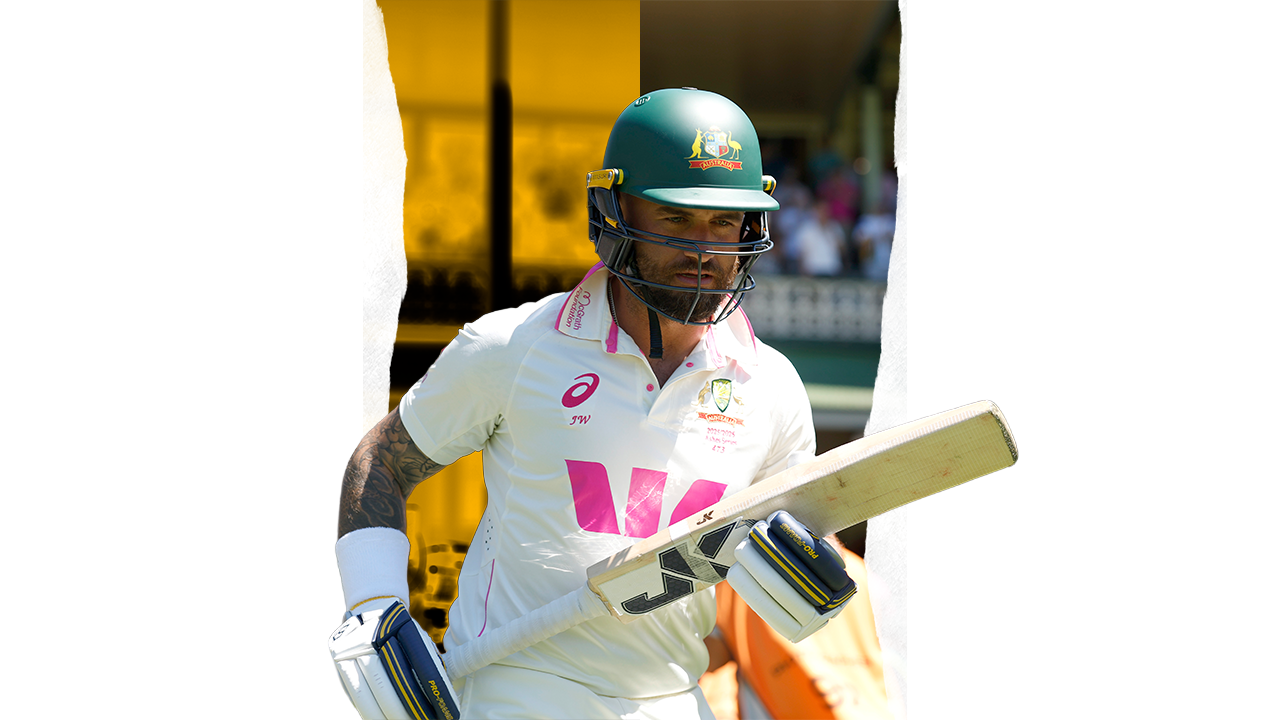
Jake Weatherald’s bid to lock down his spot for Australia’s intense run of Test cricket through 2026-27 will take him to India at the end of the home season, as the opener revealed how he has reshaped his game in the aftermath of the Ashes.
Weatherald remains unsure whether he has done enough to be retained beyond this summer after compiling 201 runs at 22.33 in five Tests against England. In largely bowler-friendly conditions, he was dismissed for under 20 in five of 10 innings but posted 72 at the Gabba and had several other helpful contributions in the 4-1 series win.
The 31-year-old was a notable absence from the final stages of the KFC Big Bash season, instead spending the gap between the Ashes and the resumption of the Sheffield Shield season ironing out technical and tactical kinks exposed during his debut international campaign.
He is holding out hope of a county deal materialising for the early part of the UK summer but will otherwise head to Bengaluru in mid-April for a week-long training camp with Perth-based batting mentor, Tom Scollay.
Weatherald, who posted 95 in Tasmania’s drawn Shield clash with NSW last week, is desperate to show national selectors he has learnt from a promising – though far from dominant – entrance to Test cricket.
The timing of Darwin winning hosting rights for its first Test in 22 years in August is tantalising for the first born-and-raised Northern Territorian to win a Baggy Green.
“It’s hard to know,” Weatherald told cricket.com.au when asked about his chances of opening the batting against Bangladesh for Australia’s next Test series.
“Obviously winning the (Ashes) series was a big thing. If we’d lost, you probably would have said no. But having won the series and contributed in some ways throughout most games, I think I’ve shown that I definitely can bat in that environment.
“But there’s a lot of water to go under the bridge. I’ve still got a few Shield games left to continue showing that I’m evolving and growing, and that I’m not the same player that will roll out in the next Test match and that I’ve gotten better.”
To that end, Weatherald has put in a mountain of work in the hope of forming a long-term partnership with the Ashes’ surprise success story against the new ball, Travis Head.
Weatherald was initially named as one of a host of Test stars returning to play T20s after the conclusion of the Tests, but the former Adelaide Strikers title-winner then pulled out of playing his first matches for the Hobart Hurricanes.
“It’s a difficult thing saying no to domestic cricket and it probably seems a little bit disrespectful to some people,” he said. “I’m sure there were a lot of disappointed people, but the Hurricanes were awesome.
“Being Cricket Australia-contracted now, the focus is getting ready for Test cricket. I’m not saying that makes me guaranteed to play in the next one. But I’m getting paid to be ready for that.”
Weatherald instead spent a solid fortnight in Hobart working on issues that emerged after being exposed to high pace on bouncy, seaming surfaces.
He sought the opinions of Scollay, Michael Smith and Michael di Venuto (the batting coaches of Tasmania and Australia respectively) as well his personal mindset coach, John Novak.
“They weren’t dramatic changes, but they were just evolutions of my game. I’ve probably realised first-class cricket … the things you’re required to do there are different to Test cricket,” he said.
“The bowling is slightly different and there’s probably more of an accuracy focus in first-class cricket, and the conditions can be quite nibbly and hard to bat in. Whereas Test cricket, while the conditions were still tough, the extra pace and bounce was probably the bigger difference there and the plans they go to were different.
“So it’s just evolving my game to understand what technically I need to do in order to go to change – not necessarily go up a level – but probably change my game to suit Test cricket, especially if I get similar conditions.”
Weatherald took it as a “massive plus” that he had not been out edging behind the wicket at all in the Test series, no small feat given the amount of seam movement both pace attacks enjoyed.
But he acknowledged the extra ball-speed of England’s bowlers left him vulnerable both to balls aimed at his stumps and his body, which had previously been strong areas for him at domestic level.
Those two methods of attack accounted for seven of his nine dismissals; Jofra Archer twice pinned him lbw, as did Brydon Carse and Ben Stokes once each, while he was out top-edging pull shots against Carse, Archer and Josh Tongue. Having then been out that way three times in a row to resume the Shield season, he concedes he must be more selective in how he plays cross-batted shots.
“It’s probably an area that I like – I like fast bowling – but it’s probably where I got found out a little bit,” said Weatherald. “I felt it was a good strength of mine, but there’s still things I can work on there.
“They’re scary things when you’ve done something really well in first-class cricket, to go away from what you’re good at.
“But you’ve got to have a bigger picture in mind. Those weeks were about slowly getting better and better, with progressions from throws, sidearms, (bowling) machine – pretty closed skills – to then quite intense training against bowlers.
“It was about understanding my positions in the Test matches, what I liked and what I didn’t like, and what I did really well, and what some of the challenges were in Test cricket, and what my strengths are and aligning them to my game.
“Then from there, it was a lot of analysing through my coaches, not trying to be too caught up in what I did wrong, but also providing options to continue to score and put pressure on bowlers.
“My thing was, ‘How can I put pressure on bowlers without sacrificing what I do really well technically?’ We spent a lot of time analysing and doing a lot of data-based stuff and looking at positions and times throughout innings where I struggled and the bowlers I struggled against.”
It is an insight into the frenetically analytical mind of Weatherald, who simultaneously also has one eye to the missions for the Test side beyond the Bangladesh series.
Those two matches in Australia’s tropical north kick-start a run of up to 21 Tests in under 12 months that features home Tests against Bangladesh, New Zealand (through December-January), England (March for a one-off anniversary contest), as well as tours to South Africa (October), India (January-March 2027) and the UK (June-July 2027).
Weatherald travelled with Scollay’s ‘Cricket Mentoring’ program to the Karnataka Institute of Cricket in southern India last year with other current and former domestic players Joel Curtis, Jon Wells and Peter Hatzoglou.
He will return with a major focus on combatting spin on the kind of turning surfaces Australia expect to face during next year’s Border-Gavaskar Trophy tour.
“I’d love to get over there and play as much red-ball cricket as I can leading into the Test series and give myself the best chance to be selected and be in good form,” said Weatherald.
“The more red-ball cricket I can play and the more different conditions I can find myself in, the better. You don’t know what the future holds and what will be going on, but at the same time, you want to prepare as well as you can for what you think is going to happen.
“With an Indian tour potentially on the cards, I want to go over there and feel as I’m as ready as I can be.
“One of the big dreams is playing in an Ashes series. I managed to achieve that, and now it’s probably kicking on and trying to play against India in India, which would be an amazing thing to do.
“You’ve watched so much cricket over there, and watched how Australia have found it hard over there, but also had a little bit of success recently – and India’s struggled a little bit there recently (in Tests) too, so I think it’s going to be a great series there.”
2026 NRMA Insurance Bangladesh Test series
First Test: August 13-17, Marrara Stadium Darwin, 10am (local)
Second Test: August 22-26, Great Barrier Reef Arena, Mackay, 10am (local)
